


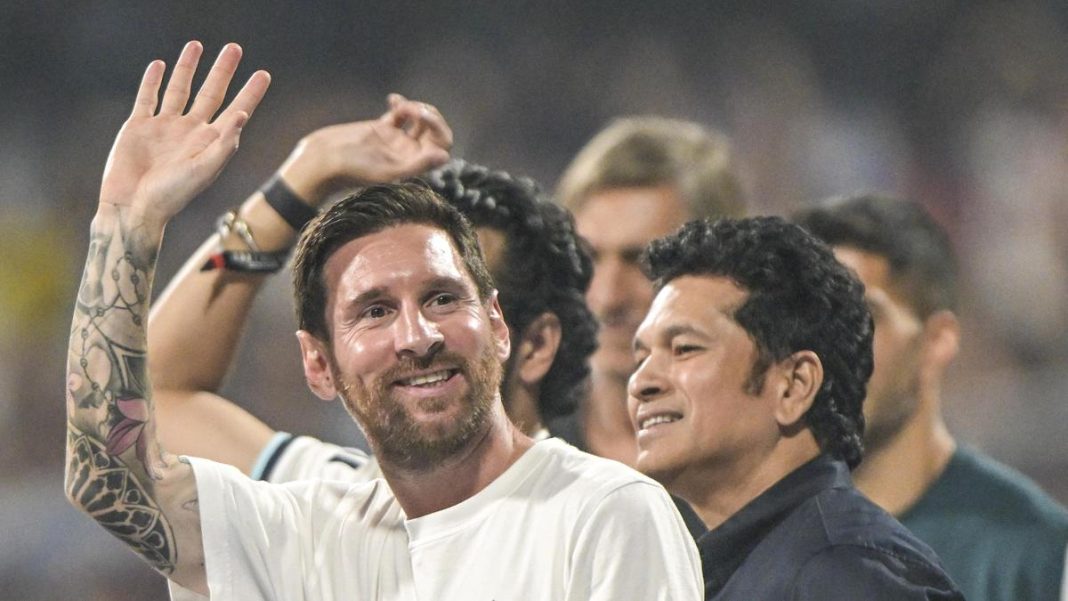
Mumbai’s iconic Wankhede Stadium, a veritable shrine to Indian cricket, recently etched another profound chapter into its illustrious history. A hallowed ground where legends have been forged and dreams realized, Wankhede witnessed the unveiling of a majestic bronze statue of Sachin Tendulkar, its most revered son. This monumental occasion, marking the ‘Little Master’s’ deep connection to the stadium – from his final match to the glorious 2011 World Cup victory – resonated far beyond the boundaries of cricket. In an era where global sporting icons like Lionel Messi continue to captivate millions, this moment at Wankhede subtly yet powerfully underscored a universal truth: the transcendent power of sporting greatness to inspire, unite, and create enduring legacies.
Wankhede: Where Legends Are Immortalized
For generations of Indian cricket fans, Wankhede Stadium isn’t merely a venue; it’s an emotional landscape. It’s the backdrop to countless heroic innings, nail-biting finishes, and moments of collective euphoria and despair. From Sunil Gavaskar’s artistry to Kapil Dev’s all-round brilliance, the stadium has been a silent witness to the evolution of Indian cricket. Yet, no name is more intrinsically linked to its soul than Sachin Tendulkar.
His farewell Test match here in 2013 was a tearful national moment, cementing his status as the “God of Cricket.” But perhaps the most defining memory is the 2011 World Cup final, where a Tendulkar-inspired Indian team lifted the trophy on home soil – a moment that unified a billion hearts. The recent unveiling of his statue, depicting him in his iconic lofted drive pose, is more than just a tribute; it’s a permanent embodiment of his spirit and an everlasting source of inspiration. It ensures that his legend, synonymous with Wankhede, will continue to inspire future generations, adding an indelible ‘glorious chapter’ to the stadium’s already rich narrative.
Messi’s Global Symphony Echoes
While Tendulkar’s statue celebrates a cricketing deity, the global sporting landscape continues to be dominated by the unparalleled brilliance of Lionel Messi. The Argentine maestro’s journey to footballing immortality culminated spectacularly with the FIFA World Cup triumph in 2022, an achievement that cemented his place as arguably the greatest footballer of all time. Messi’s appeal, much like Tendulkar’s, transcends the boundaries of his sport, making him a household name even in cricket-crazy India, where football’s popularity is steadily on the rise.
The “coming together” of Messi and Tendulkar, therefore, is not a physical meeting at Wankhede, but a symbolic convergence of two titans of sport, each representing the pinnacle of excellence in their respective domains. As Wankhede honors its own, it simultaneously becomes a poignant reminder of the universal language of sporting greatness. The cheers that once echoed for Tendulkar’s cover drives are now complemented by a growing chorus of appreciation for Messi’s dazzling dribbles, signifying a broader, more inclusive embrace of global sporting excellence within the Indian consciousness.
Indeed, the power of such figures lies in their ability to inspire beyond their immediate field. As Nelson Mandela famously said, “Sport has the power to change the world. It has the power to inspire. It has the power to unite people in a way that little else does.” This sentiment perfectly encapsulates the shared impact of Tendulkar and Messi, whose legacies are built on relentless dedication, unparalleled skill, and the profound ability to evoke deep emotion and dreams in millions.
A Unified Narrative of Sporting Transcendence
The symbolic alignment of Messi’s global stature with Tendulkar’s immortalization at Wankhede weaves a compelling narrative of sporting transcendence. Both athletes, through sheer talent and unwavering commitment, have transcended their sports to become cultural phenomena. They embody the aspiration of countless young individuals, not just to play a game, but to achieve absolute mastery and, in doing so, leave an indelible mark on history.
Wankhede, by celebrating its cricketing hero, becomes a beacon for this larger appreciation of global sporting prowess. It signifies that while cricket remains the heartbeat of India, there is a growing recognition and admiration for excellence across all sports. The ‘glorious chapter’ isn’t just about a statue; it’s about Wankhede’s continued role as a stage where the spirit of sporting greatness, whether local or global, cricket or football, is celebrated with fervent passion and respect.
In essence, the coming together of Messi and Tendulkar, albeit metaphorically, at the heart of Indian sporting consciousness, speaks to the universal appeal of human achievement and the enduring magic of sport. It solidifies Wankhede’s place not just as a stadium, but as a cultural landmark that continues to inspire, bridging the gap between national heroes and global icons, and truly adding another glorious chapter to its storied existence.

