


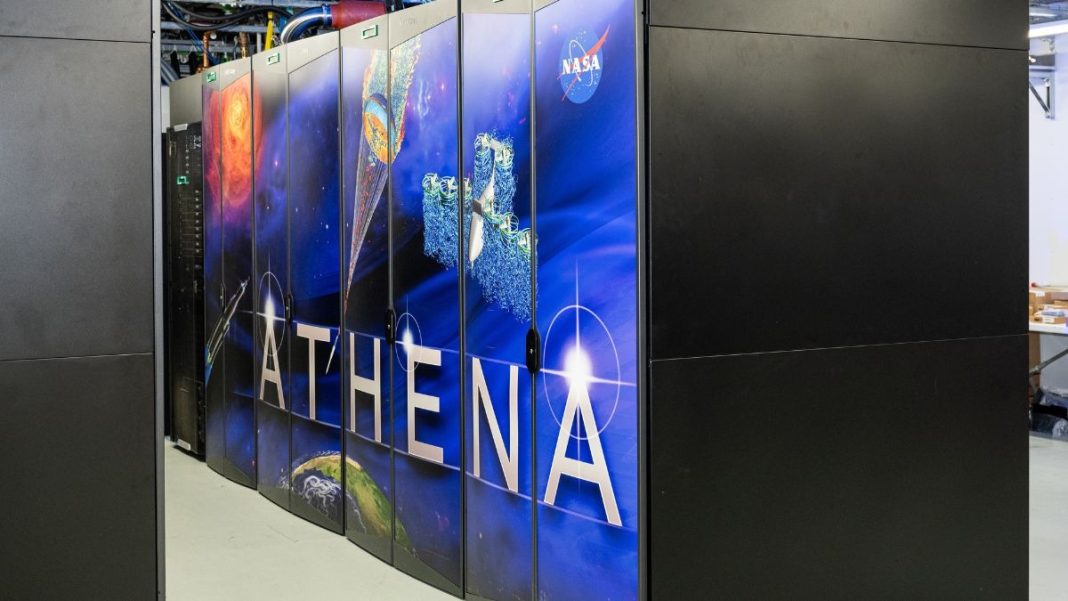
In an era where technological advancements redefine what’s possible, a new titan has emerged from the hallowed halls of NASA. Imagine a task so complex, so computationally intensive, that your high-end personal computer would toil for half a millennium – five hundred years – to complete it. Now, picture that same daunting challenge being conquered in a mere 24 hours. This isn’t science fiction; it’s the astounding reality of Athena, NASA’s latest supercomputer, poised to dramatically accelerate humanity’s understanding of the cosmos and beyond.
For a nation like India, deeply invested in space exploration and rapidly expanding its technological footprint, such global leaps in computing power hold immense significance. While Athena directly serves NASA’s ambitious missions, its capabilities underscore the universal pursuit of scientific discovery and the critical role advanced computing plays in that journey.
Unveiling Athena: A Colossus of Computation
Athena isn’t just an upgrade; it’s a paradigm shift in processing power. Developed by NASA’s Ames Research Center, this supercomputer represents the cutting edge of high-performance computing (HPC). At its core, Athena is designed to handle an unprecedented volume of data and complex simulations that are crucial for modern scientific research. From intricate climate models predicting Earth’s future to simulating the dynamics of black holes, and from designing safer spacecraft to accelerating drug discovery, Athena’s applications are as vast as they are vital.
The “500 years” comparison isn’t merely hyperbole. It illustrates the sheer scale of Athena’s computational prowess. A standard PC, while powerful for everyday tasks, operates on a fundamentally different architecture and scale compared to a supercomputer. Athena employs thousands of interconnected processors working in parallel, capable of executing quadrillions of calculations per second. This parallel processing capability allows it to tackle problems by breaking them down into smaller, simultaneous computations, a feat impossible for a single-core or even multi-core personal computer. This immense speed isn’t just about finishing tasks faster; it’s about enabling research that was previously unimaginable due to time and resource constraints.
Beyond Speed: Impact on Science and Global Context
The true value of Athena extends far beyond its raw processing speed. Its existence fundamentally alters the scope of scientific inquiry. For NASA, Athena will be instrumental in analyzing vast datasets from telescopes like the James Webb Space Telescope, refining models for planetary atmospheres, and simulating complex scenarios for future manned and unmanned missions to the Moon and Mars. It accelerates the development of artificial intelligence algorithms that can sift through astronomical data for new discoveries, identify patterns, and even assist in autonomous mission control.
But the impact isn’t confined to space. The methodologies and insights gained from supercomputing platforms like Athena cascade across various scientific disciplines. Climate scientists can run more accurate and long-term simulations of global weather patterns and their changes. Biomedical researchers can model molecular interactions with unprecedented fidelity, potentially leading to breakthroughs in understanding diseases and developing new therapies. The implications for materials science, engineering, and energy research are equally transformative.
In a global scientific landscape, India holds a significant position, with its own robust supercomputing initiatives like the PARAM series and weather forecasting systems like Pratyush and Mihir. These indigenous efforts demonstrate India’s understanding of the strategic importance of HPC for national development and scientific autonomy. While Athena is a NASA asset, its capabilities push the boundaries of what is possible globally, setting new benchmarks and inspiring collaborative efforts across international scientific communities. As Dr. Eleanor Vance, a lead researcher in computational astrophysics at NASA, once remarked, “Supercomputers like Athena are not just tools; they are extensions of our intellect, allowing us to ask bigger questions and uncover truths that were once beyond our reach.” This sentiment resonates deeply with India’s own scientific community, striving for excellence in research and innovation.
The Future Forged in Data
Athena represents a leap forward in humanity’s quest for knowledge. It embodies the relentless pursuit of understanding, pushing the frontiers of what we know about our universe and ourselves. While the initial awe might stem from its sheer speed – completing centuries of work in a day – its true legacy will be measured in the breakthroughs it facilitates, the questions it answers, and the new ones it empowers us to ask. As nations like India continue to invest heavily in science and technology, platforms like Athena serve as powerful reminders of the collaborative, data-driven future that awaits us all, a future where the impossible slowly but surely becomes attainable.
The age of the supercomputer is truly upon us, and with Athena leading the charge, the pace of discovery is set to accelerate like never before, promising an exciting era for science and technology worldwide.

