


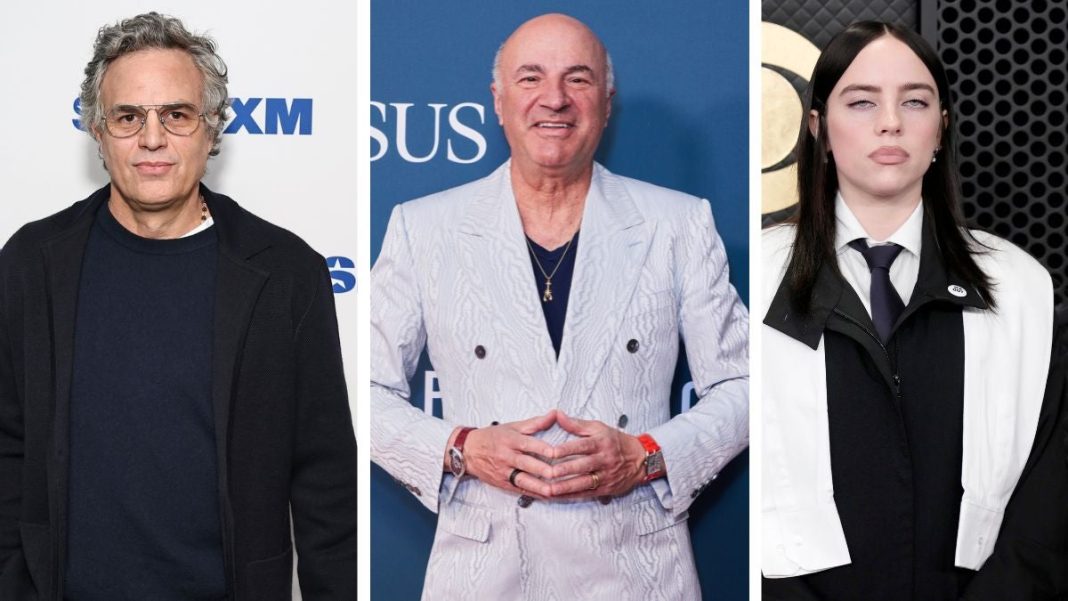
In the vibrant and often outspoken world of entertainment, debates frequently emerge that pit differing philosophies against one another. One such recent exchange captured public attention, highlighting a perennial tension between artistic creation and commercial enterprise. The conversation ignited when business magnate Kevin O’Leary, known for his direct critiques on the show Shark Tank, weighed in on musical artist Billie Eilish’s Grammy acceptance speech. His comments, delivered from a distinctly business-centric perspective, soon drew a sharp retort from acclaimed actor Mark Ruffalo, sparking a broader discussion about the value of art and the forces that fuel it.
The Investor’s Perspective: O’Leary’s Critique of Eilish’s Speech
The initial catalyst for this discourse was Kevin O’Leary’s reaction to Billie Eilish’s moment of triumph at the Grammys. While Eilish’s speech was characterized by humility and gratitude, O’Leary found fault not with what she said, but with what he perceived she omitted. From his vantage point, the omission of an acknowledgment toward the financial backing and investment that supports the music industry was a significant oversight. O’Leary argued that artists, regardless of their talent, are ultimately part of a vast commercial ecosystem, and that success is not solely a product of individual creativity but also of “capital.”
He articulated a view common in business circles: that the infrastructure, marketing, and distribution networks, all powered by investment, are as crucial to an artist’s reach and success as their raw talent. O’Leary’s commentary suggested that a comprehensive understanding of success in the entertainment world requires recognizing the contributions of financial stakeholders, implying that a failure to do so might be seen as a disconnect from the realities of the industry’s economic engine. For him, a successful artist should acknowledge the “people who write the checks” as much as the fans or collaborators.
The Artist’s Advocate: Ruffalo’s Defense of Creative Value
It was this business-first analysis that prompted Mark Ruffalo, an actor celebrated for his roles and known for his outspoken activism, to step into the fray. Ruffalo took a starkly different stance, directly challenging O’Leary’s assertion and reframing the discussion around the inherent value and origin of artistic creation. His response underscored the idea that artists like Billie Eilish are not merely beneficiaries of capital; they are, in fact, the primary generators of the value that capital seeks to invest in.
Ruffalo emphasized that it is the artist’s unique talent, vision, and connection with an audience that creates the cultural and commercial appeal in the first place. Without the original art, he argued, there would be nothing for investors to back or for labels to promote. He highlighted the passion, dedication, and often personal sacrifice involved in artistic pursuit, suggesting that these contributions are not always quantifiable in purely financial terms but are nonetheless fundamental to the industry’s existence. Ruffalo’s intervention served as a powerful reminder that while money facilitates, it is creativity that originates.
As one cultural commentator put it, “This exchange really distills a long-standing debate: is art a product to be capitalized, or is capital a tool to bring art to the world? Both views hold validity, but they start from fundamentally different places regarding intrinsic value.”
Beyond the Headlines: A Deeper Industry Dialogue
The animated exchange between O’Leary and Ruffalo quickly transcended a mere celebrity spat, evolving into a wider conversation about the intricate dynamics within the entertainment industry. It brought to the forefront questions about who truly drives value in creative fields: the investors who fund the machinery, or the artists whose imagination and labor produce the content? This debate touches upon themes of artistic integrity, commercial viability, and the often-uneasy balance between the two.
On one side, the business perspective highlights the logistical and financial heavy lifting required to scale an artist’s reach globally, arguing that without significant investment, many talents might remain undiscovered or inaccessible. On the other, the artistic perspective champions the unique, often unquantifiable spark of creativity that forms the very foundation of the industry, asserting that this intrinsic value should be recognized as paramount.
Ultimately, the public exchange between Kevin O’Leary and Mark Ruffalo served as a compelling illustration of the differing lenses through which success in the creative industries can be viewed. It highlighted the ongoing tension between the pragmatic demands of commerce and the often-ethereal nature of artistic expression, leaving audiences to ponder the complex interplay of talent, finance, and recognition that shapes the world of entertainment.

