


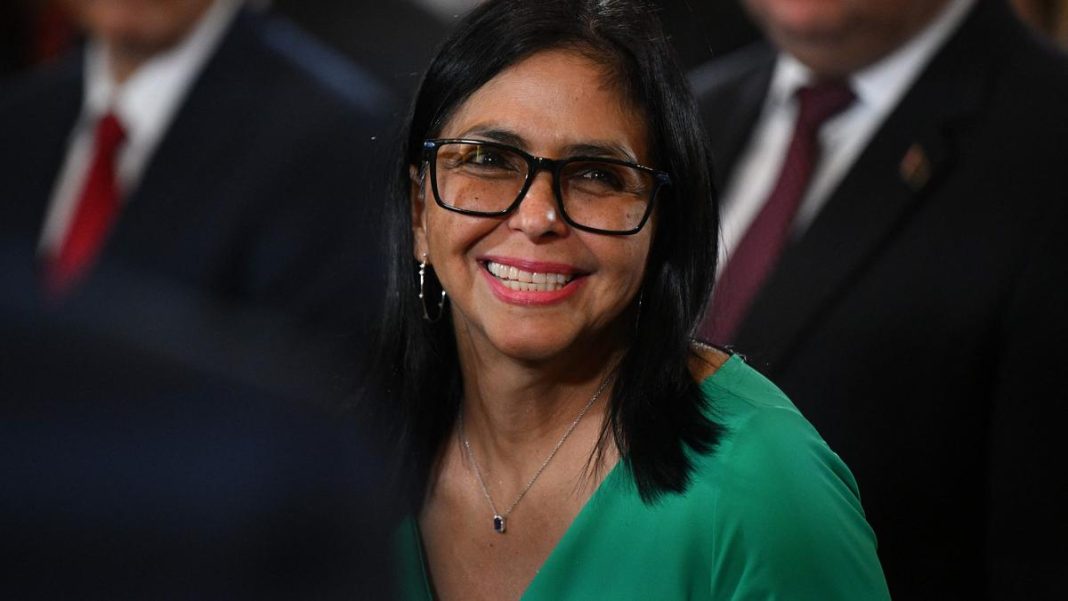
Caracas, the bustling capital of Venezuela, finds itself at a pivotal juncture as the nation’s political landscape undergoes a significant shift. In a development that has sent ripples across the global diplomatic community, Delcy Rodríguez, the long-standing and influential Executive Vice President under President Nicolás Maduro, has been sworn in as the interim President of Venezuela. This unexpected transition, emerging from what sources indicate as constitutional arrangements amidst an evolving political scenario, marks a critical moment for the South American nation, prompting observers worldwide, including India, to closely scrutinise the implications.
Rodríguez, a formidable figure in the ruling United Socialist Party of Venezuela (PSUV) and a staunch ally of President Maduro, now steps into a role that places her at the helm of a nation grappling with profound economic challenges, international sanctions, and a deeply polarised society. For India, a growing global power with significant energy needs and a nuanced foreign policy, developments in Venezuela are never merely distant news; they carry direct economic and geopolitical weight.
The Interim Presidency: A New Chapter or Continuity?
Delcy Rodríguez’s ascendancy to the interim presidency represents a complex manoeuvre within Venezuela’s political system. Known for her unwavering loyalty to the Bolivarian Revolution and her robust defence of the Maduro administration on the international stage, Rodríguez brings a wealth of experience in foreign policy and governance. Her previous roles, including Minister of Foreign Affairs, have solidified her position as a key architect of Venezuela’s diplomatic strategy.
The immediate questions arising from her swearing-in revolve around the precise nature of this interim period. Is it a temporary arrangement to navigate a specific crisis, or does it signal a more fundamental restructuring of power within the Chavista movement? Analysts suggest it could be a strategic move to stabilise governance, potentially address internal party dynamics, or even offer a new face to international interlocutors while maintaining the core tenets of the current government’s ideology. Regardless of the underlying motivations, Rodríguez now inherits the formidable task of steering a nation facing hyperinflation, severe resource shortages, and persistent political opposition. Her leadership will be tested not only by the domestic crisis but also by the need to navigate complex international relations, particularly with nations imposing sanctions on Venezuela.
India’s Geopolitical Calculus Amidst Venezuelan Shifts
For India, a nation heavily reliant on energy imports, the stability of major oil-producing countries like Venezuela is paramount. Historically, Venezuela has been a significant source of crude oil for India, though US sanctions have complicated these trade flows considerably. New Delhi’s foreign policy has consistently championed principles of non-interference in internal affairs and the sovereignty of nations, positioning India to engage with a broad spectrum of countries, irrespective of their political systems.
The change in Venezuela’s leadership, even if interim, will be watched closely by policymakers in Delhi. Any shift that could potentially impact oil production, export capabilities, or the broader economic stability of Venezuela directly influences global oil prices and, consequently, India’s energy import bill. Beyond economics, India’s strategic interests in multilateral forums like BRICS and the G20 mean that the geopolitical standing of Latin American nations, especially those with significant global resource endowments, remains a matter of ongoing assessment. India would likely seek clarity on the new administration’s approach to international engagement and its stance on economic partnerships.
“Delhi will be carefully observing this transition, particularly for any implications on oil supplies and regional stability. Our policy has always been one of non-interference, but the economic ripple effects of Venezuelan politics are undeniable for a large energy consumer like India,” notes Dr. Priya Sharma, a Delhi-based geopolitical analyst. “The continuity of engagement, while navigating the complexities of international sanctions, will be a key focus.”
The Road Ahead: Challenges and Opportunities
Delcy Rodríguez’s interim presidency opens a period of both significant challenges and potential opportunities for Venezuela. Domestically, her administration will be under immense pressure to address the humanitarian crisis, revive the economy, and potentially engage in dialogue with the opposition to foster national cohesion. Internationally, her leadership could either entrench existing diplomatic lines or, depending on her approach, pave the way for renewed engagement with a wider array of global actors. The reactions from regional neighbours and major global powers — including the United States, China, and Russia — will be crucial in shaping the trajectory of her interim term.
For India, the unfolding situation in Venezuela presents a nuanced diplomatic challenge. While upholding its principles of sovereignty, New Delhi will remain keen on ensuring the stability of global energy markets and exploring avenues for humanitarian and economic cooperation where possible. The focus will be on understanding whether this leadership change heralds a phase of greater predictability or introduces further complexities to an already volatile geopolitical landscape.
As Venezuela embarks on this new, albeit interim, chapter under Delcy Rodríguez, the world watches with bated breath. For India, the intricate dance of diplomacy and economic necessity will continue, as it seeks to navigate the ripple effects of this significant development from thousands of miles away.

