


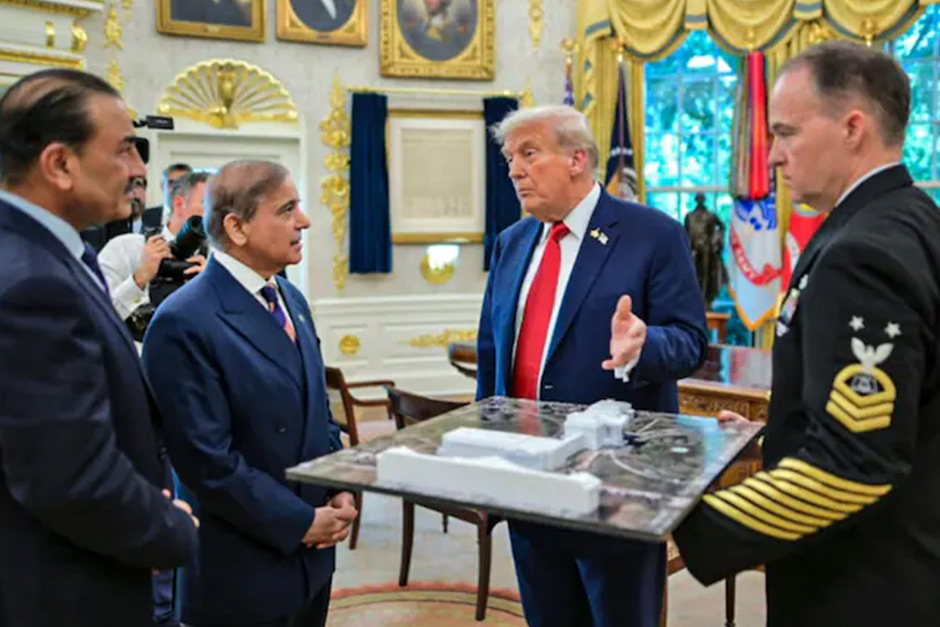
The intricate dance of global diplomacy often sees major powers seeking pragmatic solutions in volatile regions, sometimes leading to strategic gambles. One such hypothetical scenario emerging in geopolitical discussions, particularly within South Asian strategic circles, involves a potential future Donald Trump administration and its perceived reliance on Pakistan’s Army Chief, General Asim Munir. This “bet,” if one can call it that, on a military strongman to navigate Pakistan’s multifaceted crises is viewed from an Indian lens with significant skepticism, hinting at a strategy as flawed and unreliable as a hastily “made gun.”
The Illusion of Military Stability
For any US administration, the allure of a decisive figure in a country plagued by political instability, economic woes, and an ongoing battle with extremism is understandable. General Asim Munir, leading one of the world’s most formidable armies, presents himself as a powerful figure capable of restoring order. From Washington’s perspective, especially one prioritizing transactional foreign policy, Munir could appear as a reliable partner for counter-terrorism efforts, managing the Afghan border, or even subtly influencing regional power dynamics vis-à-vis China. However, this perspective, analysts in India argue, critically overlooks Pakistan’s deep-seated internal contradictions and the systemic fragility that no single military leader, however powerful, can fundamentally alter.
The “made gun” metaphor here is crucial. A reliance on the military for political stability often bypasses democratic institutions, exacerbating long-term grievances. Pakistan’s history is replete with military interventions that, while perhaps offering short-term control, ultimately undermined political development and public trust. General Munir, despite his strong grip, operates within a complex web of domestic political rivalries, a struggling economy dependent on international bailouts, and an increasingly restive populace. His authority, while immense, is not absolute or immune to internal challenges. Any US strategy built primarily on him risks being a precarious construct, prone to unforeseen failures and unintended consequences, much like an unreliable weapon.
Geopolitical Crosscurrents and Divergent Interests
The strategic calculus behind any potential US “bet” on General Munir also runs into the formidable currents of regional geopolitics. While the US might seek Pakistan’s cooperation on specific issues, Pakistan itself has increasingly cemented its strategic alignment with China, particularly through the China-Pakistan Economic Corridor (CPEC). Munir, like his predecessors, must balance Pakistan’s traditional security partnership with the US against its burgeoning economic and strategic ties with Beijing. This inherent duality limits Pakistan’s ability to be a singularly reliable partner for American objectives, especially if those objectives clash with Chinese interests in the region.
Moreover, Pakistan’s internal security challenges, including the rise of the Tehrik-i-Taliban Pakistan (TTP) and Baloch separatism, demand significant military focus and resources. These are existential threats for Pakistan that may not always align with Washington’s broader geopolitical priorities. An Indian strategic analyst, speaking on regional stability, recently noted, “Externally imposed solutions, or those relying solely on military strongmen, rarely yield enduring peace in complex geopolitical theatres. True stability emerges from internal democratic processes and economic resilience, not from geopolitical convenience that ignores underlying fragilities.” This underscores the Indian view that betting on a single military leader is a superficial fix that ignores the deeper fissures within Pakistan.
The Indian Calculus: Implications for Regional Stability
From India’s perspective, any US policy that strengthens the Pakistani military, particularly in a manner perceived to bolster its political influence at the expense of democratic institutions, is viewed with caution. India’s primary security concern remains cross-border terrorism, an issue historically linked to elements within Pakistan’s establishment. A US focus on a military strongman, without robust conditionalities addressing these concerns, risks empowering an institution that India has long held responsible for regional instability.
Furthermore, an American policy overly reliant on Munir could inadvertently lend legitimacy to Pakistan’s deep state, potentially diverting attention from the urgent need for a more democratic and economically stable Pakistan. Such a scenario could lead to a less predictable and potentially more volatile neighbour for India. The “made gun” here represents a policy crafted for one purpose – perhaps counter-terrorism or regional influence – but which risks backfiring by exacerbating the very instabilities it seeks to mitigate, leading to a prolonged cycle of regional tension and mistrust. India advocates for comprehensive solutions that encourage Pakistan’s evolution into a stable, democratic state, rather than short-term tactical alliances with its military establishment.
In conclusion, while the temptation for a future US administration, possibly under Donald Trump, to lean on General Asim Munir for stability in a turbulent Pakistan might seem pragmatic, it represents a bet fraught with peril. The “made gun” analogy perfectly captures the essence of such a strategy: a seemingly decisive tool built on unstable ground, likely to prove unreliable and potentially counterproductive. From an Indian standpoint, a genuine path to regional stability requires addressing Pakistan’s systemic issues through democratic evolution and economic reform, rather than placing undue reliance on military figures whose primary loyalty will always remain to their nation’s internal dynamics, often at odds with enduring peace in South Asia.

