


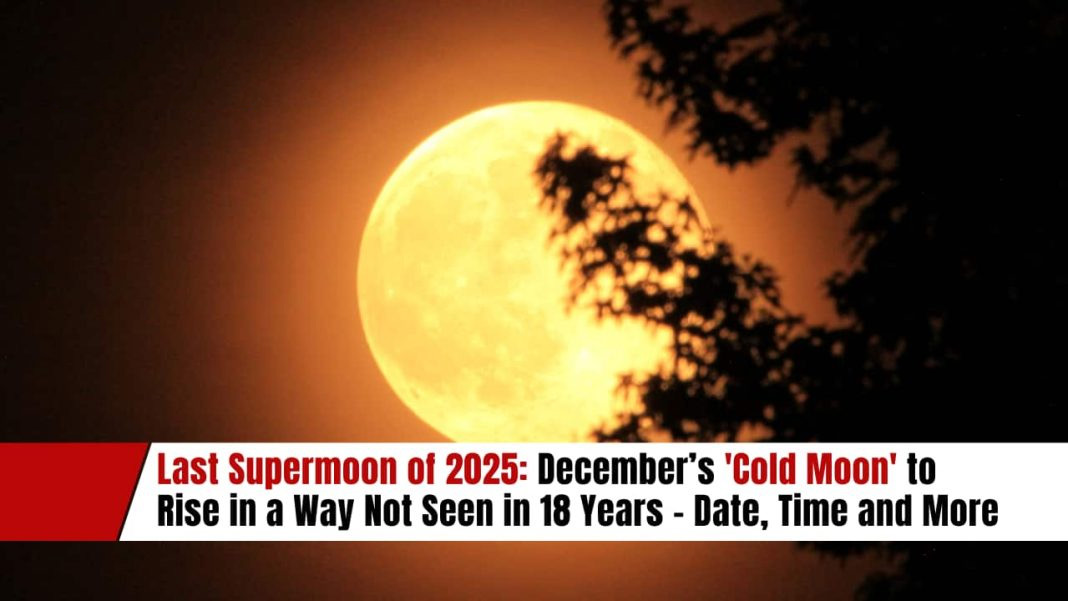
As 2025 draws to a close, sky-gazers across India and the globe are in for a celestial treat. Tonight, December 14th, marks the final Supermoon of the year, affectionately known as the ‘Cold Moon.’ What makes this particular event truly special, however, is its unprecedented appearance: it will rise in a way not witnessed in 18 years, promising an exceptionally vivid display. From the bustling streets of Mumbai to the serene landscapes of Kerala, millions will have the chance to witness our lunar companion at its most magnificent, offering a fitting farewell to the year’s astronomical calendar.
The Celestial Mechanics Behind This Rare Cold Moon
A Supermoon occurs when a full moon coincides with the Moon’s closest approach to Earth in its elliptical orbit, a point known as perigee. This proximity makes the Moon appear significantly larger and brighter than an average full moon. December’s full moon traditionally earns the moniker ‘Cold Moon,’ a name rooted in Native American traditions reflecting the onset of winter and plummeting temperatures in the Northern Hemisphere. For India, it signifies the deepening of the winter season, particularly in the northern states.
The ‘not seen in 18 years’ distinction elevates this Cold Moon beyond a typical Supermoon. While Supermoons are relatively common, tonight’s event is characterized by an extraordinary alignment. Experts suggest it’s due to a precise confluence of the Moon reaching its absolute closest perigee for the year simultaneously with its full phase, combined with its orbital path reaching a high declination in the sky. This unique celestial geometry means the Moon will not only appear remarkably large but also exceptionally bright, tracing a high arc across the night sky, making it a particularly dominant presence overhead. Such a pronounced perigee syzygy, offering this specific visual spectacle, truly is a rare occurrence that has eluded observers for nearly two decades.
Optimal Viewing in India: Timing and Tips
For eager observers across India, the Cold Moon will begin its ascent shortly after sunset, reaching its peak illumination around 8:30 PM IST. While the full illumination peaks at a specific moment, the Moon will appear largely full and spectacular throughout the night, offering a generous viewing window. Those in Eastern states like West Bengal and Assam will witness its rise a little earlier, while Western states such as Gujarat and Maharashtra will experience it later, aligning with local sunsets.
To make the most of this rare spectacle, finding a location away from urban light pollution is highly recommended. Rooftops, open fields, or even a clear balcony facing the eastern horizon shortly after sunset will provide excellent vantage points. No special equipment is needed to appreciate the Moon’s magnified presence; the naked eye will reveal its striking size and brilliance. However, binoculars or a small telescope can enhance the experience, allowing for a closer look at lunar craters and mare. Budding astrophotographers should prepare their equipment to capture this unique celestial event, experimenting with long exposures and stable tripods.
The Cold Moon’s Echoes and Scientific Significance
Beyond its visual grandeur, this Cold Moon holds both cultural resonance and significant astronomical value. In India, full moon nights, or Purnima, are often associated with various festivals and spiritual practices, adding another layer of contemplation to this celestial display. Astronomically, such events serve as powerful reminders of the dynamic orbital mechanics governing our solar system, offering an accessible gateway into understanding the cosmos.
“This particular Cold Moon offers a rare alignment, allowing us to appreciate the intricate dance between Earth and its natural satellite. Its unique brightness and size tonight are a vivid reminder of the dynamic nature of our solar system,” says Dr. Priya Sharma, a senior astrophysicist at the Indian Institute of Astrophysics. “It’s an excellent opportunity for people of all ages to connect with astronomy and marvel at the predictable yet occasionally spectacular rhythms of the universe.”
As the last Supermoon of 2025 graces our skies tonight, it’s more than just a beautiful sight; it’s a testament to the wonders of the universe unfolding above us. This exceptionally bright and large ‘Cold Moon,’ appearing in a manner not seen in nearly two decades, offers a unique opportunity for introspection and awe. Whether you are an avid sky-gazer or simply seeking a moment of wonder, take a moment this evening to step outside, look up, and immerse yourself in the rare glow of our cosmic neighbour. It’s a fitting, luminous finale to the year, reminding us of the enduring magic in the heavens.

