


For many across India, the battle against acne doesn’t end when the pimples fade. What often remains are stubborn scars, silent reminders that can impact confidence and self-esteem. Thankfully, modern dermatology offers powerful solutions, with laser treatments and microneedling standing out as two of the most popular and effective choices for post-acne scar revision. But which one truly delivers the best results for the diverse range of Indian skin tones, and what factors should one consider before making a decision?
Understanding the Mechanisms: Laser vs. Microneedling
Laser Treatments: A Targeted Approach
Laser resurfacing employs focused light energy to treat acne scars. The principle involves controlled damage to the skin’s outer layers or heating the underlying dermis, stimulating the body’s natural healing process and collagen production. This new collagen then helps to fill in depressed scars, improving skin texture and tone.
There are primarily two types of lasers used for scars: ablative and non-ablative. Ablative lasers, like CO2 and Er:YAG, remove thin layers of skin, offering dramatic results for deeper scars but requiring significant downtime. Non-ablative lasers, such as Fraxel or PicoSure, work by heating the underlying tissue without removing the surface, leading to less downtime but generally requiring more sessions for comparable results. For Indian skin, which often falls under Fitzpatrick types IV-VI, the risk of Post-Inflammatory Hyperpigmentation (PIH) is a significant concern, especially with ablative lasers. Newer fractional non-ablative lasers are often preferred due to their safer profile for darker skin tones.
Microneedling: Collagen Induction Therapy
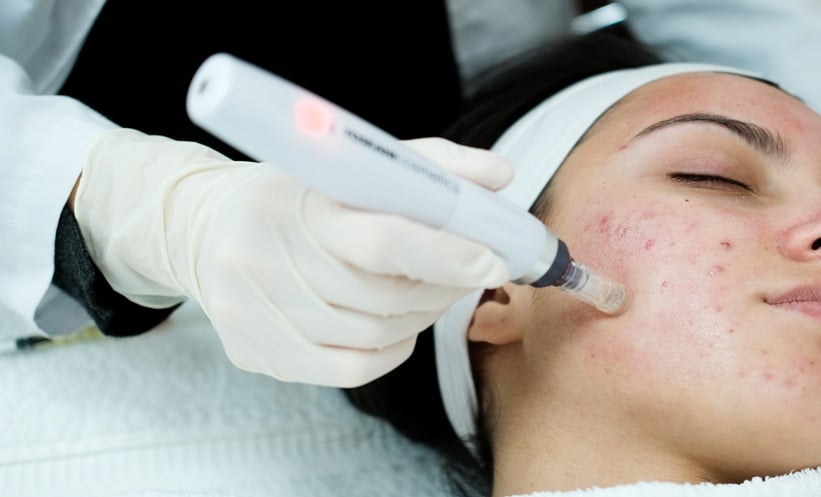
Microneedling, also known as Collagen Induction Therapy (CIT), is a minimally invasive procedure that uses a device with fine needles to create tiny, controlled punctures in the skin. These micro-injuries trigger the skin’s wound-healing response, leading to the production of new collagen and elastin. This process helps to remodel the skin, reducing the appearance of various scar types, including ice pick, boxcar, and rolling scars.
Microneedling can be performed using manual derma-rollers or automated derma-pens. It is generally considered safer for all skin types, including darker Indian complexions, as it causes less thermal damage compared to many laser treatments, significantly reducing the risk of PIH. The depth of the needles can be adjusted to target different scar severities.
Key Considerations: Efficacy, Downtime, and Cost
Effectiveness and Suitability
Both treatments are effective, but their suitability often depends on the type and severity of the scars, as well as the individual’s skin type. For very deep or severe atrophic scars, lasers, particularly fractional ablative ones, might offer more pronounced results in fewer sessions. However, the associated risks, especially for darker skin tones, necessitate careful consideration and expert consultation.
Microneedling is highly effective for mild to moderate atrophic scars and is often the preferred choice for individuals with darker skin tones due to its lower risk of hyperpigmentation. It can significantly improve skin texture, firmness, and the overall appearance of scars. Combination therapies, where microneedling is paired with other treatments like PRP (Platelet-Rich Plasma) or topical serums, can further enhance results.
“There’s no one-size-fits-all solution for acne scars,” says Dr. Priya Sharma, a leading dermatologist based in Bengaluru. “The best approach is always tailored to the individual’s skin type, scar severity, and lifestyle, factoring in potential risks like post-inflammatory hyperpigmentation, which is a significant concern for Indian skin.”
Downtime and Recovery
Downtime is a major differentiator. Ablative laser treatments can involve significant downtime, ranging from one to two weeks, with redness, swelling, and scabbing. Even non-ablative lasers might require a few days of redness. Patients need to be diligent with sun protection during the recovery period, which is particularly important in India’s sunny climate.
Microneedling, on the other hand, typically involves much less downtime. Patients might experience redness and mild swelling similar to a sunburn for 1-3 days, which can often be camouflaged with makeup. This makes it a more appealing option for individuals with busy schedules.
Financial Investment
Cost is a crucial factor for many patients in India. Laser treatments, especially advanced fractional lasers, tend to be more expensive per session. While they might require fewer sessions overall for significant improvement, the total investment can be substantial. Microneedling is generally more affordable per session. While it might require a greater number of sessions (typically 3-6 sessions spaced a few weeks apart) to achieve optimal results, the cumulative cost can sometimes be more manageable.
It is important to remember that these are not one-time solutions; maintenance sessions might be recommended for both treatments to sustain results.
Ultimately, both laser treatments and microneedling offer compelling pathways to smoother, clearer skin post-acne. While lasers can provide powerful results for deeper scars, particularly for individuals with lighter skin tones or when the risk of PIH is carefully managed, microneedling presents a gentler, often safer alternative for the diverse range of Indian complexions, minimizing the risk of hyperpigmentation. The crucial takeaway remains: consult a board-certified dermatologist who can assess your specific scar type, skin tone, and overall health to craft a personalized treatment plan. An expert opinion will ensure the most effective and safest path towards reclaiming your skin’s natural beauty.

