


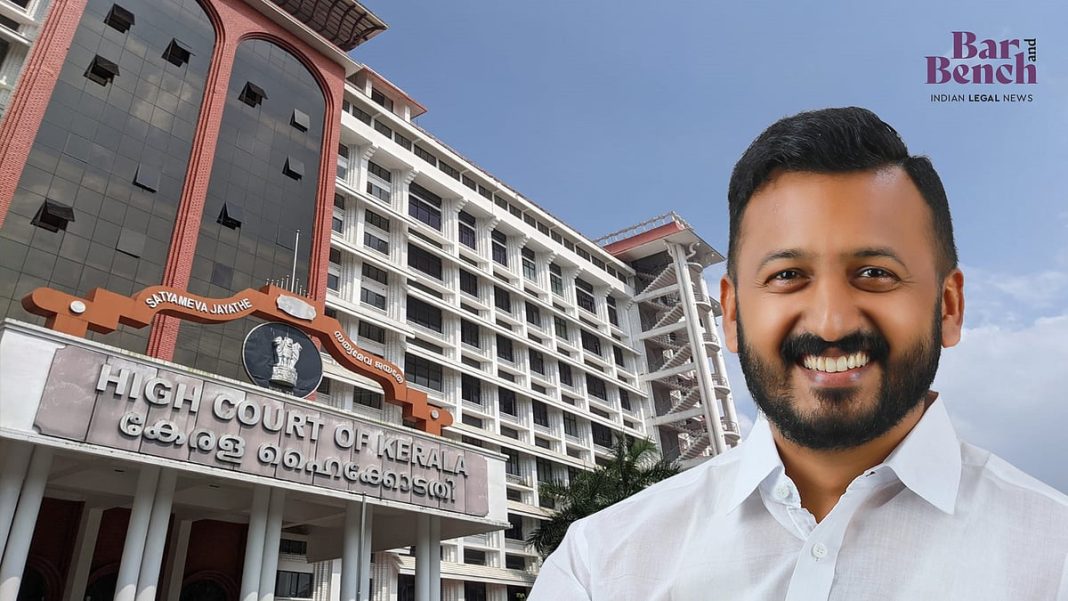
In a significant development that has drawn considerable attention across Kerala’s political landscape, the Kerala High Court has granted an interim stay on the arrest of Congress MLA, Rahul Mamkootathil, in connection with a rape case. The single bench of the High Court issued the order, providing temporary relief to the legislator from the Adoor constituency, thereby preventing immediate custodial action against him. This decision, while procedural, underscores the intricate balance the judiciary seeks to maintain between the rights of the accused and the imperative of a thorough investigation in sensitive matters.
The case involves grave allegations of sexual assault, filed by a woman, which had led to the registration of an FIR against Mamkootathil. His legal team had approached the High Court seeking anticipatory bail, arguing against the necessity of immediate arrest and asserting his cooperation with any legitimate investigative process. The court’s interim protection comes as a crucial juncture, allowing for further legal scrutiny before any definitive action is taken by the investigating agencies.
The Court’s Interim Protection and Investigative Mandate
The interim order from the Kerala High Court specifically prohibits the police from arresting Rahul Mamkootathil until the next hearing of his anticipatory bail application. This judicial intervention is not a clean chit but rather a temporary shield, mandating that the investigation proceed without the immediate threat of incarceration. The court, in its observation, is understood to have considered various factors, including the prima facie material presented by both sides, and the principle that arrest should not be a routine matter but a tool used when necessary for investigation, to prevent evidence tampering, or to ensure the accused’s presence.
Legal experts often highlight that such interim orders underscore the judiciary’s role in ensuring a meticulous investigation, protecting individual rights while allowing law enforcement to gather facts comprehensively before resorting to arrest. “The court’s decision reflects a commitment to due process, ensuring that the investigative machinery functions effectively without infringing upon personal liberty prematurely. It allows the accused to present their side without the pressure of immediate detention,” observed a prominent legal analyst familiar with such proceedings.
The interim order typically comes with certain conditions, which may include directions for the accused to cooperate fully with the investigation, not to influence witnesses, or to tamper with evidence. Such stipulations ensure that the temporary relief does not impede the progress of justice. This legal manoeuvre provides the MLA a window to consolidate his defence and present his arguments more robustly during subsequent hearings, while the police are directed to continue their probe and gather all pertinent information.
Allegations, Political Fallout, and Background
The allegations against Rahul Mamkootathil are serious, reportedly involving charges under various sections of the Indian Penal Code (IPC), including those related to rape. The complainant, whose identity has been withheld for privacy, has accused the MLA of sexual assault, leading to widespread concern and debate, particularly given Mamkootathil’s public stature. He represents the Adoor constituency in the Kerala Legislative Assembly and is a prominent youth leader within the Indian National Congress party, adding a significant political dimension to the legal battle.
The registration of the FIR and the subsequent legal proceedings have predictably sent ripples through Kerala’s political circles. The Congress party, already navigating a complex political landscape, faces the challenge of managing the fallout from allegations against one of its elected representatives. While the party has yet to issue a definitive statement on the legal aspects, such cases invariably place immense pressure on political organizations to demonstrate accountability and uphold public trust. For Mamkootathil himself, the accusations pose a severe threat to his political career and public image, regardless of the eventual legal outcome.
The details surrounding the alleged incident, including the precise dates, locations, and circumstances, are currently under police investigation. The initial complaint would have detailed these aspects, forming the basis of the police’s probe. In India, cases involving public figures, especially those related to sexual offences, attract intense media scrutiny and public discussion, necessitating a cautious and transparent approach from both legal authorities and political entities involved.
The Road Ahead: Investigation and Legal Scrutiny
The Kerala High Court’s interim stay does not conclude the matter; it merely pauses one aspect of the legal process. The investigation by the police will continue rigorously, with officers tasked to collect evidence, record statements, and piece together the sequence of events. The complainant’s statements, forensic evidence if any, and other corroborating details will be crucial in building the prosecution’s case. The police will also be required to submit their findings and progress report to the court at the next hearing.
Rahul Mamkootathil’s legal team will now focus on securing a more permanent form of protection, potentially a confirmation of anticipatory bail. The court will critically examine the evidence gathered by the police, the necessity of custodial interrogation, and the arguments put forth by both the prosecution and the defence before making a final decision on the anticipatory bail application. Should the court deny anticipatory bail subsequently, the police would then be free to proceed with his arrest.
This case serves as a poignant reminder of the complexities inherent in legal battles involving public figures and serious allegations. The judiciary’s role remains paramount in ensuring that justice is served fairly, impartially, and in accordance with the law, while upholding the fundamental rights of all individuals involved. As the investigation progresses and the legal proceedings unfold, all eyes will be on the Kerala High Court and the police department for further developments.
—

