


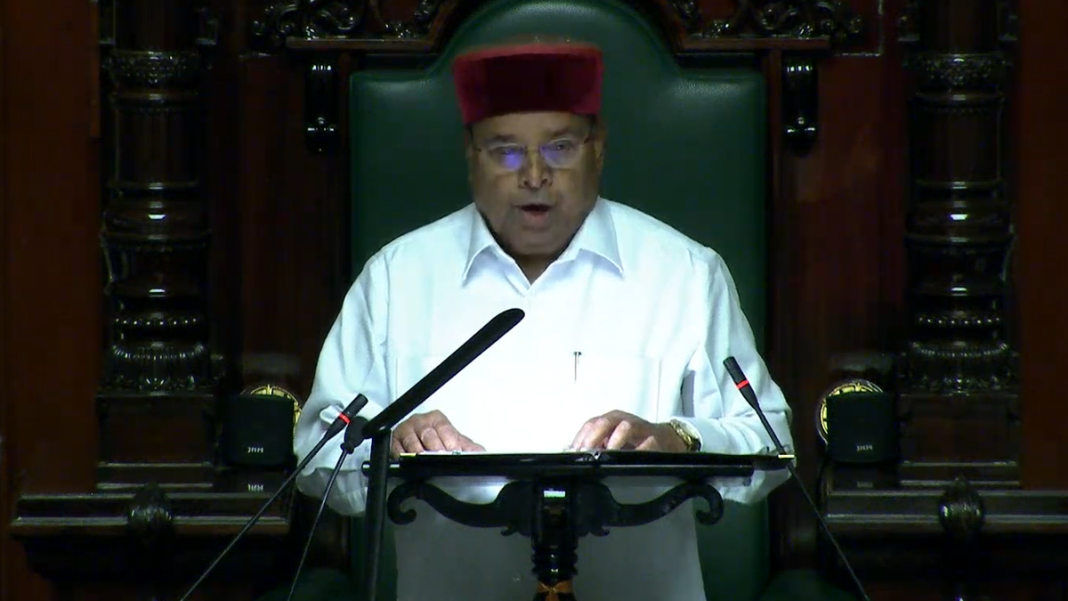
A unprecedented scene unfolded in Karnataka’s legislature recently, as Governor Thawarchand Gehlot abruptly walked out of a joint session after delivering a mere two lines of his customary address. The dramatic exit, met with boos from the Opposition and cheers from the ruling party, immediately ignited a fierce political firestorm, with Chief Minister Siddaramaiah swiftly condemning the Governor as a “Centre’s puppet.”
The incident has intensified the already palpable friction between the state government and the Governor’s office, once again highlighting the delicate balance of federal relations and constitutional propriety in India.
The Abrupt Departure and Its Immediate Aftermath
The joint session of the Karnataka Legislature commenced on a tumultuous note. As Governor Thawarchand Gehlot began his address, outlining the state government’s agenda and achievements as per constitutional tradition, members of the principal opposition Bharatiya Janata Party (BJP) and the Janata Dal (Secular) [JD(S)] immediately rose in protest. Their dissent stemmed from various issues, including allegations of the Congress government’s failure to address drought relief, maintain law and order, and manage the state’s finances effectively.
Amidst the shouts and counter-shouts – with Congress members defending their government and praising its initiatives – the Governor’s address was barely audible. After attempting to proceed for a few moments, Governor Gehlot paused, visibly perturbed by the continuous disruptions. In a move that sent shockwaves through the legislative chambers, he read only the introductory and concluding lines from his prepared speech, summarily stating, “It is my pleasure to address the joint session of the Karnataka Legislature… I extend my best wishes to all members for a fruitful session.”
Without waiting for the House to settle or the proceedings to conclude, Governor Gehlot then turned and walked out, escorted by marshals, leaving behind a bewildered assembly. The Speaker of the Legislative Assembly and the Chairman of the Legislative Council, who were presiding, were left to continue the session, attempting to restore order in the wake of the Governor’s unprecedented exit. This act immediately sparked a debate over constitutional decorum and the role of the Governor, traditionally seen as the non-partisan constitutional head of the state, in the legislative process.
CM Siddaramaiah’s Scathing Critique
The Governor’s walkout drew swift and sharp condemnation from Chief Minister Siddaramaiah, who minced no words in his subsequent interaction with the media. Terming the Governor’s actions as a disgrace to the Constitution and democracy, Siddaramaiah launched a scathing attack, accusing Governor Gehlot of acting under political pressure from the Central government and the BJP.
“He has behaved like a puppet of the Central government and the BJP. It is an insult to the Constitution and democracy,” Chief Minister Siddaramaiah declared, his voice laced with indignation. He elaborated that the Governor, by refusing to read the full speech prepared by the elected state government, had disregarded his constitutional duty and undermined the sanctity of the legislative session. Siddaramaiah further alleged that the walkout was a deliberate act orchestrated by the BJP to destabilise the state government and create an unnecessary political crisis.
The Chief Minister highlighted specific grievances, including the Centre’s alleged delay in releasing drought relief funds to Karnataka and its purported reluctance to implement the recommendations of the State Finance Commission. He argued that the Governor’s action was not merely an impulsive reaction to protests but a politically motivated move to support the opposition’s narrative against the state government. This accusation squarely positions the Governor as an agent of the Centre, rather than an impartial constitutional authority, thereby escalating the ongoing tensions between the state and central administrations.
Political Reactions and Constitutional Precedent
The incident naturally elicited strong reactions from all political quarters. While the Congress government stood united in its criticism of the Governor, the BJP and JD(S) leaders defended the Governor’s actions, albeit indirectly. They argued that the chaotic environment created by the ruling Congress members, coupled with the government’s perceived failures, made it impossible for the Governor to deliver his address respectfully.
BJP leaders accused CM Siddaramaiah of showing disrespect towards the Governor and orchestrating the very disruptions that led to the walkout. They maintained that the Governor was justified in his response to what they described as an intentional attempt by the Congress to overshadow the serious issues facing the state. This tit-for-tat exchange underscores the highly polarised political landscape in Karnataka, where every institutional action is quickly framed through a partisan lens.
From a constitutional perspective, the Governor’s walkout sets a concerning precedent. The Governor’s address is traditionally a formal presentation of the elected government’s policy roadmap, even if the Governor personally disagrees with it. By refusing to complete the address, Governor Gehlot has arguably overstepped the boundaries of his constitutional role, which largely involves acting on the “aid and advice” of the Council of Ministers. This incident is likely to fuel further debates on the powers and limitations of the Governor’s office, especially in states where the ruling party is different from that at the Centre.
The dramatic walkout of Governor Thawarchand Gehlot from the joint legislature session marks a significant escalation in the political tussle within Karnataka. CM Siddaramaiah’s sharp ‘Centre’s puppet’ accusation lays bare the deep-seated mistrust and antagonism between the state government and the Governor, mirroring broader federal tensions in India. As Karnataka navigates this constitutional tightrope, the incident sets a concerning precedent and signals a period of heightened political confrontation, with implications for democratic norms and inter-institutional relations.

