


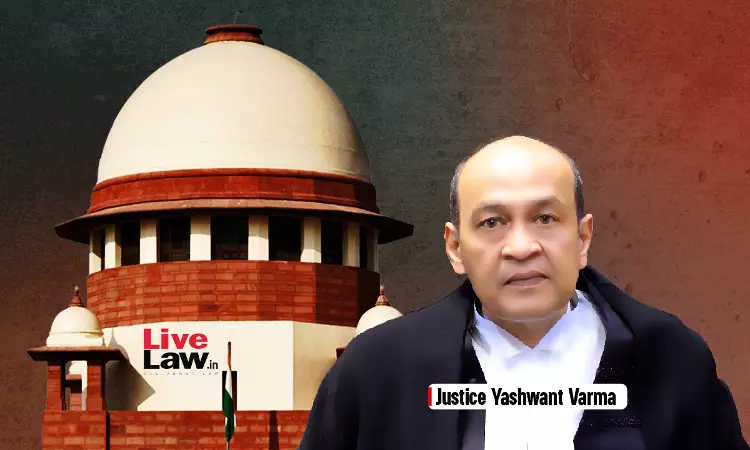
In a significant development that underscores the delicate balance between India’s legislative and judicial arms, Delhi High Court’s Justice Yashwant Varma has moved the Supreme Court, challenging the inquiry committee constituted by the Lok Sabha in connection with impeachment proceedings initiated against him. This unprecedented move marks a crucial moment in India’s constitutional history, setting the stage for a profound legal and institutional debate.
The challenge by a sitting High Court judge against an parliamentary impeachment inquiry committee is a rare occurrence, drawing attention to the intricate procedural and constitutional safeguards designed to ensure judicial independence while allowing for accountability. The Supreme Court’s eventual ruling in this matter could set vital precedents regarding the interpretation of parliamentary powers and the extent of judicial scrutiny over such processes.
The Genesis of the Challenge: Impeachment and Inquiry
The journey leading to Justice Varma’s Supreme Court petition began with an impeachment motion submitted by a group of Members of Parliament against him. While the specific grounds of the motion have not been fully detailed in public domain, such proceedings typically involve allegations of misbehaviour or incapacity, as laid out in the Constitution. Following the acceptance of the motion by the Lok Sabha Speaker, an inquiry committee was constituted as per the provisions of the Judges (Inquiry) Act, 1968. This committee, generally comprising a Supreme Court judge, a Chief Justice of a High Court, and a distinguished jurist, is tasked with investigating the allegations and submitting a report.
Justice Varma’s petition reportedly questions the very constitutionality and procedural fairness of this inquiry committee. Sources close to the development indicate that the challenge is not against the concept of accountability itself, but rather against alleged irregularities in the formation of the committee or its mandate, potentially infringing upon principles of natural justice or established legal procedures. This move highlights a judge’s right to challenge the process through which their conduct is being scrutinised, ensuring that the investigative mechanism itself adheres to the highest standards of legality and impartiality.
The implications of this challenge are far-reaching, probing the boundaries of parliamentary privilege in constituting such panels and the judiciary’s inherent power to review processes that directly impact its members. It underscores the robust checks and balances enshrined in the Indian Constitution, where even parliamentary actions can be subjected to judicial review under specific circumstances.
Constitutional Framework and Procedural Scrutiny
The impeachment of a judge in India is governed by Articles 124(4) and 217 of the Constitution and further elaborated by the Judges (Inquiry) Act, 1968. This process is intentionally arduous, requiring substantial parliamentary support and a rigorous inquiry, reflecting the constitutional designers’ intent to protect judicial independence from political interference. The Act outlines detailed steps for the investigation, including giving the concerned judge an opportunity to present their case and legal representation.
Justice Varma’s petition is expected to critically examine whether the formation and proposed functioning of the Lok Sabha’s inquiry committee align strictly with these constitutional provisions and statutory mandates. Questions may arise concerning the committee’s composition, its terms of reference, or any deviation from the prescribed investigative methodology that could compromise the fairness of the proceedings. The judiciary, as the custodian of the Constitution, often intervenes to ensure that all arms of the state operate within their prescribed constitutional limits.
Legal experts suggest that such a challenge, while rare, is a crucial mechanism for upholding due process and the rule of law. “The sanctity of judicial independence is paramount for a functioning democracy,” commented a constitutional law expert, preferring anonymity due to the ongoing nature of the proceedings. “Any process that seeks to examine a judge’s conduct must not only be fair in its outcome but also demonstrably fair and constitutionally sound in its methodology. This Supreme Court challenge underscores that fundamental principle.” Past instances of impeachment proceedings against judges have seen intricate legal battles, though a direct challenge to the inquiry committee’s constitution by the judge himself, at this stage, is a novel dimension.
Broader Implications for Governance and Judicial Independence
This challenge by Justice Varma before the apex court is not merely about an individual judge; it has profound systemic implications. It directly confronts the delicate separation of powers between the legislature and the judiciary, re-examining the extent to which parliamentary actions, particularly those impacting the judiciary, are subject to judicial review. The Supreme Court’s decision will inevitably shape the future interpretation of parliamentary oversight on the judiciary and the safeguards available to judges facing impeachment proceedings.
The outcome will have a significant bearing on how future impeachment processes are conducted and perceived, reinforcing or redefining the boundaries of parliamentary authority in matters of judicial accountability. It also serves as a critical test of the strength of India’s institutional framework, ensuring that the process of holding judges accountable is itself beyond reproach and firmly anchored in constitutional principles.
As the Supreme Court takes up this matter, all eyes will be on its deliberations, which are poised to deliver a landmark ruling that could redefine the contours of judicial accountability and constitutional governance in India.
The case represents a vital chapter in India’s legal narrative, emphasising that adherence to constitutional propriety and due process remains paramount, even in the gravest of proceedings involving the highest offices of the land. The verdict will undoubtedly contribute to the ongoing evolution of India’s robust democratic institutions.

