


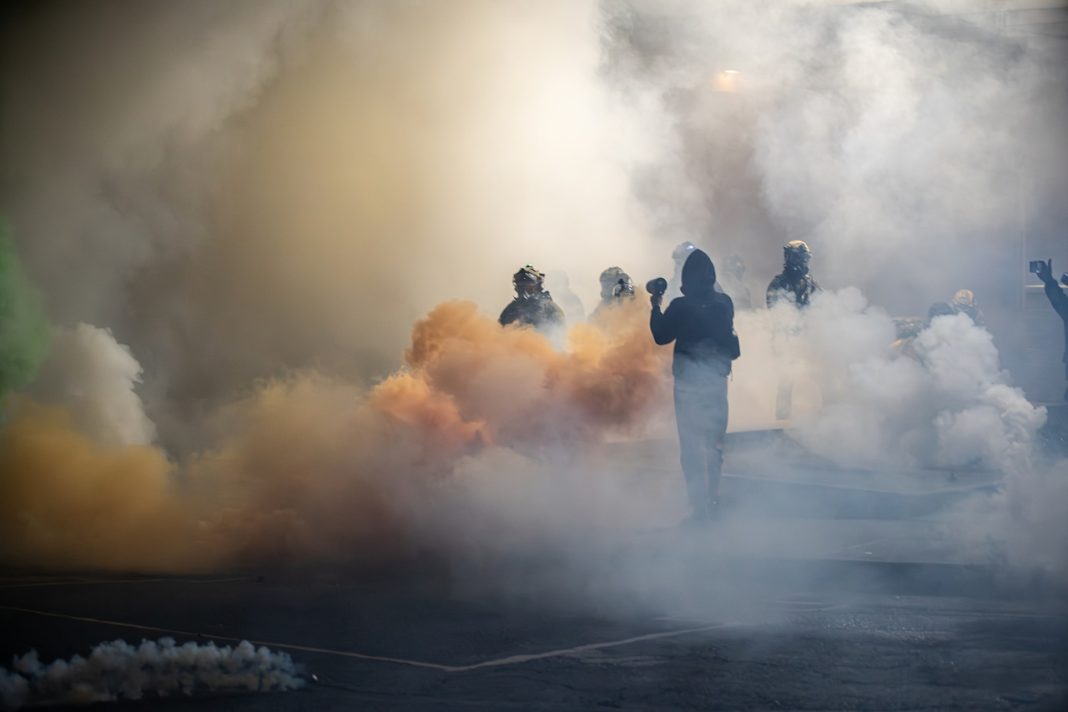
In a development that has garnered significant attention, a federal judge has issued a directive to federal agents operating at ongoing protests in Portland, Oregon. This order specifically calls for a limitation on the use of certain crowd control measures, particularly tear gas and other less-lethal weapons. The ruling reflects an ongoing legal and public discourse surrounding the appropriate scope of law enforcement actions during demonstrations.
The Judicial Intervention
The judge’s order stems from legal challenges brought forward by groups and individuals concerned about the tactics employed by federal agents during protests. These complaints often highlighted instances where chemical agents and impact munitions were reportedly used in ways that were perceived as indiscriminate or excessive, leading to injuries and raising questions about constitutional rights to protest peacefully. The court, in its role of interpreting the law and protecting civil liberties, weighed these concerns against the government’s asserted need to maintain order and protect federal property.
The directive is not a blanket prohibition but rather a set of clear parameters intended to guide federal agents’ conduct. It underscores the judiciary’s role in overseeing executive actions, especially when they intersect with fundamental rights. This intervention signals a judicial acknowledgement of the heightened tensions and the potential for escalation when certain crowd control methods are deployed.
Understanding the Limitations
Under the new judicial order, federal agents are now subject to specific restrictions regarding the deployment of tear gas and other less-lethal weapons. The core of the ruling dictates that such measures should only be used in specific, limited circumstances. For example, the use of tear gas is generally prohibited unless there is an immediate and grave threat to life or serious bodily injury to agents or others. This moves away from its use as a general crowd dispersal tool.
Similarly, the order addresses less-lethal projectile weapons, such as pepper ball launchers or kinetic impact projectiles. Their use is also restricted, typically requiring a direct and immediate threat rather than being deployed against a broad crowd. The intent behind these limitations is to encourage de-escalation and to ensure that force is proportional to the threat faced, thereby reducing the risk of harm to protesters and observers while still allowing agents to respond to genuine dangers.
Implications and Perspectives
The judicial order carries significant implications for both federal agents and protesters. For law enforcement, it necessitates a recalibration of crowd control strategies, emphasizing more precise and threat-specific responses. It may encourage a shift towards negotiation and de-escalation tactics where feasible, rather than immediate reliance on chemical agents or projectiles for dispersal.
For protesters, the ruling could be seen as an affirmation of their rights to assemble and express dissent without undue interference or the risk of disproportionate force. It aims to create an environment where demonstrations can proceed with a greater sense of safety, though the dynamics of large public gatherings remain complex. As Dr. Lena Chen, a conflict resolution specialist, points out, “This ruling reflects an ongoing societal discussion about the appropriate boundaries of force in public gatherings. It’s about balancing constitutional rights with safety and order, and finding that equilibrium is always a challenging but necessary endeavor.”
Ultimately, this judicial directive serves as a notable point in the ongoing dialogue about public protest, federal intervention, and the rule of law. It highlights the judiciary’s power to mediate disputes between citizens and government agencies, setting precedents that could influence how similar situations are handled in the future across the nation.

