


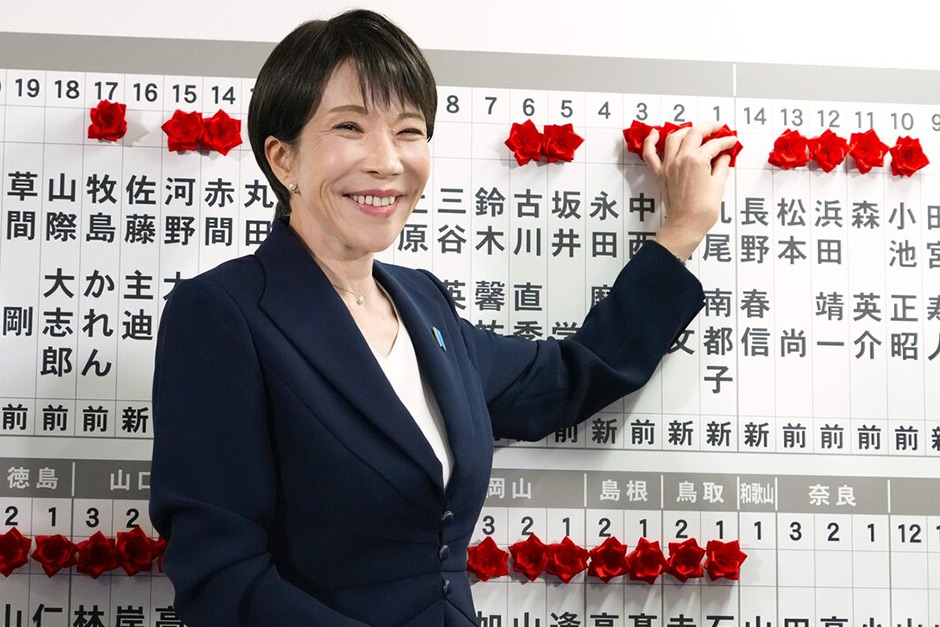
Japan’s political landscape has witnessed a significant reaffirmation of power as Prime Minister Sanae Takaichi’s Liberal Democratic Party (LDP) decisively secured a majority in the snap elections for the House of Representatives. The unexpected call for an early election, just months into her tenure, was a calculated gamble by PM Takaichi, aiming to solidify her mandate amidst evolving economic challenges and a complex geopolitical environment. The overwhelming victory not only bolsters her position but also signals continuity in Japan’s domestic and foreign policy, with substantial implications for regional stability, including its crucial partnership with India.
The Mandate and Its Implications
The LDP, campaigning on a platform of economic recovery, national security, and constitutional reform, managed to secure a comfortable majority, exceeding the 233 seats required in the 465-member lower house. While final figures saw the LDP fall slightly short of an absolute single-party majority, its coalition with the smaller Komeito party easily surpassed the threshold, granting PM Takaichi a strong hand to push forward her agenda. This victory is widely interpreted as public endorsement for her vision of a robust Japan capable of navigating global uncertainties.
Analysts suggest that the snap election was strategically timed to capitalize on a relatively stable approval rating and a fragmented opposition. PM Takaichi’s leadership, marked by a blend of economic pragmatism and assertive foreign policy, resonated with a populace seeking stability and a clear direction. The mandate empowers her government to accelerate crucial legislative reforms, including further economic stimulus packages designed to counter inflation and stimulate growth, along with potential revisions to Japan’s pacifist constitution, particularly Article 9, a long-standing aspiration for the LDP’s conservative wing.
Takaichi’s Vision: Economy and Geopolitics
At the heart of PM Takaichi’s renewed mandate lies her economic strategy, often dubbed “Sanae-nomics.” This approach largely builds upon the legacy of her predecessors, emphasizing aggressive monetary easing, flexible fiscal policy, and structural reforms to boost Japan’s long-term competitiveness. The immediate focus will be on addressing the cost of living crisis, supporting small and medium-sized enterprises, and fostering innovation in critical sectors like digital technology and green energy. The stability provided by this electoral win is expected to reassure markets and investors, both domestic and international.
On the geopolitical front, Takaichi’s administration is set to maintain a firm stance. Japan’s commitment to a “Free and Open Indo-Pacific” strategy remains a cornerstone of its foreign policy. This involves strengthening alliances, particularly with the United States, and deepening partnerships with like-minded democracies such as Australia, India, and the United Kingdom, within frameworks like the Quad. The increasing assertiveness of China in the region and the ongoing tensions in Ukraine have underscored Japan’s resolve to enhance its defense capabilities, a policy direction that this strong mandate will undoubtedly accelerate.
Dr. Rohan Sharma, a political analyst specializing in East Asian affairs at the Delhi Policy Group, commented on the outcome: “This victory provides a clear mandate for Prime Minister Takaichi to continue her robust agenda, especially concerning Japan’s economic recovery and its strategic positioning in the Indo-Pacific. For India, this continuity is highly beneficial, promising a stable and predictable partner.”
India-Japan Ties: A Path Forward
For India, the outcome of Japan’s snap elections signifies business as usual, but with renewed vigor. The strategic partnership between India and Japan has blossomed over the past two decades, encompassing robust cooperation in economic development, infrastructure, defense, and technology. From the Mumbai-Ahmedabad High-Speed Rail project to joint military exercises and collaboration on critical and emerging technologies, the two nations share a deep alignment of interests and values.
PM Takaichi’s re-elected government is expected to continue prioritizing this crucial relationship. Both countries are key pillars of the Indo-Pacific strategy, advocating for a rules-based international order, freedom of navigation, and peaceful resolution of disputes. The stability offered by the LDP’s continued leadership means that existing projects and future initiatives can proceed without political uncertainty, further solidifying the trust and synergy between New Delhi and Tokyo. This continuity is vital for regional stability and for fostering a resilient global supply chain, particularly relevant in the post-pandemic world.
The snap election results in Japan underscore a preference for stable governance and a clear policy direction. PM Sanae Takaichi’s LDP has not only secured a mandate for her domestic agenda but also reaffirmed Japan’s commitment to its international role. For India, this translates into a steadfast partner eager to deepen engagement across various sectors, contributing significantly to a prosperous and secure Indo-Pacific region.

