


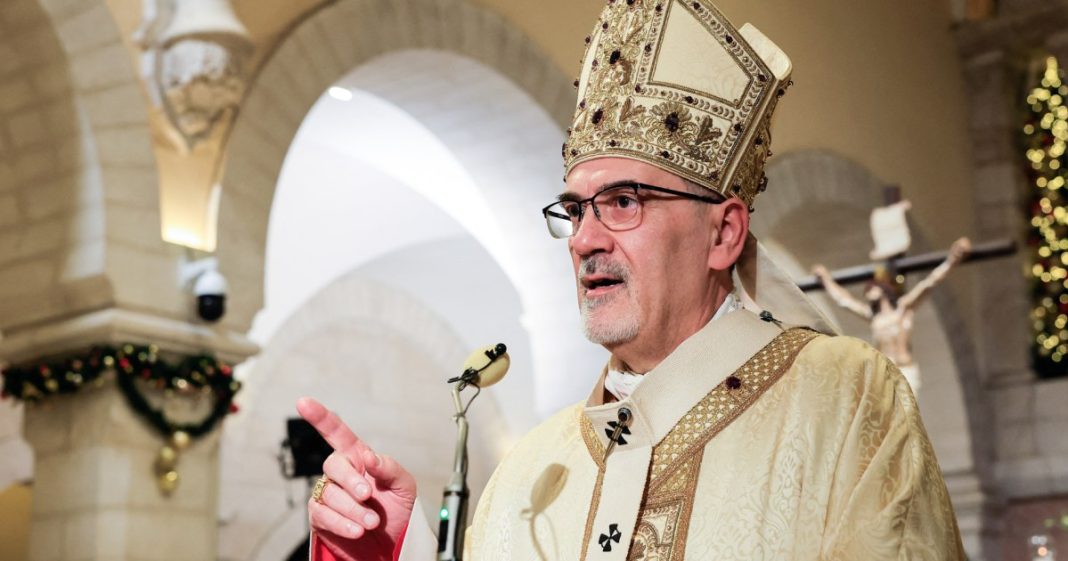
Jerusalem, a city often described as the heart of three Abrahamic faiths, witnessed a deeply unsettling scene this past Palm Sunday, a day meant for solemn procession and spiritual reflection. What should have been a vibrant celebration of faith, marked by pilgrims and religious leaders retracing Christ’s steps, instead turned into a moment of profound contention. At the venerable Church of the Holy Sepulchre, the very site believed to house the tomb of Jesus, Israeli police reportedly blocked Catholic leaders and numerous worshippers from accessing the traditional Palm Sunday Mass, casting a shadow over one of Christianity’s holiest days.
A Sacred Procession Disrupted
The annual Palm Sunday procession is a cornerstone of the Christian Holy Week, drawing clergy, monks, and pilgrims from around the world to commemorate Jesus’s entry into Jerusalem. This year, however, the joyous atmosphere was overshadowed by significant security measures and reported friction. Accounts from the scene describe Israeli police setting up barriers and severely limiting access to the Church of the Holy Sepulchre and its surrounding pathways. This led to frustrating standoffs, with Catholic patriarchs and other senior clergy reportedly prevented from entering the church for the scheduled Mass, their path obstructed by officers.
The disruption wasn’t just limited to the most prominent figures; ordinary worshippers, including elderly pilgrims and families, also faced difficulties. Videos and reports circulating online depicted scuffles and arguments as individuals attempted to navigate the blocked routes. For many, the experience was not merely an inconvenience but a deeply painful infringement on their religious freedom, particularly on such a significant occasion. The sight of religious leaders arguing with armed police outside their sacred sanctuary was a jarring image that resonated far beyond the ancient walls of Jerusalem.
The Weight of History and the Struggle for Access
This isn’t an isolated incident but rather a recurring flashpoint in the delicate ecosystem of Jerusalem’s Old City, where religious freedom often intersects with security concerns and political realities. Israeli authorities frequently cite security imperatives and crowd control as reasons for implementing such restrictions, especially during major religious holidays that attract large numbers of people. However, religious leaders and human rights advocates consistently argue that these measures often disproportionately impact Christian communities, limiting their ability to worship and celebrate their traditions freely.
The Old City operates under a complex arrangement known as the “Status Quo,” a centuries-old understanding governing access and jurisdiction over holy sites, particularly the Holy Sepulchre. Incidents like these, where access is severely curtailed, are seen by many as a direct challenge to this fragile balance and a disregard for the rights of Christian denominations. It creates a sense of apprehension and frustration among a community that feels increasingly marginalized in its own spiritual homeland.
As Miriam Aboud, a long-time Christian resident of the Old City, powerfully observed, “This isn’t just about crowd control; it feels like an erosion of our ancient rights to worship freely in our most sacred spaces. Each time this happens, a piece of our history and our presence here feels diminished.” Her words echo the sentiment of many who witness these repeated confrontations, highlighting the deep emotional and spiritual impact of such restrictions.
The scenes from Palm Sunday at the Holy Sepulchre serve as a potent reminder of the ongoing challenges faced by religious communities in Jerusalem. While security is undeniably a crucial concern, striking a balance that respects and upholds the fundamental right to religious freedom and access to holy sites remains an imperative. The hope is always for a Jerusalem where faith can flourish unimpeded, and sacred days can be observed in peace and reverence, rather than contention.

