


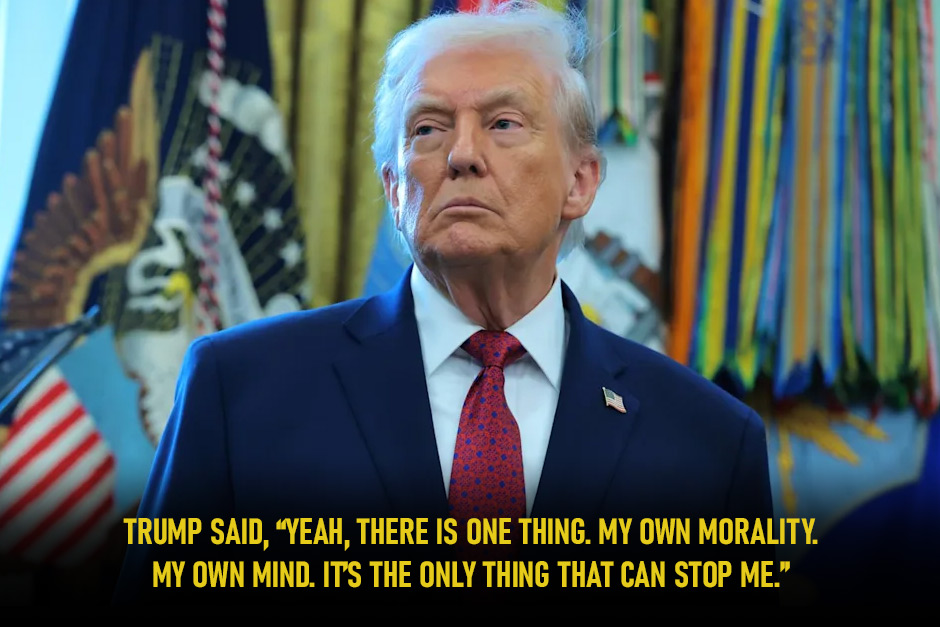
Donald Trump’s presidency, from its contentious beginning to its dramatic end, redefined the boundaries of political discourse and executive power, not just in the United States but globally. His “America First” doctrine, coupled with an often confrontational style, led many to question whether there was any effective check on his expansive view of presidential authority. Yet, amidst the debates about his influence, Trump himself has often acknowledged a singular, fundamental constraint on his power, one deeply rooted in the American democratic experiment.
The Constitutional Guardrails: Trump’s Acknowledged Limit
Throughout his term, former President Trump frequently tested the traditional norms and institutions of American governance. From executive orders on immigration to challenges against electoral outcomes, his administration often found itself embroiled in legal battles. It was in these very legal skirmishes that a consistent, if sometimes grudging, acknowledgement of a higher authority emerged from the President himself. While known for his assertions of broad executive privilege, Trump often pointed to the US Constitution and its legal framework as the ultimate arbiter, even when disagreeing with specific rulings.
He once stated, concerning judicial processes, “I’m a big believer in the Constitution and I’m a big believer in judicial process.” This sentiment, expressed at various points during his tenure, highlights that despite his powerful persona and often singular decision-making, even a US President like Trump implicitly or explicitly recognizes the supremacy of the nation’s founding document and the independent judiciary tasked with interpreting it. For a leader whose global reach felt unprecedented, this internal constitutional architecture was the one thing he admitted could, and often did, stop him or at least significantly alter his course.
Understanding US Presidential Power and its Global Resonance
The power of the US President is immense, extending far beyond American borders. Through foreign policy decisions, military deployments, trade agreements, and diplomatic initiatives, a US President can reshape global alliances, influence economic markets, and impact security landscapes from the Indo-Pacific to the Middle East. India, for instance, keenly observes these shifts, as US foreign policy directly affects its strategic partnerships, trade relations, and regional stability efforts, such as the Quad dialogue.
However, the American system is designed with a robust framework of checks and balances. The legislative branch (Congress) controls funding, declares war, and can impeach a President. The judicial branch, through courts ranging from district level to the Supreme Court, can review executive actions and strike down those deemed unconstitutional. This separation of powers is not merely an academic concept; it’s a living mechanism that repeatedly demonstrated its ability to curb executive overreach during the Trump administration, often compelling policy changes or even outright reversals. For the world, including India, this internal dynamic offers a degree of predictability and stability, ensuring that even the most determined leader operates within established legal parameters.
The Indian Perspective: Valuing Constitutional Democracy
From an Indian standpoint, the debate surrounding the limits of US presidential power resonates deeply. As the world’s largest democracy, India places immense value on constitutionalism, the rule of law, and the independence of its own institutions. The struggles and triumphs of the US system in upholding its constitutional principles serve as a global case study, reinforcing the idea that even the most powerful leaders in democratic nations are ultimately subordinate to the law and the will of the people, expressed through established legal and electoral processes.
India’s strategic calculations are often predicated on the perceived stability and institutional strength of its global partners. A US presidency that respects its constitutional limits, even when pushing boundaries, provides a more reliable and predictable partner in an increasingly complex world. While Trump’s presidency often presented unique challenges to traditional diplomacy, the resilience of American democratic institutions in checking his power offered reassurance that the fundamental tenets of democratic governance remained intact. This ability of a nation’s internal legal and constitutional structures to act as the ultimate brake on executive power is a principle that democracies everywhere, including India, observe closely and hold in high regard.
In conclusion, while the global reach of a US President’s power is undeniable and often appears boundless, the ultimate limit, as even Donald Trump implicitly acknowledged, resides within the intricate constitutional framework of the United States itself. This internal mechanism of checks and balances serves not only to safeguard American democracy but also provides a critical anchor for global stability, reassuring allies like India that the pursuit of power will always, eventually, yield to the rule of law.

