


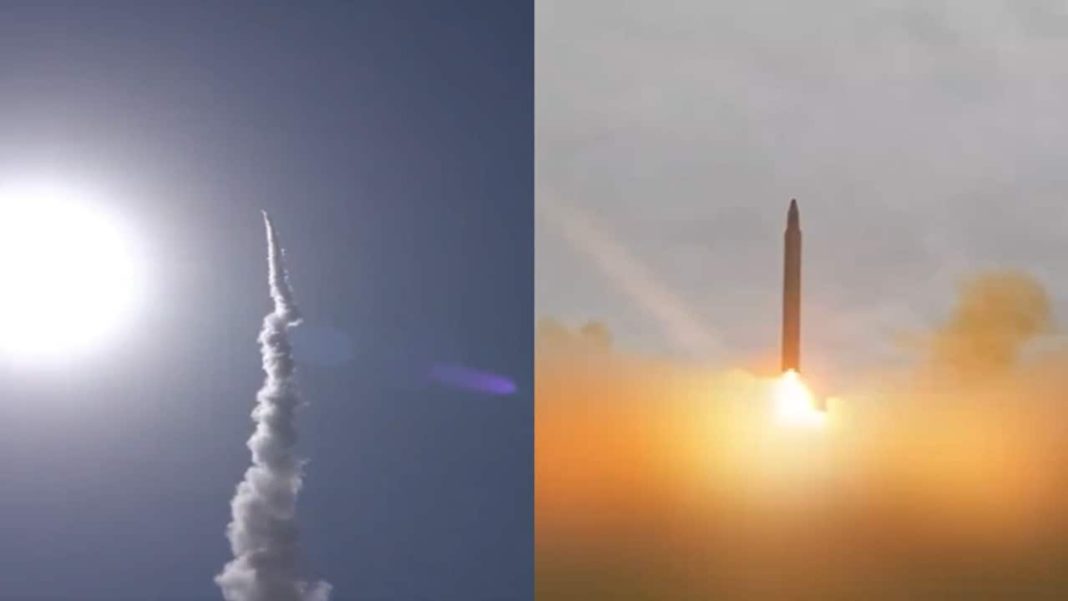
The intricate geopolitical chessboard of West Asia has once again seen a significant move, as reports emerge of Iran’s sophisticated Sejjil missile making its operational debut in recent regional skirmishes. Dubbed the “dancing missile” for its advanced in-flight manoeuvrability, the Sejjil represents a considerable leap in Iran’s strategic capabilities, sending ripples across an already volatile region and prompting observers worldwide, including in India, to carefully assess its implications for stability and power dynamics.
For India, a nation with deep historical, economic, and strategic ties to West Asia, any significant shift in the regional military balance is a matter of close scrutiny. The introduction of such an advanced weapon system by a key player like Iran could recalibrate deterrence calculations, intensify arms races, and potentially exacerbate existing tensions, all of which have direct or indirect consequences for India’s energy security, trade routes, and the well-being of its vast diaspora in the Gulf.
The Sejjil’s Strategic Agility: Unpacking its Capabilities
At the heart of the current discussion is the Sejjil, a two-stage, solid-propellant ballistic missile that stands as a testament to Iran’s indigenous missile development program. What earns it the moniker of the “dancing missile” is its reported ability to perform evasive manoeuvres during its terminal phase, making it significantly harder for conventional missile defence systems to intercept. Unlike older, liquid-fuelled missiles that require extensive pre-launch preparations, making them vulnerable to pre-emptive strikes, the Sejjil’s solid-fuel design allows for rapid deployment and launch, drastically reducing warning times and enhancing its survivability.
The technical specifications of the Sejjil underscore its strategic importance. With an estimated range exceeding 2,000 kilometres, it places a wide arc of the region, including parts of Eastern Europe and US military bases, within its reach. Furthermore, its reported speed, potentially reaching Mach 10 or more, positions it as a near-hypersonic weapon. This combination of speed, range, and evasive capability presents a formidable challenge to existing anti-ballistic missile defence systems, primarily those deployed by the United States and its allies in the region. Its accuracy, enhanced by advanced guidance systems, means it’s not merely a deterrent but a credible strike weapon.
Iran has long viewed its missile program as a cornerstone of its defensive and deterrent strategy, particularly against perceived threats from regional rivals and Western powers. The operational deployment of the Sejjil signifies a maturation of this program, moving from theoretical capability to demonstrated readiness. It enhances Iran’s ability to project power and complicates the strategic calculus of any adversary contemplating military action, potentially forcing a re-evaluation of defensive postures and escalation thresholds.
Redrawing Regional Lines: Implications for West Asia and Beyond
The debut of the Sejjil missile marks a new chapter in West Asia’s already complex security landscape. For countries like Israel, which possesses its own sophisticated missile defence network, and for the United States, which maintains significant military presence in the region, the Sejjil’s capabilities present a heightened challenge. It introduces an element of uncertainty into the effectiveness of existing defence architectures and could prompt a renewed push for more advanced countermeasures, potentially fuelling an arms race.
“This missile represents a significant leap in Iran’s conventional deterrence capabilities, potentially reshaping the regional military balance and forcing a re-evaluation of strategic assumptions,” observed Dr. Anjali Sharma, a New Delhi-based geo-strategic analyst. “For India, maintaining stability in West Asia is paramount. Such advancements necessitate close monitoring, as they can inadvertently impact global energy markets, trade routes vital for our economy, and the safety of our diaspora.”
Beyond the immediate military implications, the Sejjil’s operational status carries significant geopolitical weight. It is a powerful statement of Iran’s technological prowess and its unwavering commitment to bolster its defensive capabilities amidst sanctions and international pressure. This development could embolden Iran in its regional foreign policy, potentially leading to increased assertiveness. Conversely, it could also lead to a hardening of positions from its adversaries, escalating tensions further.
The international community will be closely watching how this development influences ongoing diplomatic efforts in the region. The Sejjil’s emergence adds another layer of complexity to the broader discussions on nuclear non-proliferation and regional arms control. For a globally interconnected world, a more volatile West Asia, especially one equipped with increasingly sophisticated weaponry, poses risks that extend far beyond its borders.
As the “dancing missile” takes its place in the operational theatre, it underscores the dynamic and unpredictable nature of West Asian geopolitics. Its capabilities will undoubtedly be factored into future strategic planning across the region and beyond, necessitating careful diplomatic engagement and continued vigilance to mitigate potential escalations.
The debut of the Sejjil is not just a technological milestone for Iran; it is a significant variable introduced into an already delicate equation, one that demands a nuanced and informed understanding from all stakeholders, including India, navigating its implications for a stable global order.

