


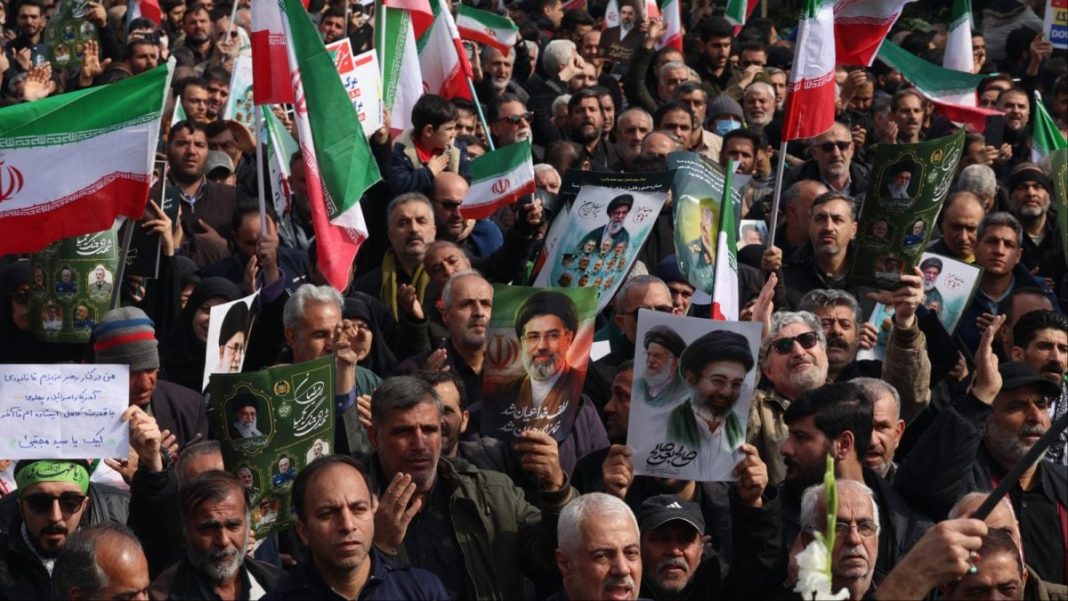
The tragic helicopter crash claiming the lives of Iranian President Ebrahim Raisi and Foreign Minister Hossein Amir-Abdollahian has cast a long shadow over the Islamic Republic, intensifying global scrutiny on its opaque power dynamics. As Iran braces for snap presidential elections and grapples with the void at its top executive tier, whispers of a more profound power shift are growing louder. Central to this evolving narrative are two key elements: the increasingly assertive role of the Islamic Revolutionary Guard Corps (IRGC) and the conspicuous absence from public view of Mojtaba Khamenei, son of the ailing Supreme Leader Ayatollah Ali Khamenei, often considered a potential successor. The confluence of these factors suggests that Iran might be navigating not just a temporary leadership vacuum, but a fundamental realignment of its power structure, with the IRGC tightening its grip.
Post-Raisi Iran: Navigating a Successional Labyrinth
The sudden demise of President Raisi removed a figure widely perceived as a frontrunner for the Supreme Leadership, an office of ultimate authority in Iran. His passing has thrown the intricate succession process into disarray, prompting a scramble within the conservative establishment to identify and consolidate support around new potential candidates. While Iran quickly installed an interim president and announced swift elections, the deeper question of who will eventually succeed the 85-year-old Ayatollah Ali Khamenei remains paramount. The Supreme Leader’s health has been a recurring subject of international speculation, making the succession a matter of pressing national and regional concern. The lack of a clear, universally accepted successor at this juncture amplifies the regime’s inherent vulnerabilities and provides fertile ground for various power blocs to assert their influence.
Mojtaba Khamenei’s Elusive Profile Amidst Speculation
Amidst the national mourning and political ferment, the absence of Mojtaba Khamenei from prominent public events, including President Raisi’s funeral, has fueled intense speculation. Mojtaba, a mid-ranking cleric and a vital behind-the-scenes operator, has long been discussed as a potential successor to his father, despite the Islamic Republic’s historical aversion to dynastic rule. His influence within the Supreme Leader’s office, especially over appointments and key policy decisions, is widely acknowledged. His unusual quietness, particularly during a period of such high political drama and uncertainty, has led observers to ponder various possibilities: is he deliberately maintaining a low profile to avoid appearing opportunistic, or does it signal internal power struggles or even health concerns? Regardless of the reason, his retreat from the public eye only adds another layer of opacity to Iran’s already complex succession calculus, leaving many to wonder about his position in the unfolding power play.
IRGC’s Expanding Domain: From Guardians to Kingmakers?
In this climate of uncertainty, one entity stands out for its growing institutional power: the Islamic Revolutionary Guard Corps. Far more than just a military force, the IRGC is a sprawling empire with significant economic, political, and ideological influence. It controls vast sectors of the Iranian economy, operates parallel intelligence networks, and maintains a profound ideological commitment to safeguarding the principles of the Islamic Revolution. The IRGC has historically played a critical role in times of national crisis, often stepping in to ensure stability and continuity. With the recent presidential vacancy and the looming question of the Supreme Leader’s succession, the IRGC’s leverage is arguably at its zenith.
An astute observer of Iranian politics, Dr. Rohan Gupta, a professor of West Asian Studies at Jawaharlal Nehru University, commented, “The IRGC is not merely a player in Iranian politics; it is increasingly the ultimate arbiter. In moments of leadership transition, their institutional cohesion, vast resources, and ideological commitment make them indispensable. They have the power to shape the succession outcome, directly or indirectly, through their influence on various state organs and and their control over societal discourse.” This statement underscores the IRGC’s pivotal role, not just as a guardian of the revolution, but as a potential kingmaker, capable of influencing who eventually ascends to Iran’s highest offices.
Iran stands at a critical juncture, navigating the immediate challenge of replacing its president while the long-term question of the Supreme Leader’s succession looms large. The intertwined narratives of Mojtaba Khamenei’s enigmatic absence and the IRGC’s undeniable ascendance point towards a period of significant redefinition within the Islamic Republic. Regardless of who eventually occupies the presidential palace or even the exalted office of the Supreme Leader, the IRGC’s enhanced institutional power and its growing influence over the state apparatus appear to be a defining feature of post-Raisi Iran. For regional stability and international relations, understanding these internal shifts is paramount, as they will undoubtedly shape Iran’s trajectory for years to come.

