


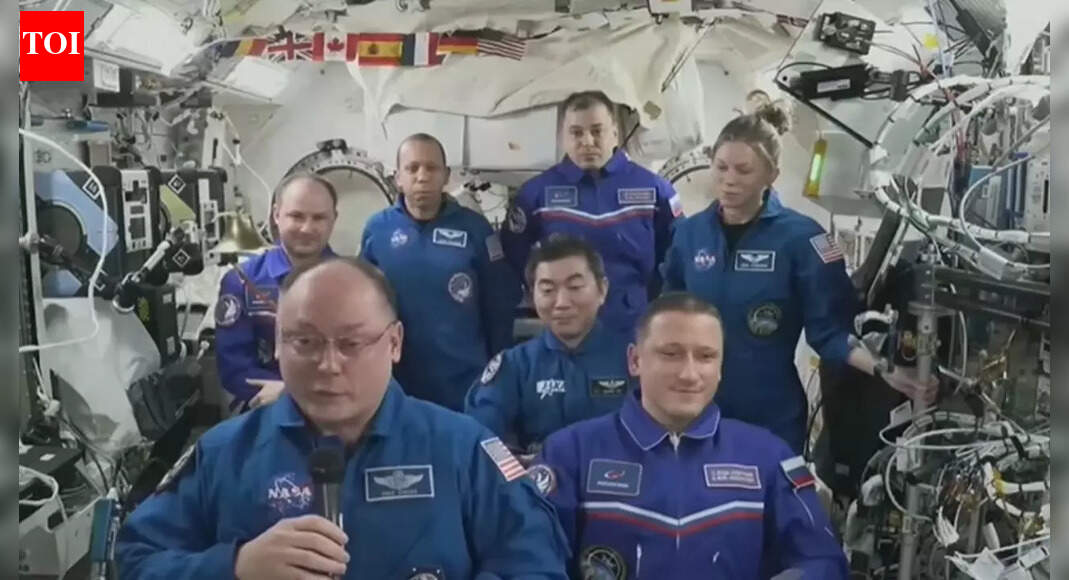
The International Space Station (ISS), a beacon of global scientific collaboration orbiting 400 kilometres above Earth, recently marked a significant transition as it welcomed a new commander. This routine yet crucial change in leadership underscores the continuous human presence in low-Earth orbit and the seamless operational rhythm of humanity’s most ambitious off-world outpost. Veteran Roscosmos cosmonaut Oleg Kononenko officially took the helm, assuming command from European Space Agency (ESA) astronaut Andreas Mogensen.
For over two decades, the ISS has served as a unique laboratory and a symbol of international partnership, bringing together space agencies from the United States, Russia, Europe, Japan, and Canada. Each change of command is more than a mere formality; it represents a transfer of immense responsibility for the safety, well-being, and productivity of the multinational crew, along with the intricate operations of the station itself.
A Seamless Transition of Leadership
The change of command ceremony, a tradition deeply rooted in maritime and aviation practices, saw Andreas Mogensen pass the ‘key’ to the station to Oleg Kononenko. Mogensen, who led Expedition 70 for several months, oversaw numerous scientific experiments, maintained the station’s complex systems, and facilitated the arrival and departure of various cargo and crew vehicles. His tenure highlighted the diverse skill sets and adaptability required for long-duration space missions.
Oleg Kononenko is no stranger to the responsibilities of ISS command. This is his fifth spaceflight and his fourth time commanding the orbital laboratory, making him one of the most experienced cosmonauts in history. His extensive experience brings a steady hand to the station’s operations, ensuring continuity in research and maintenance. Such veteran leadership is vital in an environment where every decision can have profound implications, from routine maintenance to handling unexpected contingencies. The command shift is not just about individuals; it’s a testament to the robust training protocols and the integrated operational frameworks that allow for such smooth transitions among an international crew.
The Commander’s Pivotal Role in Orbit
The ISS commander holds a multifaceted role, acting as the primary decision-maker on board, responsible for the overall morale and safety of the crew, and the execution of the mission’s scientific objectives. This involves coordinating daily schedules, overseeing spacewalks, managing resource allocation, and maintaining open lines of communication with mission control centers spread across the globe. The position demands not only exceptional technical prowess but also strong leadership and interpersonal skills to manage a diverse team living in close quarters for extended periods.
Under Kononenko’s leadership, Expedition 71 will continue its rigorous schedule of scientific research, ranging from biological experiments studying human adaptation to microgravity to material science and Earth observation. These experiments contribute invaluable data that not only prepare humanity for deeper space exploration but also yield practical benefits for life on Earth, addressing challenges in medicine, agriculture, and environmental science. The station also remains a crucial testbed for technologies that will be essential for future lunar and Martian missions.
The seamless functioning of the ISS, despite geopolitical complexities on Earth, is a powerful reminder of what nations can achieve when united by a common scientific purpose. India, with its ambitious Gaganyaan human spaceflight program and growing space capabilities, closely observes these international space endeavors. Such transitions offer critical insights into long-duration mission management, crew psychology, and advanced life support systems – all essential components for future Indian space stations or extended lunar missions.
“The appointment of a new ISS commander underscores the continuous human presence in low-Earth orbit and the critical role of international partnerships,” says Dr. Rohan Gupta, a Bengaluru-based aerospace analyst. “For nations like India, who are charting their own course in human spaceflight with missions like Gaganyaan, observing these transitions offers invaluable insights into long-duration space operations and crew management. It highlights the universal challenges and successes of living and working in space.”
Looking Skyward: The Future of Space Collaboration
As the ISS continues its vital mission, the change of command serves as a powerful metaphor for the ongoing relay race of human space exploration. Each commander and crew builds upon the work of their predecessors, pushing the boundaries of scientific knowledge and technological innovation. The station itself is slated to operate until 2030, after which new commercial space stations are expected to take over, further decentralizing and expanding human presence in low-Earth orbit.
The transition of command is a moment not just of handover, but of renewed commitment to exploration, innovation, and global collaboration. It reaffirms the collective human desire to understand our universe and apply that knowledge for the betterment of all. For India, a nation rapidly advancing its capabilities in space, the ISS and its leadership transitions offer a valuable blueprint for fostering international cooperation and managing complex long-duration missions in the decades to come.

