


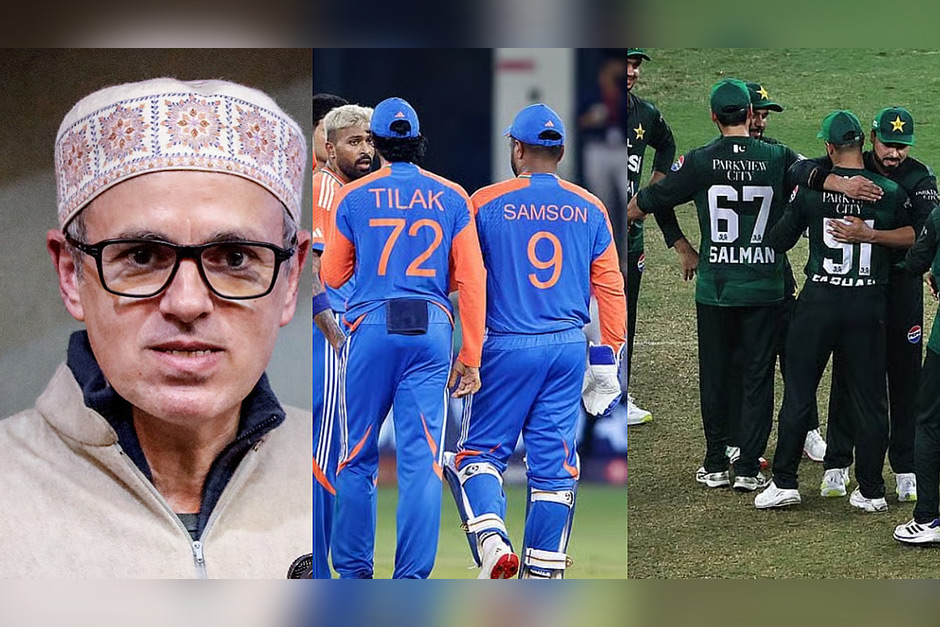
The rivalry between India and Pakistan is one of the most intense and emotionally charged in modern geopolitics, extending beyond borders into the realms of sport, culture, and media. This charged atmosphere has often led to the portrayal of even routine interactions as high-stakes confrontations. It is against this backdrop that former Jammu and Kashmir Chief Minister, Omar Abdullah, made a poignant observation, stating that the dynamic between the two nuclear-armed neighbours is frequently “presented as war.” His remark underscores a critical concern about how public discourse, particularly within media narratives, shapes perceptions and potentially hinders genuine peace efforts between the nations.
The Battleground of Perception: Media and Public Narrative
Abdullah’s statement highlights a pervasive issue: the tendency for media outlets and sections of the political establishment in both countries to frame any interaction between India and Pakistan through the lens of conflict. Whether it’s a cricket match, a diplomatic exchange, or even a cultural event, the competitive spirit often escalates into a rhetoric of rivalry and antagonism. This “war” narrative is deeply rooted in the tumultuous history of partition, multiple conflicts, and ongoing border tensions, particularly concerning Jammu and Kashmir. For many, the very mention of the other nation immediately evokes strong emotional responses, often fuelled by a constant barrage of news and commentary that emphasizes differences over commonalities.
The consequences of such a narrative are far-reaching. It contributes to a climate of jingoism, making it challenging for nuanced discussions about peace, cooperation, or resolution of long-standing disputes to gain traction. Instead, public opinion can become polarized, demanding decisive victory rather than constructive engagement. This phenomenon is particularly evident during high-profile sporting events, where a cricket match transforms into a battle for national honour, complete with military metaphors and thinly veiled hostility. While a healthy rivalry can be exciting, the constant elevation to a state of war can be detrimental to fostering any semblance of regional stability or people-to-people connections.
Omar Abdullah’s Critique: A Call for Sober Reflection
As a seasoned politician from Jammu and Kashmir, a region historically central to India-Pakistan tensions, Omar Abdullah’s perspective carries significant weight. His observation is not merely an offhand remark but a reflection on the lived reality of many in the subcontinent, especially those who bear the direct brunt of hostilities. Abdullah’s point is that this manufactured animosity often overshadows the complex socio-economic and political realities that demand pragmatic solutions rather than emotional grandstanding. He suggests that by consistently presenting the relationship as a zero-sum game or a perpetual conflict, critical space for diplomacy and understanding is eroded.
Abdullah has often been vocal about the need for de-escalation and dialogue. His words serve as a crucial reminder to stakeholders, including political leaders, media houses, and the general public, about the responsibility that comes with shaping national narratives. “We need to move beyond this constant framing of our relationship as a state of war,” Abdullah might argue. “It is counterproductive, creates unnecessary fear, and ultimately harms the prospects for a stable, prosperous future for both nations. There is a vast difference between competition and conflict, and we must learn to distinguish between the two.” This perspective advocates for a more mature and responsible approach, one that acknowledges historical grievances but actively seeks avenues for reconciliation and mutual respect.
Beyond the Headlines: Envisioning a Different Narrative
The challenge lies in consciously shifting away from the ingrained “war” narrative towards one that embraces complexity and promotes constructive engagement. This requires a concerted effort from various quarters. Media organizations have a powerful role to play in presenting balanced reports, offering diverse perspectives, and resisting the urge to sensationalize every development. Political leadership in both countries must demonstrate a willingness to engage in dialogue, even in the face of setbacks, and to temper rhetoric that fuels animosity. Furthermore, civil society, cultural exchanges, and people-to-people initiatives can help bridge divides by fostering a deeper understanding of shared heritage and common aspirations.
While the historical baggage is immense, and genuine security concerns persist, the constant portrayal of India and Pakistan as perpetual enemies locked in an ideological battle does a disservice to the vast majority of citizens who yearn for peace and stability. Omar Abdullah’s insight is a powerful call to examine the narratives we consume and propagate. It urges a shift from a jingoistic, confrontational stance to one that prioritizes diplomacy, empathy, and the pursuit of shared progress. Ultimately, acknowledging the humanity on both sides of the border, and recognizing that competition does not equate to perpetual conflict, is the first step towards building a more hopeful future for the subcontinent.

