


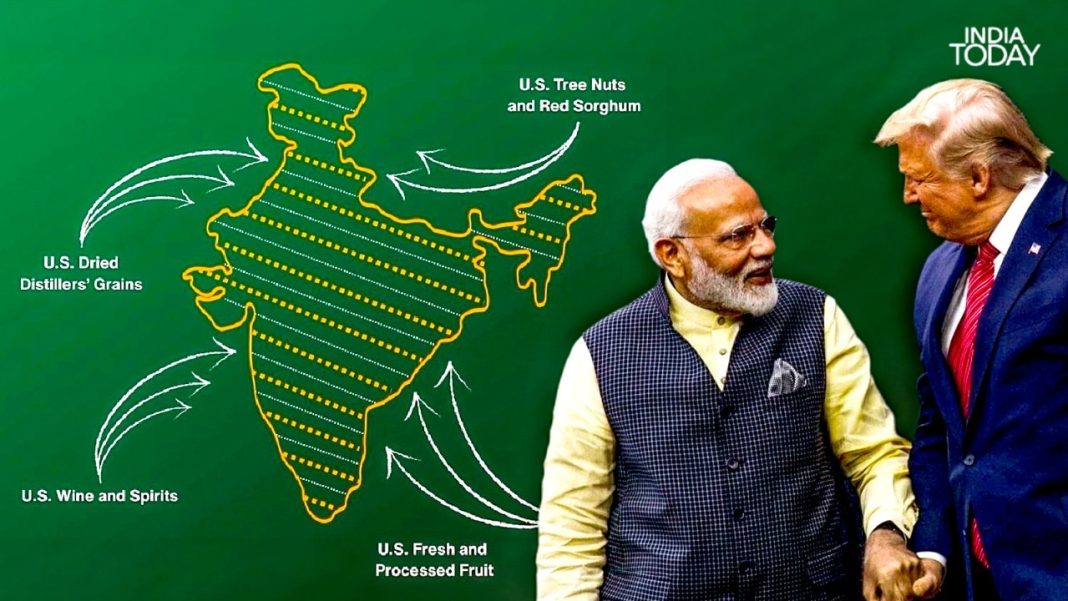
The strategic partnership between India and the United States has deepened considerably in recent years, encompassing areas from defence and technology to counter-terrorism and climate change. Economic ties, particularly trade, form a crucial pillar of this relationship, with both nations actively negotiating a comprehensive trade deal aimed at fostering greater market access and resolving long-standing issues. However, the path to a seamless partnership is often fraught with diplomatic nuances, and a recent incident involving a map shared by a U.S. government entity has brought these complexities to the forefront, stirring debate and concern within India.
The Cartographic Controversy Unpacked
The incident in question arose when a map, reportedly accompanying a U.S. trade-related document or report, depicted India’s geographical boundaries in a manner inconsistent with New Delhi’s official stance. Specifically, the map is said to have shown Pakistan-occupied Kashmir (PoK) as separated from India by a dashed line, implying a disputed territory, and Aksai Chin as part of China. This cartographic representation immediately drew sharp reactions in India, where both PoK and Aksai Chin are unequivocally considered integral parts of the Indian Union.
For India, the territorial integrity of Jammu and Kashmir, and by extension, Ladakh (which includes Aksai Chin), is a non-negotiable principle. PoK, administered by Pakistan but claimed by India, and Aksai Chin, administered by China but claimed by India, are deeply sensitive subjects. India’s official maps consistently show these regions as part of its sovereign territory. The U.S. map, by diverging from this established Indian position, inadvertently touched upon a raw nerve, raising questions about Washington’s understanding or official policy regarding these disputed regions.
Such cartographic misrepresentations, whether intentional or accidental, have historically been a point of contention in India’s foreign relations. They are often seen by New Delhi as a subtle but significant challenge to its sovereignty and territorial claims. The timing of this particular incident, amidst ongoing high-stakes trade negotiations, only amplified its impact, adding an unexpected layer of complexity to the bilateral dialogue.
Geopolitical Implications Amidst Bilateral Ties
The India-U.S. relationship is arguably one of the most vital global partnerships of the 21st century. Both nations share democratic values and increasingly aligned strategic interests, particularly concerning regional stability and countering growing assertiveness in the Indo-Pacific. Trade, an essential component, is seen as a means to further solidify these ties, boost economic growth, and create employment.
However, incidents like the map controversy underscore the delicate balance required in managing such a multifaceted relationship. While U.S. official policy has generally acknowledged India’s concerns regarding the Line of Control (LoC) and the Line of Actual Control (LAC), a nuanced stance on disputed territories has sometimes led to such cartographic ambiguities. From India’s perspective, any depiction that deviates from its sovereign claims can be interpreted as a lack of clear support or, worse, an implicit endorsement of rival claims.
Diplomatic circles in New Delhi would undoubtedly view this as an opportunity to reiterate India’s unwavering position. As a seasoned observer of India-U.S. relations, Dr. Meenakshi Aiyar, a geopolitical analyst, commented, “For India, territorial integrity is sacrosanct and not merely a cartographic detail. Any perceived ambiguity from a strategic partner, especially one with whom we are forging closer ties, naturally raises concerns and warrants clarification. It highlights the depth of sensitivity surrounding these historical claims.” This sentiment reflects the broader Indian expectation that strategic allies should respect its core sovereign principles without reservation.
Navigating the Trade Deal and Beyond
The immediate question stemming from this map controversy is its potential impact on the ongoing India-U.S. trade deal negotiations. While such incidents can certainly inject a degree of friction, it is unlikely to entirely derail the broader trade discussions. Both countries have invested significant diplomatic capital in strengthening their economic partnership, recognizing the mutual benefits it offers.
However, the incident could prompt India to seek formal clarification or even a correction from the U.S. side. New Delhi might leverage this moment to re-emphasize the importance of respecting its territorial claims in all official communications and representations. It serves as a reminder that while the overarching strategic interests align, attention to detail and sensitivity to national sentiments remain paramount in fostering true trust and cooperation.
Ultimately, the map controversy serves as a valuable lesson in the complexities of international diplomacy. It highlights that even seemingly minor details can carry significant symbolic and political weight, especially when dealing with issues of national sovereignty. For the India-U.S. trade deal to progress smoothly and for the broader partnership to flourish, both nations must continue to engage with mutual respect, understanding, and a clear recognition of each other’s core national interests and sensitivities.
The incident, while a hiccup, underscores the ongoing need for precise and respectful communication as India and the U.S. navigate their strategically important relationship toward a more robust and integrated future.

