


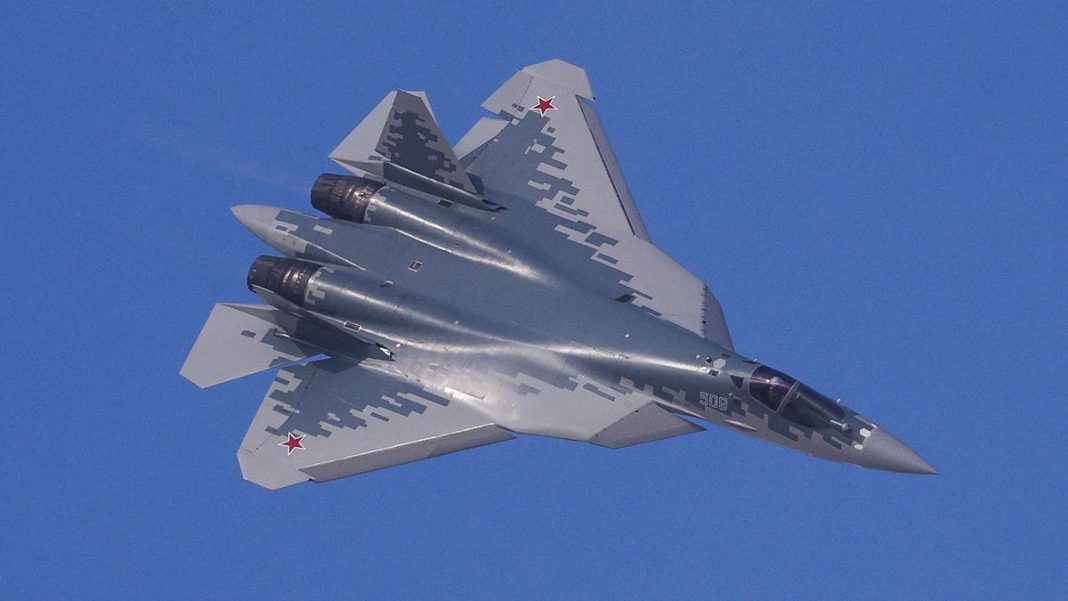
For decades, Russia has stood as India’s foundational defence partner, a relationship forged in the crucible of geopolitical necessity. From fighter jets to submarines, Russian military hardware has formed the backbone of India’s armed forces. However, recent overtures from Moscow, pushing for sales of its advanced Su-57 stealth fighter, long-range drones, and next-generation submarines, have met with a noticeably lukewarm reception from New Delhi.
This shift underscores a profound evolution in India’s strategic defence procurement, marked by a determined pursuit of diversification, technological self-reliance, and a meticulous evaluation of global offerings. The era of unquestioning allegiance to a single defence supplier appears to be steadily receding into history, replaced by a pragmatic approach focused on future-proofing its military capabilities.
The Lure of Fifth-Gen: Su-57 and India’s Airpower Ambitions
Russia’s re-pitch of its Sukhoi Su-57 Felon fifth-generation fighter jet to India represents a persistent effort to rekindle a once-promising collaboration. India’s previous involvement in the joint Fifth Generation Fighter Aircraft (FGFA) program, a derivative of the Su-57, ended in 2018 amid concerns over its stealth capabilities, modular engine design, and overall project delays. Today, India’s airpower strategy is charting a significantly different course.
The Indian Air Force (IAF) has already invested heavily in French Rafale jets and is aggressively pursuing its indigenous Advanced Medium Combat Aircraft (AMCA) project, envisioned as India’s own stealth fighter. With design work progressing and prototypes expected in the coming years, the AMCA is a cornerstone of India’s ‘Aatmanirbhar Bharat’ (self-reliant India) initiative in defence. While the Su-57 undoubtedly boasts advanced avionics and impressive maneuverability, India’s current calculus prioritizes proven stealth, advanced sensor fusion, and the ability to integrate seamlessly with its evolving network-centric warfare architecture. Doubts about the Su-57’s operational readiness and the depth of technology transfer on offer also temper enthusiasm. The geopolitical landscape, too, plays a role, with India increasingly looking towards Western partners for cutting-edge platforms that offer more reliable supply chains and interoperability with emerging strategic alignments.
Evolving Naval and Drone Strategies: Beyond Traditional Partnerships
The Russian push extends beyond air superiority to crucial maritime and aerial reconnaissance assets. Moscow has been keen to offer its long-range Unmanned Aerial Vehicles (UAVs) and advanced conventional submarines, including upgrades to India’s aging Kilo-class fleet and new Project 636 Varshavyanka submarines. However, India’s naval and drone procurement strategies have also undergone significant recalibration.
For long-range drones, India has largely gravitated towards Western options, notably the procurement of MQ-9B SeaGuardian (Predator B) drones from the United States. These High Altitude Long Endurance (HALE) platforms offer superior endurance, payload capacity, and proven operational efficacy, critical for monitoring India’s vast maritime borders and land frontiers. India is also investing substantially in its domestic drone ecosystem, aiming for self-sufficiency in various UAV categories, thereby reducing external dependencies.
Similarly, in submarine acquisition, the emphasis has shifted towards indigenous development and diversified international partnerships. India’s ambitious Project 75I seeks to build six advanced conventional submarines with Air Independent Propulsion (AIP) technology, a crucial feature for extended underwater endurance. While Russia remains a contender, European giants like Naval Group (France) and ThyssenKrupp Marine Systems (Germany) are actively vying for the contract, offering advanced AIP technologies and deeper levels of co-production. Furthermore, India’s strategic focus on its own nuclear submarine program, the Arihant-class, signals a long-term vision of strategic independence in underwater warfare, moving beyond mere procurement to genuine design and manufacturing capability.
“India’s defence strategy is no longer about singular dependencies but about strategic autonomy and technological diversification,” notes Dr. Rajeshwari Pillai Rajagopalan, a distinguished New Delhi-based defence analyst, highlighting the pragmatic pivot in India’s procurement philosophy.
India’s measured response to Russia’s latest defence offers is not a repudiation of a long-standing friendship but rather a reflection of its evolving strategic priorities. The focus has firmly shifted towards bolstering indigenous capabilities under the ‘Make in India’ initiative, diversifying its defence import basket to mitigate risks, and acquiring the most advanced and proven technologies available globally, irrespective of their origin. While Russia will undoubtedly remain a significant partner, particularly for maintenance and upgrades of legacy systems, India’s future defence landscape will increasingly be characterized by greater self-reliance and a nuanced, multi-faceted approach to security, ensuring its strategic interests are met with the best possible assets from a wider array of global partners.

