


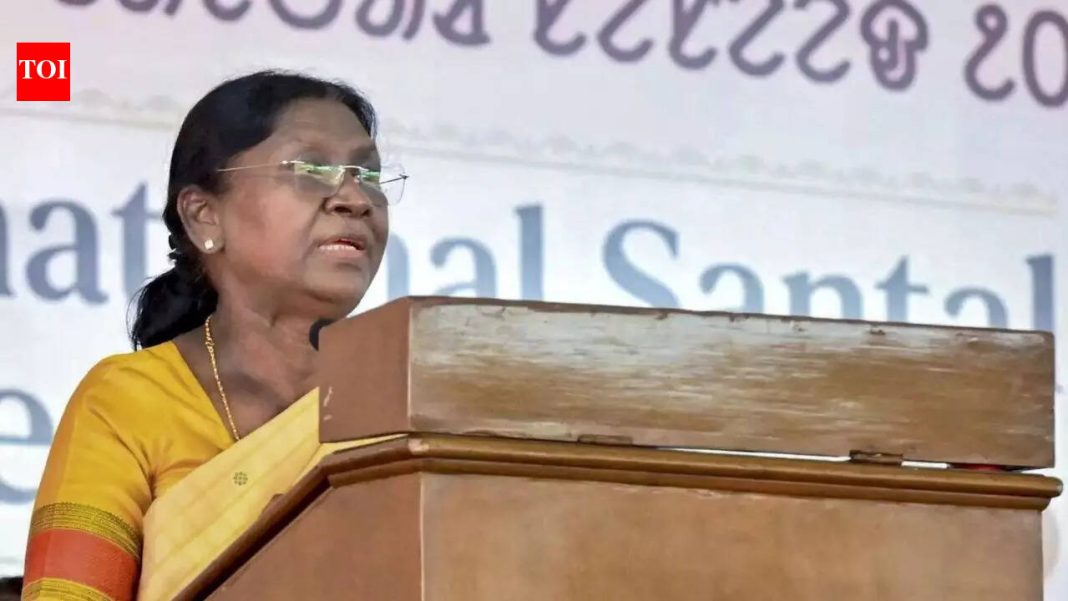
President Droupadi Murmu, India’s first tribal President and a distinguished member of the Santhal community, recently voiced her profound disappointment regarding the West Bengal government’s allocation of a smaller-than-expected venue for a significant Santhal literary and cultural event. Her candid remarks, made during her visit to Bolpur in Birbhum district, have drawn considerable attention, underscoring the delicate balance between cultural recognition and governmental support for indigenous communities.
President Expresses Disappointment Over Santhal Event Venue
The incident unfolded during President Murmu’s itinerary in West Bengal, where she was invited to attend the 36th annual conference of the Adivasi Santhal Writers’ Association. This event, a crucial gathering for the promotion and preservation of Santhal language and culture, was scheduled to take place in the Santiniketan area, a region historically associated with cultural and intellectual pursuits. However, upon observing the arrangements, the President openly expressed her sadness, implying that the provided venue did not meet the expectations commensurate with a presidential visit and the significance of the Santhal cultural congregation.
Addressing the attendees, President Murmu stated, “I’m very sad. When I first heard that I will be visiting Shantiniketan, I was very happy… I was going to attend the Santhal Sahitya Sabha. I thought that a grand stage would be prepared. But I’m very sad to see this stage.” Her words, delivered with evident emotion, highlighted a perceived inadequacy in the arrangements made by the state administration. While the specific details of the venue’s size or facilities were not elaborated upon, her statement indicated that it fell short of the dignity and scale she anticipated for an event dedicated to a vibrant tribal literary tradition, particularly one she was personally gracing as the Head of State.
The President’s remarks implicitly placed the onus on the West Bengal government, responsible for the logistical arrangements for such high-profile events. Coming from a President who often champions tribal rights and cultural preservation, her expression of sadness serves as a powerful, albeit subtle, critique of the state’s handling of an important tribal cultural initiative.
Cultural Significance and Presidential Advocacy
President Droupadi Murmu’s connection to the Santhal community is central to understanding the weight of her words. As a Santhal herself, her ascension to the highest office in India was a historic moment, symbolizing a broader recognition of India’s diverse tribal heritage. Her public disappointment over the venue choice transcends mere logistical concerns; it resonates deeply with the aspirations and struggles of tribal communities for recognition, respect, and adequate support for their cultural expressions.
The Santhal language, with its unique Ol Chiki script, is one of the 22 languages recognized in the Eighth Schedule of the Indian Constitution. Events like the Adivasi Santhal Writers’ Association’s conference are vital platforms for fostering the language, promoting literature, and celebrating the rich cultural tapestry of the Santhal people. When the President of India, a Santhal herself, expresses concern over the treatment of such an event, it elevates the issue beyond a local administrative matter to a national discourse on tribal cultural preservation and the government’s role in facilitating it.
Her statement can be seen as an act of advocacy, using her powerful position to draw attention to the need for greater sensitivity and more robust support for indigenous cultural initiatives. It reinforces the idea that cultural events of tribal communities should be accorded the same prominence and resources as other mainstream cultural gatherings, especially when a dignitary of the President’s stature is involved.
Implications for Tribal Recognition and State Engagement
President Murmu’s public objection has stirred a conversation about how state governments perceive and support tribal cultural events. Her remarks, while apolitical in their framing, carry significant symbolic implications, particularly in a state like West Bengal, which has a substantial tribal population and a complex political landscape.
The incident serves as a stark reminder to all levels of administration about the importance of being culturally sensitive and proactively supportive of tribal heritage. For the Santhal community, and indeed for other tribal groups across India, the President’s words validate their desire for their culture to be celebrated with appropriate dignity and resources. It underscores that recognition should not merely be symbolic but translate into tangible support and infrastructure for cultural preservation and promotion efforts.
Ultimately, President Murmu’s expression of sadness is a call for greater introspection into the mechanisms of state engagement with tribal communities. It highlights the need for governments to ensure that cultural events, particularly those involving the Head of State and vital indigenous traditions, are organized with the utmost care, respect, and provision of facilities that truly reflect their significance.
President Droupadi Murmu’s candid “I’m very sad” statement concerning the venue for the Santhal literary event is more than a comment on logistics; it’s a powerful message. It underscores the ongoing need for enhanced recognition, respect, and adequate governmental support for tribal cultural initiatives across India. Her voice, as the first tribal President, lends immense weight to this imperative, urging state administrations to approach such cultural engagements with heightened sensitivity and a profound understanding of their significance.

