


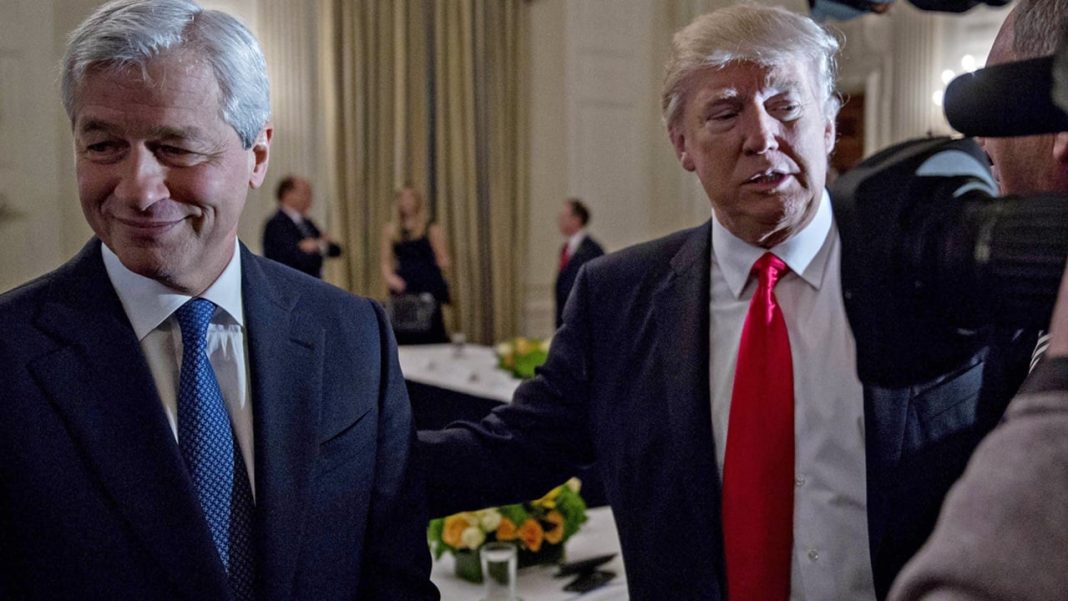
In a dramatic escalation of rhetoric, former US President Donald Trump has publicly threatened to sue JPMorgan Chase and its chief executive, Jamie Dimon, accusing the banking giant of politically motivated “debanking.” The extraordinary declaration, made during a campaign rally, shines a harsh spotlight on the contentious issue of financial institutions’ power to close accounts and the volatile intersection of corporate decisions with high-stakes politics.
Trump’s remarks specifically targeted Dimon, who recently made comments at the World Economic Forum in Davos, where he suggested that he might not use the term “deplorable” to describe Trump’s supporters, a word famously used by Hillary Clinton in 2016. While Dimon’s recent statements appeared to soften his stance on Trump and his base, the former president interpreted them not as a genuine shift, but as a calculated move to salvage his reputation after what Trump claims was JPMorgan’s previous efforts to “debank” his associates for political reasons. This perceived hypocrisy has fueled Trump’s ire, leading to the highly publicised threat.
The Allegations and the Retort: A Battle of Giants
The crux of Trump’s accusation rests on the claim that JPMorgan, under Dimon’s leadership, had previously closed accounts belonging to individuals or entities associated with him, allegedly due to their political affiliations. While specific details or widespread evidence of JPMorgan directly “debanking” Trump-related entities solely for political reasons remain largely unsubstantiated in public record, the former president’s claims tap into a broader narrative of financial institutions wielding their power to influence political outcomes or punish adversaries.
Jamie Dimon has historically been a critic of Trump, though his recent comments in Davos represented a more conciliatory tone. He stated, “I just want to be careful. They’re not deplorable, and they’re voting for Trump because they’re unhappy about something. They feel left out.” This nuanced view, however, did little to appease Trump, who viewed it as disingenuous. Trump’s immediate retort was sharp: “I’ll sue Jamie Dimon… Because he’s a wise guy. Because he was trying to curry favour. He got caught.” This direct personal challenge to one of America’s most prominent bankers highlights the deep personal animosity often characteristic of Trump’s political battles.
Debanking: A Global Conundrum with Political Overtones
The phenomenon of “debanking” — where banks close accounts of individuals or businesses — is a growing concern globally, extending far beyond the realm of US politics. Financial institutions often cite compliance with anti-money laundering (AML), counter-terrorist financing (CTF) regulations, or managing reputational risk as reasons for such actions. However, critics argue that these regulations, while necessary, can sometimes lead to arbitrary decisions, particularly affecting politically exposed persons (PEPs), certain industries, or even individuals whose views are deemed controversial.
In countries like India, the issue of banks exercising discretion in client relationships, often influenced by regulatory pressure or perceived risk, is also a topic of debate. While the context differs significantly, the broader principle of financial institutions deciding who gets access to essential banking services and the potential for these decisions to be politicised resonates. Trump’s leveraging of the “debanking” narrative adds a potent political dimension, framing it as an attack on his movement and an example of corporate overreach against free speech and political association.
Implications for Corporate Power and Political Accountability
Donald Trump’s threat against JPMorgan and Jamie Dimon is more than just another salvo in a contentious political campaign; it underscores a growing tension between immense corporate power and the demands of political accountability. Should Trump pursue legal action, it would set a precedent for how former political leaders can challenge financial institutions for actions they perceive as politically motivated. Such a battle would undoubtedly be protracted and highly publicised, potentially forcing banks to re-evaluate their criteria for account management, especially concerning high-profile clients and political figures.
For observers, this episode highlights the delicate balance financial institutions must strike between regulatory compliance, risk management, and maintaining political neutrality. In an increasingly polarised world, the decisions of major banks are scrutinised not just for their financial implications but also for their perceived political leanings. As the 2024 US election draws closer, this saga serves as a potent reminder that the intersection of finance and politics remains a highly combustible arena.

