


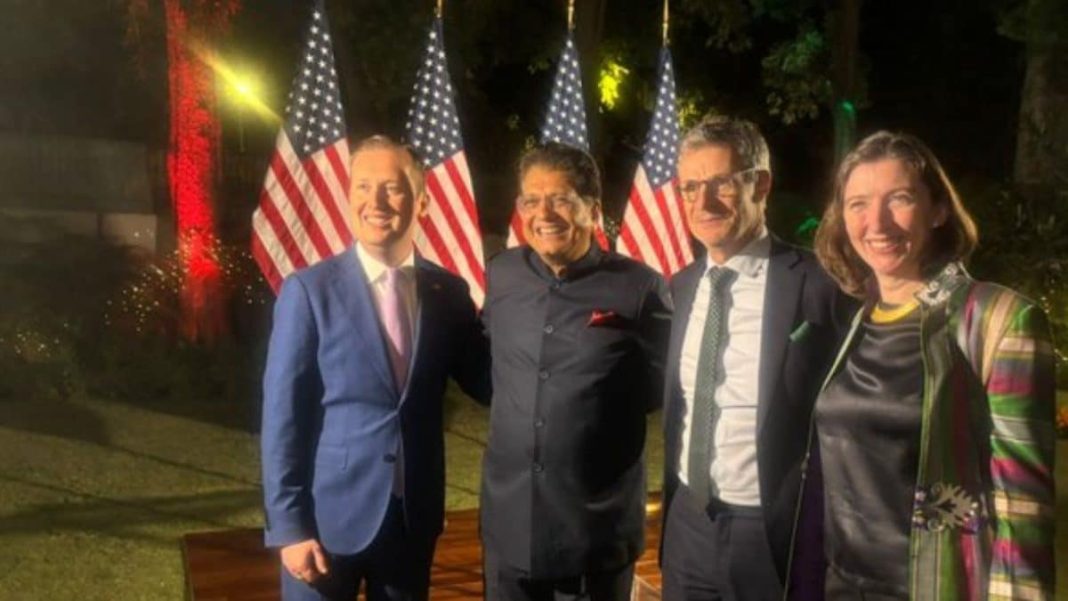
In the high-stakes arena of international trade and diplomacy, a well-timed quip can often cut through the formality, adding a touch of humour and relatability to serious discussions. Union Minister Piyush Goyal, known for his articulate and often witty remarks, recently delivered such a moment, drawing amusement from American political strategist Sergio Gor with a cricket-themed analogy. This light-hearted exchange, centred on the critical issue of tariffs, offers a glimpse into the dynamic and evolving trade relationship between India and the United States, underscored by India’s deep-rooted passion for cricket.
The Witty Quip and its Diplomatic Resonance
The interaction, which quickly garnered attention across business and diplomatic circles, unfolded during a recent engagement aimed at fostering stronger economic ties between India and the US. Piyush Goyal, India’s Minister of Commerce and Industry, Consumer Affairs, Food & Public Distribution, and Textiles, was addressing a gathering when he playfully linked India’s cricketing prowess to the complex dynamics of trade tariffs. The specific context revolved around discussions concerning market access and the reduction of trade barriers between the two nations.
With characteristic charm, Goyal remarked to Sergio Gor, a prominent figure in American political strategy and media, “If you’d zero tariffs, US would’ve won India match.” This statement, delivered with a smile, instantly brought a wave of amusement. The quip cleverly encapsulated India’s position on trade barriers, suggesting that a more liberal approach to tariffs from the American side could significantly alter the ‘score’ in the bilateral economic ‘match’. It was a moment that not only highlighted a key economic point but also showcased the minister’s ability to engage with international counterparts on a personal, relatable level.
Sergio Gor, an American political commentator and strategist, known for his work in US politics and media, clearly appreciated the humour. His amusement underscored the success of Goyal’s diplomatic play – using a widely loved sport in India to make a serious point about economic policy, thereby softening potential friction and building rapport. The comment, while a jest, subtly conveyed India’s keen interest in achieving equitable and mutually beneficial trade agreements, particularly concerning tariff reductions that could boost Indian exports to the US.
Cricket as a Diplomatic Lever: Bridging Cultures and Commerce
The use of cricket in diplomatic discourse, especially by an Indian minister, is far from incidental. Cricket is more than just a sport in India; it is a national obsession, a cultural touchstone that unites millions. By invoking a cricket match, Minister Goyal tapped into a shared national sentiment, making his point instantly understandable and memorable within the Indian context, even as it transcended cultural boundaries to amuse an American dignitary. This approach serves multiple purposes:
- Humanizing Diplomacy: It breaks down rigid formalities, fostering a more relaxed and open environment for dialogue.
- Relatability: For an Indian audience, the analogy instantly resonates, explaining complex trade issues through a familiar lens.
- Subtle Persuasion: It allows for the gentle articulation of a negotiating position without sounding overtly confrontational, paving the way for further discussion.
The underlying message of Goyal’s quip points to ongoing efforts by both nations to navigate their trade relationship. While India and the US are strategic partners with growing trade volumes, areas of contention, particularly regarding tariffs on certain goods, persist. India has often advocated for lower tariffs from the US on products like textiles, agricultural goods, and steel, while the US has expressed concerns over India’s import duties on items like Harley-Davidson motorcycles and medical devices. Goyal’s remark, therefore, was a witty reminder that mutual concessions, particularly on tariffs, are vital for both nations to achieve their full economic potential and perhaps, in a metaphorical sense, “win” together.
The India-US Economic Partnership: A Strategic Imperative
Beyond the humour, this interaction underscores the strategic importance of the India-US economic partnership. Both nations recognise the immense potential for growth, collaboration, and mutual benefit. India seeks greater access to the vast American market for its burgeoning industries, while the US views India as a critical partner in global supply chains, a significant market for its goods and services, and a key player in its Indo-Pacific strategy. Discussions around tariffs and market access are central to unlocking this potential, moving towards a trade relationship that is not just substantial but also balanced and fair.
The dialogue between leaders like Piyush Goyal and influential figures like Sergio Gor, even when punctuated by light-hearted banter, signifies a deeper commitment to fostering robust bilateral ties. Such exchanges help build personal connections and trust, which are invaluable assets in complex trade negotiations. As both nations continue to navigate global economic shifts and geopolitical complexities, the ability to communicate openly, even humorously, about sensitive issues like tariffs, remains a cornerstone of a strong and resilient partnership.
Piyush Goyal’s cricket quip was more than just a witty aside; it was a testament to the dynamic nature of international diplomacy and the enduring power of cultural references to bridge divides. It highlighted India’s strategic push for tariff rationalisation while playfully acknowledging the competitive spirit inherent in both cricket and global commerce. As India and the US look to deepen their economic engagement, such moments of candour and shared laughter pave the way for more constructive dialogue and ultimately, a stronger partnership that benefits both nations.

