


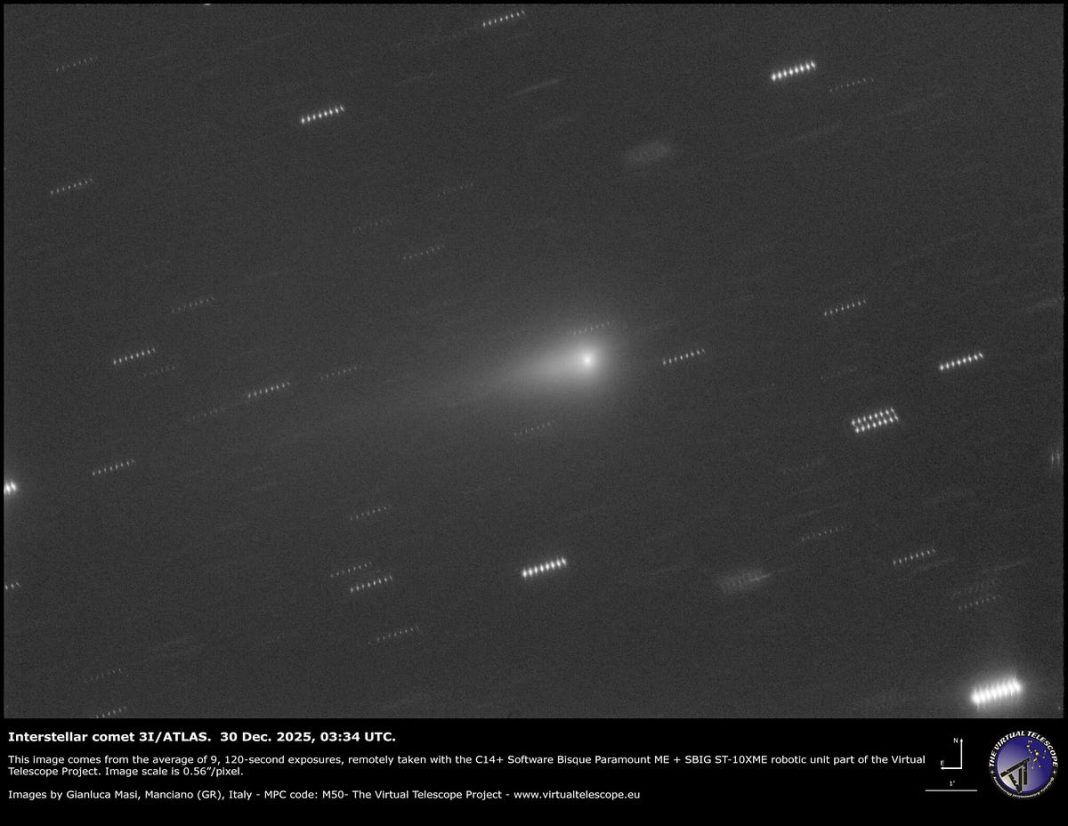
The universe often serves up mysteries, from distant quasars to the everyday phenomenon of a comet streaking across the night sky. When Comet 3I/ATLAS made headlines, it was largely for its unusual characteristics, not for becoming a subject of intrigue involving intelligence agencies. Yet, the internet buzzes with questions about why the CIA would issue a “neither deny nor confirm” response regarding records about what appears to be, at its core, simply a comet. Let’s explore the possible layers behind such a seemingly enigmatic stance.
The ‘Glomar Response’: A Tool of Strategic Ambiguity
The phrase “neither confirm nor deny” is a hallmark of intelligence agencies, famously known as the “Glomar Response.” Its origin traces back to a 1970s incident involving the Hughes Glomar Explorer, a ship ostensibly built for deep-sea mining but secretly tasked by the CIA to recover a sunken Soviet submarine. When asked about its true purpose, the CIA invoked this response, not to hide the fact that they didn’t have records, but to avoid confirming or denying the existence of such a mission.
The core principle here is that acknowledging whether records exist about a particular topic can, in itself, reveal sensitive information. Even a denial could be revealing. For instance, if the CIA denied having records on 3I/ATLAS, it might indirectly signal what they do track. If they confirmed, it would raise questions about why they track it, potentially exposing methods, sources, or operational interests.
As one observer put it, “It’s not about the comet itself; it’s about the precedent. If they confirm or deny one seemingly innocuous thing, where does it end? They’d be forced to set a pattern they can’t maintain for genuinely sensitive matters.” The Glomar Response, therefore, is a blanket policy designed to protect national security interests by maintaining a consistent level of strategic ambiguity, regardless of the apparent innocence of the subject matter.
Beyond the Comet: Why Space Objects Can Touch Intelligence
Even if 3I/ATLAS is undeniably a comet, it doesn’t automatically mean it’s entirely outside the realm of intelligence interest, albeit indirectly. Government agencies, including those with intelligence mandates, do maintain an active interest in space situational awareness. This involves tracking objects in orbit, identifying potential threats (from space debris to adversary satellites), and understanding the broader space environment.
While a comet poses no direct military threat, its observation might overlap with existing surveillance systems or intelligence collection platforms. For example:
- Observational Overlap: Intelligence assets designed to monitor Earth orbit or distant space for other purposes might incidentally capture data on a comet. The existence of these assets or their capabilities could be sensitive.
- Interagency Information Sharing: The CIA might receive information about celestial objects from other scientific or defense agencies (like NASA or the Department of Defense) that do routinely track such phenomena. Acknowledging these records could reveal partnerships or information-sharing protocols.
- Technological Implications: The ability to track and characterize objects in space, even comets, showcases technological capabilities. Confirming or denying records could reveal the sophistication of a nation’s space monitoring or intelligence-gathering prowess.
In essence, the “neither confirm nor deny” response might not be about 3I/ATLAS being something other than a comet, but rather about protecting the methods, systems, or interagency relationships that might have incidentally encountered or stored information about it. The comet itself might be mundane, but the intelligence apparatus around it is not.
Conclusion
The CIA’s “neither confirm nor deny” response regarding Comet 3I/ATLAS, while sparking curiosity, is a standard tool in their operational playbook. It’s less about the specific object in question and more about preserving the integrity of intelligence operations, methods, and partnerships. Rather than indicating a hidden agenda concerning the comet itself, it likely reflects a broader policy designed to prevent any acknowledgment, positive or negative, from inadvertently revealing sensitive information about the agency’s capabilities or activities. In the world of intelligence, sometimes the most telling answer is no answer at all.

