


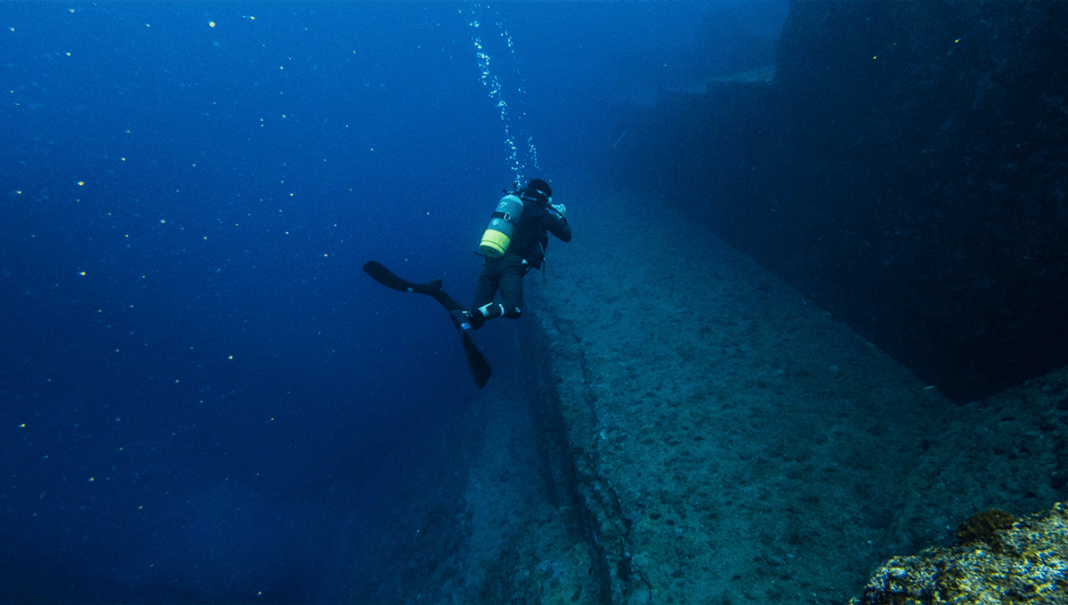
Yonaguni’s Underwater Mystery: A Natural Wonder, Not Human-Made?
Off the coast of Yonaguni Island, Japan, lies a submerged geological formation that has fascinated divers, scientists, and enthusiasts for decades. Often referred to as the “Yonaguni Monument,” this immense structure rests at depths of 5 to 40 meters, showcasing what appear to be incredibly precise angles, flat surfaces, and terraced steps. Its striking appearance has fueled a captivating debate: is it a relic of an ancient, lost civilization, or an extraordinary example of nature’s artistry?
The Allure of Ancient Architectures
It’s easy to see why many observers are quick to attribute the Yonaguni structures to human hands. The formation’s most distinctive features include what look like giant staircases, straight edges, and sharp right-angle corners. There are even formations resembling a pyramid, a stadium, and carved animal figures. These characteristics evoke images of monumental architecture, prompting tantalizing questions about sophisticated cultures existing thousands of years ago, perhaps even before the last ice age, that might have built such an impressive underwater city.
The sheer scale and geometric precision perceived in these formations defy our typical understanding of natural erosion. For many, the idea of an advanced civilization, now lost to the depths, adds an irresistible layer of mystery, making the site a pilgrimage for those who believe in forgotten histories and undiscovered wonders.
Geological Explanations Take Shape
Despite the powerful allure of an ancient city, a consensus among geologists suggests a different origin for the Yonaguni structures: nature itself. The primary rock type at the site is sandstone, which is known for its propensity to fracture in predictable, straight lines due to natural geological processes. Over immense spans of time, tectonic activity and the relentless forces of erosion by waves and currents can sculpt sedimentary rocks in remarkably organized patterns.
Geologists point to natural phenomena such as parallel jointing, where fractures form in layers, creating sharp edges and flat surfaces that mimic human masonry. Bedding planes, which are the boundaries between layers of sedimentary rock, can also create horizontal “steps” or terraces. “Geological processes, especially in sedimentary rocks like sandstone, can produce remarkably straight lines and sharp angles through jointing and erosion,” explains Dr. Arisato, a marine geologist who has studied similar formations. “What looks like a monumental staircase to the untrained eye is often the work of millennia of water and tectonic stress acting upon the rock’s inherent weaknesses.” Furthermore, natural erosion can carve out concave and convex shapes, leading to features that resemble arches or platforms.
The Absence of Definitive Human Imprints
Another compelling argument for a natural origin lies in the lack of definitive evidence of human intervention. While the formations are visually striking, scientific expeditions have yet to uncover any tools, carvings, inscriptions, or other artifacts that would unequivocally confirm human modification. There are no consistent tool marks, no traces of mortar, and no coherent layout suggesting deliberate construction in the way an actual city or monument would be built. The “carvings” often cited are largely attributed to natural weathering or biological activity on the rock surface, rather than intentional human design.
When examined closely, the purported “man-made” elements often blend seamlessly into the surrounding natural geology, lacking the distinct and uniform characteristics that define engineered structures. This absence of archaeological corroboration strengthens the argument that the Yonaguni Monument is a testament to the Earth’s own incredible sculptural capabilities, rather than a lost civilization.
The Yonaguni structures remain a profound testament to the power of nature and the human imagination. While the romantic notion of a submerged city is captivating, the geological evidence strongly suggests that these enigmatic formations are a natural phenomenon. Regardless of their origin, they serve as a potent reminder of the mysteries that lie beneath the ocean’s surface and the remarkable ways in which our planet shapes its own landscapes, creating wonders that can easily be mistaken for the work of ancient hands.

