


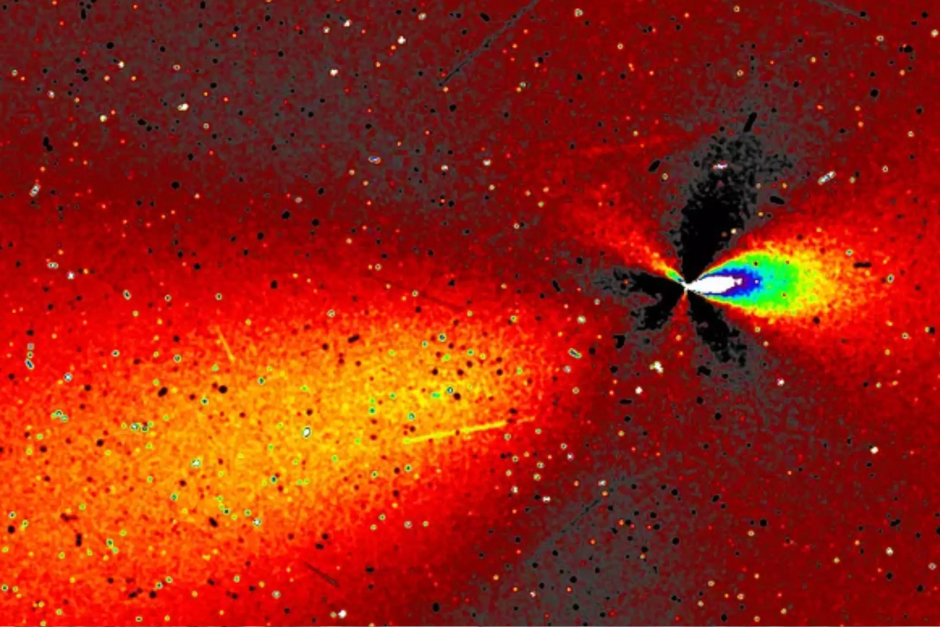
The cosmos is a stage for constant, breathtaking revelations, and few observatories deliver the drama quite like the Hubble Space Telescope. Its enduring gaze recently turned to a fascinating interstellar visitor, 3I/ATLAS, revealing unprecedented details that are sending ripples through the astronomical community. Get ready to have your mind blown, because this isn’t just about pretty pictures; it’s about dynamic behavior telling a deep cosmic story.
Hubble’s Sharp Eye on an Interstellar Wanderer
Remember 3I/ATLAS? It’s the second confirmed interstellar comet to grace our solar system, an enigmatic traveler from beyond our sun’s gravitational influence. Its initial discovery sparked immense excitement, offering scientists a rare chance to study material from another star system up close. Now, fresh observations from Hubble have delivered a treasure trove of data, showcasing the comet in a more active and complex state than ever before. These new images aren’t just snapshots; they’re windows into the comet’s dynamic personality, capturing it as it sheds volatile materials in an intricate dance.
What makes 3I/ATLAS so compelling is its origin. Unlike the comets that orbit our Sun, this object formed in a completely different stellar nursery. Studying its composition and behavior can offer profound insights into the conditions and processes in other star systems, potentially revealing how common water or organic molecules might be across the galaxy. Every flicker, every jet, every subtle change observed on 3I/ATLAS contributes to our understanding of the broader universe.
The Mesmerizing Mystery of Wobbling Jets
The star of the show in these new Hubble images? The distinct, wobbling jets emanating from 3I/ATLAS. Comets develop jets when solar radiation heats their icy nuclei, causing frozen gases to sublimate directly into space, carrying dust particles along. Typically, these jets can be relatively stable or show gradual changes. However, what Hubble observed on 3I/ATLAS was a surprising, rhythmic oscillation – the jets weren’t just streaming, they were wobbling.
Imagine a tiny, cosmic sprinkler system, but instead of a steady spray, its nozzles are gently swaying back and forth. This peculiar motion isn’t merely a visual quirk; it’s a crucial piece of the puzzle. It strongly suggests an intricate interplay of forces and characteristics within the comet itself. Scientists believe this wobbling could be indicative of the comet’s rotation interacting with the outgassing, or perhaps an irregular shape causing the gases to escape unevenly. It might even point to varying distributions of ice beneath the comet’s surface, leading to asymmetrical bursts of activity as it spins.
“This wobble isn’t just a pretty visual; it’s a dynamic fingerprint,” explains Dr. Lena Petrova, a planetary scientist involved in the analysis. “It provides crucial clues about the comet’s rotation, its internal structure, and how it’s shedding material as it journeys through our system. For an interstellar visitor, this data is gold, allowing us to peek into the heart of an alien world in a way we couldn’t before.”
Unlocking the Secrets of Interstellar Objects
The discovery of wobbling jets on 3I/ATLAS deepens our understanding of interstellar objects and cometary physics. Prior to these observations, much of what we knew about such distant visitors was speculative. Now, we have direct evidence of complex, dynamic processes occurring on an object that originated far, far away. These jets are essentially venting material that has travelled unimaginable distances, potentially carrying pristine samples of another star system’s building blocks.
The observations encourage further research into comet rotation and the interaction between a comet’s nucleus and its coma. Comparing 3I/ATLAS’s behavior to comets native to our own solar system can highlight unique differences – or surprising similarities – in their formation and evolution. This ongoing vigilance from telescopes like Hubble not only satisfies our innate curiosity but also equips us with vital knowledge for future missions and a broader comprehension of our place in a vast, interconnected cosmos.
The universe continues to unveil its wonders, and thanks to the iconic Hubble, we’re privileged to witness its spectacular performances, one wobbling jet at a time.

