


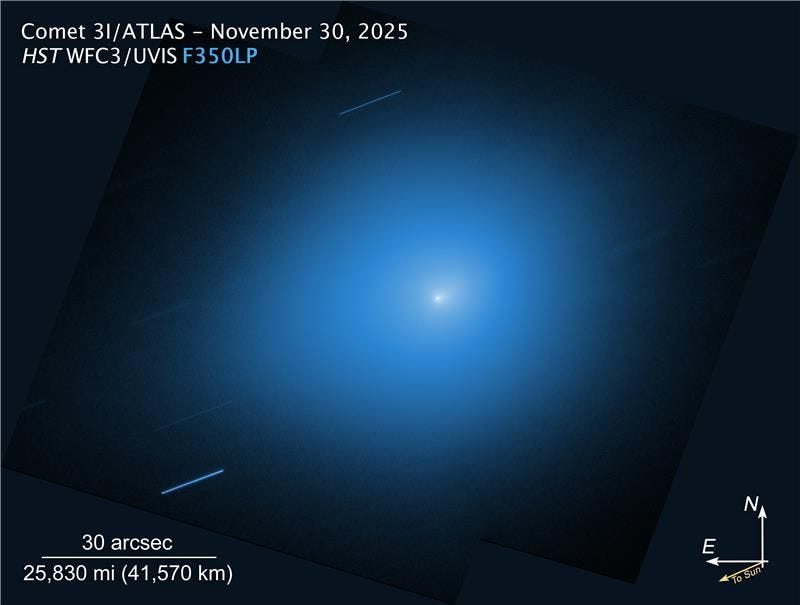
The universe continues to unveil its mysteries, one stunning image at a time, and humanity’s steadfast gaze through the Hubble Space Telescope consistently delivers. Its recent focus on 3I/ATLAS has captured the astronomical community’s attention, offering a unique window into an object unlike any other native to our solar system. This isn’t just another pretty picture; it’s a profound snapshot of an interstellar wanderer, providing invaluable clues about cosmic environments far beyond our own.
A Messenger from Across the Stars
What makes 3I/ATLAS so compelling isn’t merely its visual appeal, but its extraordinary origin. As an interstellar object, it didn’t form in the cold, dusty disc that eventually coalesced into our sun and planets. Instead, it journeyed here from another star system, propelled through the vast darkness of space for millennia before making a fleeting pass through our cosmic neighborhood. Hubble’s observations of this celestial visitor are therefore akin to receiving a postcard from an alien world, offering a rare opportunity to study raw material that originated light-years away.
The telescope’s detailed imagery has allowed scientists to scrutinize the comet’s behavior as it interacts with our Sun. Unlike comets born within our solar system, which have known compositional biases, 3I/ATLAS presents a fresh canvas. Its observed brightness, the structure of its coma (the fuzzy atmosphere around its nucleus), and any potential tail formations are all critical pieces of a puzzle, painting a picture of its distant birthplace. Every photon captured by Hubble from this object is a whisper from another stellar nursery, revealing secrets about the chemistry and physics of planet formation in an entirely different corner of the Milky Way.
Decoding an Interstellar Wanderer
Hubble’s powerful optics have been instrumental in providing the resolution needed to analyze 3I/ATLAS with remarkable precision. The “latest picture” isn’t a singular static image but rather a collection of observations that track its dynamic evolution. These images have highlighted key characteristics, such as the shape and size of its nucleus, and, crucially, how its activity levels respond to solar heating. For instance, observations have sought to understand if it behaved like other comets, outgassing familiar substances like water, or if its activity presented novel signatures.
This careful analysis is about more than just identification; it’s about comparative planetology on an interstellar scale. By studying its composition and behavior, scientists can infer what conditions might have been like in its home system. Was it a rich, icy environment? Or something far more exotic?
“This comet is a Rosetta Stone, offering unprecedented clues about the primordial building blocks of another star system,” observes Dr. Aris Thorne, a planetary scientist. “Every spectral line, every flicker of its tail, tells us something profound about cosmic evolution beyond our local bubble.” The data derived from these pictures are helping astronomers build models to understand the diversity of planetary systems and the materials that form them across the galaxy.
The visual evidence provided by Hubble’s dedicated gaze upon 3I/ATLAS underscores the telescope’s enduring legacy. It reminds us that our solar system is not an isolated entity, but rather a tiny speck within a bustling galaxy, frequently traversed by material from other stars. These interstellar objects are cosmic travelers, bringing fragments of distant realities right to our doorstep. Each observation, each carefully analyzed pixel, expands our understanding of the universe’s grand, interconnected narrative, continually pushing the boundaries of what we know about our galactic home and beyond.

