


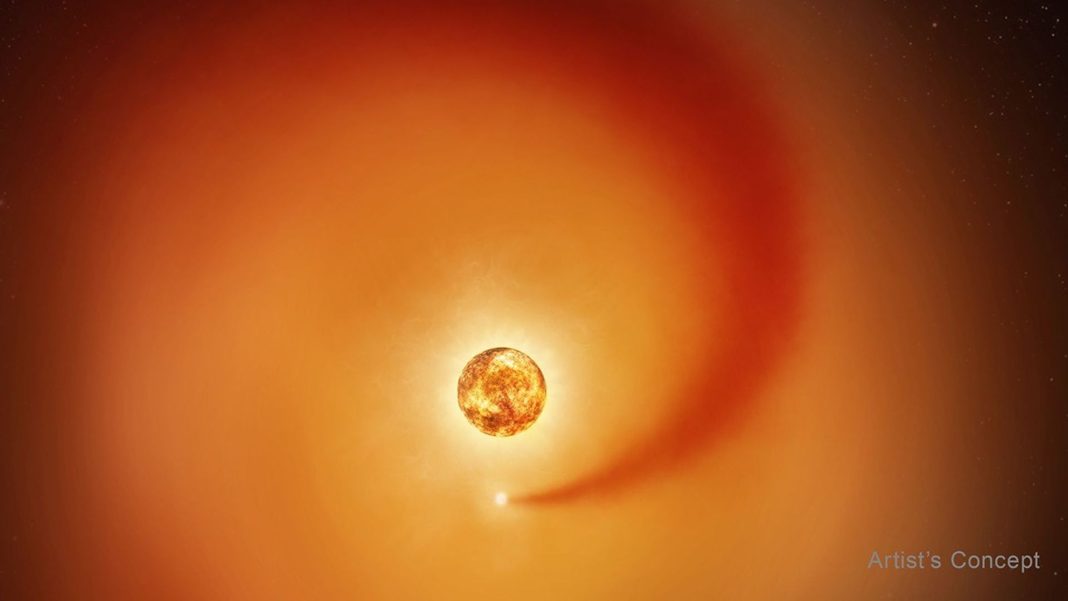
Betelgeuse, the flickering red giant in Orion, has always been a star of intrigue. Remember its dramatic dimming a few years back, sparking supernova rumors? Well, Hubble has peered into its tumultuous atmosphere once more, revealing something even more fascinating: the cosmic calling card of a secret companion, leaving a tell-tale “wake” in its stellar wind.
The Red Giant’s Secret Passenger
Betelgeuse is a true celestial behemoth, a red supergiant nearing the end of its life, constantly shedding layers of itself into space. For decades, astronomers have watched its erratic behavior, its pulsations, and the occasional massive eruptions of gas and dust. The great dimming of 2019-2020 was one such event, where a colossal dust cloud temporarily obscured our view.
But what if some of these dramatic events weren’t solely from Betelgeuse itself? What if another, smaller celestial body was stirring the pot? That’s precisely what Hubble’s latest observations suggest. We’re not just seeing the star’s own breath, but the ripple left by a companion that was once unseen.
A Cosmic Bow Wave in the Stellar Ocean
Imagine a boat moving through water, leaving a distinctive V-shaped wake behind it. Now scale that up to cosmic proportions. Hubble has detected a powerful “bow shock” – an arc of superheated, compressed gas and dust – leading Betelgeuse as it moves through interstellar space. But here’s the kicker: this bow shock isn’t from Betelgeuse’s own motion. Instead, scientists believe it’s caused by a smaller, faster companion star that’s plowing through the vast, diffuse stellar wind constantly blowing off Betelgeuse.
This companion, previously hidden by the glare and dust of its massive partner, acts like a celestial snowplow, creating a discernible “wake” as it carves a path through Betelgeuse’s expanding outer atmosphere. This indirect evidence is a testament to Hubble’s incredible sensitivity, allowing us to infer the presence of a hidden player by its cosmic signature.
“It’s like finally hearing the smaller engine alongside the rumbling of a giant,” shared Dr. Elias Vance, an astronomer captivated by this discovery. “This ‘bow shock’ is the smoking gun, showing us there’s a dynamic dance happening that we never fully appreciated.”
Unraveling Betelgeuse’s Fiery History
The existence of this companion profoundly changes our understanding of Betelgeuse. It means many of the star’s peculiar eruptions and dramatic mass-loss events might have been influenced, if not directly triggered, by this smaller partner’s gravitational tug and its disruptive journey through the supergiant’s outer layers. The 2019 dimming event, for example, could be better understood in the context of a binary system, where interactions between the two stars might predispose certain regions of Betelgeuse to shed material more readily.
This isn’t just about finding another star; it’s about uncovering a hidden mechanical interaction, a cosmic ballet that dictates how this famous star lives and dies. It shows us that even the most well-studied celestial objects can hold profound surprises, urging us to look deeper.
From a star that once seemed to be just a solo act, Betelgeuse has revealed itself to be part of a dynamic duo. The “wake” spotted by Hubble isn’t just a pretty cosmic arc; it’s a testament to the complex, often unseen, interactions that shape the universe. It reminds us that even when we think we know a celestial neighbor, there are always more layers to peel back, more secrets waiting to be unveiled by our tireless cosmic explorers. The universe truly is a stage for endless drama!

