


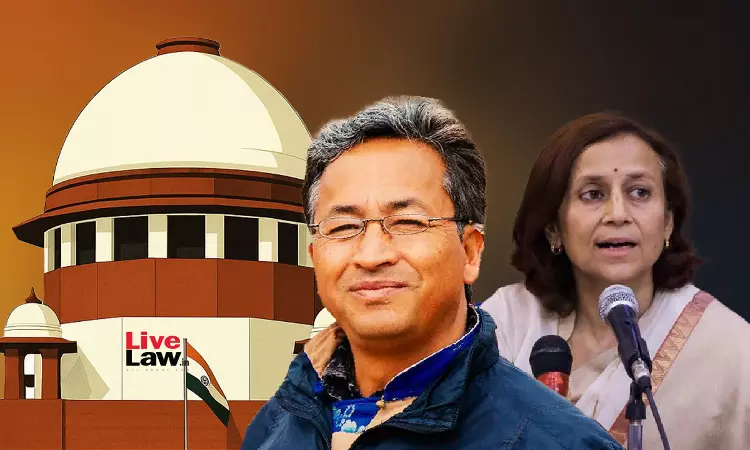
The spotlight recently turned to the Supreme Court of India as it deliberated on the petitions concerning restrictions placed on renowned innovator and environmental activist Sonam Wangchuk in Ladakh. Wangchuk had embarked on a ‘climate fast’ to advocate for the implementation of the Sixth Schedule of the Constitution for Ladakh and to highlight environmental degradation concerns in the ecologically fragile region. His proposed march from Leh to the China border was reportedly curtailed, leading to petitions challenging these restrictions as an infringement on his fundamental rights. The Supreme Court’s intervention brought forth a series of incisive questions, underscoring the delicate balance between public order and the cherished right to protest.
The Genesis of the Legal Challenge: Restrictions on Dissent
Sonam Wangchuk’s activism gained national attention with his call for a ‘climate fast’ and a subsequent protest march, aimed at drawing attention to the environmental vulnerability of Ladakh and the demands for constitutional safeguards under the Sixth Schedule. The proposed march, however, faced governmental restrictions, with authorities citing concerns over public order and potential disturbances. Wangchuk and others subsequently approached the Supreme Court, arguing that these restrictions amounted to an arbitrary curtailment of their fundamental rights, specifically the right to freedom of speech and expression, and the right to assemble peacefully without arms, as guaranteed under Article 19 of the Indian Constitution.
The petitioners contended that the restrictions were disproportionate and lacked a clear legal basis, effectively preventing a peaceful exercise of democratic rights. The case therefore became a significant test for how the judiciary would interpret and uphold the constitutional right to protest in the face of state concerns about maintaining law and order, particularly in a sensitive border region. This sets the stage for the Supreme Court’s scrutiny, moving beyond the immediate facts to probe the underlying principles of governance and individual liberties.
Supreme Court’s Scrutiny: Probing Questions on Fundamental Rights
During the hearings, a bench comprising Justices Sanjiv Khanna and Dipankar Datta engaged in a rigorous examination of the state’s actions and justifications. The Court’s questioning was sharp, direct, and focused on the legality and proportionality of the restrictions imposed. A central theme of the queries revolved around the nature of the restrictions: were they legitimate precautionary measures or an overreach that suppressed fundamental rights?
The bench repeatedly questioned the counsel representing the Union Territory of Ladakh about the extent of the restrictions. “You cannot have an iron curtain,” Justice Khanna remarked, emphasizing the constitutional imperative to allow peaceful dissent. He further asserted, “People have a right to protest, but it has to be peaceful.” This statement encapsulated the Court’s stance: while acknowledging the state’s responsibility to maintain peace, it firmly upheld the right of citizens to express their grievances. The Court sought clarity on whether the restrictions effectively amounted to house arrest or preventive detention, and if so, under what specific legal provisions they were imposed.
Further questions delved into the specifics of the proposed protest. The Court inquired whether the entire march was prohibited or just certain segments, and what concrete intelligence or evidence justified such extensive restrictions. The judiciary’s role as a guardian of fundamental rights was evident in its persistent probing, pushing the state to provide tangible reasons rather than broad, generalized concerns about law and order. The judges also explored whether alternative, less restrictive measures could have been adopted, demonstrating a judicial preference for solutions that balance security with liberty.
Balancing Act: The State’s Justifications and Judicial Oversight
In response to the Supreme Court’s inquiries, the counsel for the Ladakh administration argued that the restrictions were necessary to prevent potential law and order disturbances, given the sensitive nature of the region and the possibility of external elements exploiting the situation. They maintained that the measures were precautionary, aimed at ensuring public safety and preventing any untoward incidents that could arise from a large gathering and march towards the border area. The administration also highlighted efforts to engage with Wangchuk and his supporters, suggesting that dialogue was preferred over confrontation.
However, the Supreme Court remained steadfast in its commitment to scrutinize these justifications. The judges reiterated that preventive measures must not become a pretext for stifling legitimate dissent. The hearings underscored a critical principle of Indian constitutional law: restrictions on fundamental rights must be reasonable, proportionate, and demonstrably necessary. The Court’s probing questions served as a robust check on executive power, reminding the state that even in matters of public order, the constitutional rights of citizens cannot be easily overridden without compelling and well-articulated reasons.
The ultimate outcome of the petitions saw the Supreme Court urging the Ladakh administration to engage in dialogue with Sonam Wangchuk and to uphold the right to peaceful protest, while also cautioning against any actions that could escalate tensions. This judicial guidance reflects a continuous effort to navigate the complex terrain where individual liberties intersect with the state’s imperative to maintain stability.
The Supreme Court’s handling of the Sonam Wangchuk matter serves as a vital reminder of the judiciary’s role in safeguarding democratic freedoms. By posing pointed questions about the nature and legality of restrictions on protest, the Court reaffirmed that the right to express dissent is a cornerstone of India’s democratic fabric. While the state has a legitimate role in maintaining public order, it cannot do so by creating an “iron curtain” around peaceful activism. The dialogue initiated within the courtroom highlights the ongoing challenge of balancing security concerns with fundamental rights, and the unwavering importance of judicial oversight in upholding the constitutional guarantees for all citizens.

