


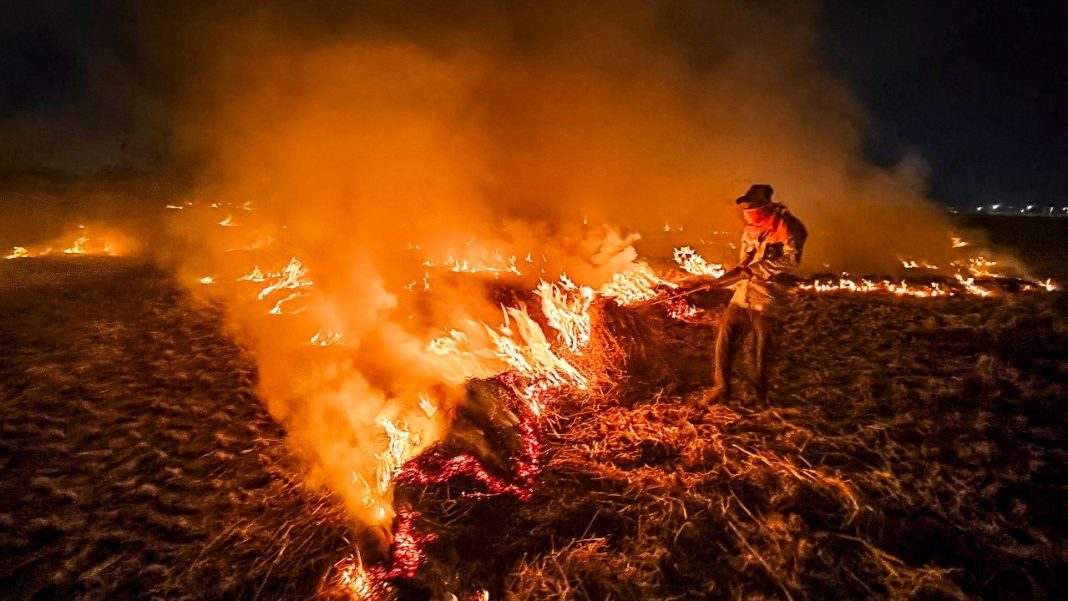
As winter approaches, the familiar pall of smog begins to descend upon North India, particularly engulfing Delhi and its surrounding regions. A significant contributor to this annual environmental crisis is stubble burning, the practice by farmers of setting fire to paddy residue in their fields. To monitor and curb this practice, the Indian government, often in collaboration with international agencies, relies heavily on satellite imagery. However, an emerging pattern suggests that farmers are developing ingenious methods to evade detection, with the ‘5 PM trick’ gaining notoriety for its effectiveness in circumventing satellite surveillance.
The Invisible Fires: A Game of Cat and Mouse
For years, satellite data from agencies like NASA and ISRO (Indian Space Research Organisation) have been instrumental in identifying hot spots and quantifying the extent of farm fires. Satellites equipped with thermal sensors, such as MODIS and VIIRS, orbit the Earth multiple times a day, capturing images that pinpoint active fire incidents. This data forms the basis for government policies, fines, and public awareness campaigns aimed at curbing pollution.
However, farmers, under immense economic pressure and facing tight sowing windows, have reportedly adapted their burning practices. The ‘5 PM trick’ isn’t about magical invisibility; it’s a strategic exploitation of how satellite systems operate. Most polar-orbiting satellites used for fire detection have fixed overpass times, often during midday when sunlight is optimal for imaging. By delaying burns until late afternoon or early evening, after 5 PM, farmers significantly reduce the chances of their fires being captured by these primary satellite passes. The logic is simple: fires started later in the day, especially as ambient temperatures drop and daylight wanes, are less intense or might have died down by the time a subsequent satellite pass occurs much later, or the thermal signature blends more effectively with background temperatures, making them harder to distinguish.
“It’s a race against time for us,” explains Gurpreet Singh, a farmer from Punjab’s Sangrur district. “The government tells us not to burn, but doesn’t provide viable, affordable alternatives that fit our schedule. If we burn after 5 PM, we finish before the dew sets in, and the satellites don’t catch us as easily. It’s not about fooling anyone; it’s about survival.”
Why the Evasion? Understanding the Farmers’ Plight
The ingenuity of the ‘5 PM trick’ underscores a deeper, more complex issue. Farmers in states like Punjab and Haryana face a critical dilemma. The window between harvesting paddy and sowing wheat is remarkably narrow, often just 10-15 days. Managing the vast amount of paddy stubble (approximately 10-12 tonnes per acre) without burning requires significant financial investment in machinery like Happy Seeders or Super Seeders, or manual labour, which are often beyond the means of small and marginal farmers.
Despite government subsidies for machinery and efforts to promote in-situ (on-field) stubble management, the adoption rate remains slow. Many farmers perceive burning as the quickest, cheapest, and most efficient way to clear their fields, even while acknowledging its environmental consequences. The fear of penalties and the pressure from local authorities push them to seek methods of evasion, with the 5 PM trick being a practical, albeit temporary, solution to their immediate problems.
The Implications for Policy and Public Health
The widespread adoption of such tactics has significant implications. If a substantial portion of farm fires goes undetected, official statistics will underreport the true extent of stubble burning. This skewed data can mislead policymakers, potentially resulting in inadequate measures to combat air pollution. For instance, if the perceived number of fires is low, the urgency for sustainable alternatives or stricter enforcement might diminish, exacerbating the annual smog crisis.
Furthermore, the environmental and public health consequences remain dire, regardless of detection. The smoke from stubble burning contains harmful particulate matter (PM2.5, PM10), carbon monoxide, methane, and other pollutants, significantly contributing to respiratory illnesses, cardiovascular problems, and reduced visibility across the Indo-Gangetic Plain. The ‘5 PM trick’ might help farmers avoid immediate penalties, but it does nothing to mitigate the broader ecological and health disasters unfolding each winter.
Beyond Detection: Towards Sustainable Solutions
Addressing the challenge of farm fires requires a multi-faceted approach that extends beyond mere satellite surveillance. While improving detection methods, perhaps through more frequent satellite passes or ground-based monitoring, could expose more fires, it risks turning the situation into a never-ending cat-and-mouse game. A sustainable solution must focus on empowering farmers with economically viable and accessible alternatives.
This includes increasing awareness, providing greater subsidies for stubble management machinery, establishing decentralized stubble collection centres for biomass energy production, and promoting crop diversification away from water-intensive paddy. Ultimately, bridging the gap between policy intent and ground realities will require empathy, innovation, and a collaborative spirit that supports farmers rather than merely penalizes them.
The ‘5 PM trick’ is a stark reminder that environmental challenges often have deep socio-economic roots. Resolving the farm fire conundrum demands a systemic overhaul, ensuring that farmers are not forced to choose between their livelihood and the health of the nation.

