


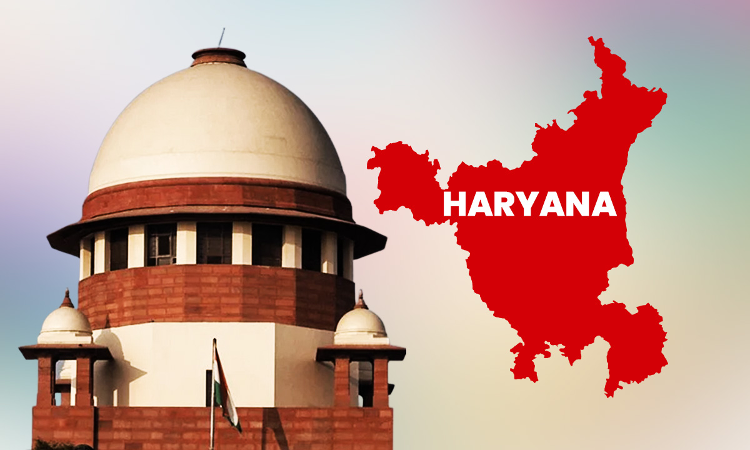
In a powerful testament to its role as the guardian of justice, India’s Supreme Court has stepped in to address a deeply troubling case involving a four-year-old rape survivor. The apex court recently formed a Special Investigation Team (SIT) to probe the allegations, making strong observations about the conduct of the Haryana Police. This intervention highlights not just the critical need for justice for vulnerable victims, but also raises serious questions about accountability within law enforcement agencies.
The case, which dates back four years, has languished amidst accusations of deliberate inaction and attempts to shield the accused. The Supreme Court’s sharp remarks, suggesting that the “Haryana Police tried to protect accused,” have sent ripples through legal and public circles, underscoring the imperative for transparent and impartial investigation, especially in crimes against children.
A Glimmer of Hope: Supreme Court Intervenes
The Supreme Court’s decision to constitute a Special Investigation Team offers a renewed beacon of hope for the young survivor and her family, who have reportedly been battling for justice for an arduous four years. The bench, comprising justices who expressed profound dismay over the handling of the case, emphasized the paramount importance of ensuring that justice is not only done but is seen to be done, particularly when a child’s fundamental rights and safety are at stake.
This judicial intervention comes at a crucial juncture, asserting the judiciary’s ultimate authority when lower enforcement mechanisms falter. The SIT’s mandate will be to conduct a thorough, unbiased investigation into all aspects of the case, including the original crime and the subsequent actions – or inactions – of the state police. The court’s directive is a clear signal that the gravity of the matter demands immediate and meticulous attention, free from any influence that may have previously hampered the process.
During the proceedings, the Supreme Court did not mince words, reportedly stating, “This is a very serious matter. It appears the Haryana Police tried to protect the accused in the four-year-old’s rape case.” Such an observation from the highest court of the land is a scathing indictment of the alleged conduct of the police and necessitates an urgent redressal of systemic issues.
Allegations of Police Inaction and Obstruction
The heart of the Supreme Court’s concern lies in the disturbing allegations that the Haryana Police actively sought to protect the accused individuals in this harrowing case. For a four-year-old survivor, the journey for justice is already an unimaginable ordeal, made infinitely worse if the very institutions meant to protect her are perceived to be complicit or obstructive. The Court’s observation points towards a potential breach of public trust and a grave miscarriage of justice.
Such allegations underscore a pervasive issue that sometimes plagues law enforcement – the perception, or reality, of influence, corruption, or apathy in handling sensitive cases, especially those involving vulnerable sections of society. When police forces, tasked with upholding the law and protecting citizens, are accused of such egregious conduct, it erodes public confidence in the entire justice delivery system. The protracted nature of the case, spanning four years without a satisfactory resolution, further fuels these concerns, suggesting a deliberate stalling or mishandling that prevented timely justice.
The formation of the SIT, with its direct oversight by the Supreme Court, is a critical step to circumvent any potential local influences or systemic biases. It ensures that the investigation will proceed with a fresh perspective, aimed solely at unearthing the truth and bringing the perpetrators, and anyone who may have aided them, to justice. This move aims to restore faith in the system, promising an independent probe that leaves no stone unturned.
Conclusion: A Call for Accountability and Swift Justice
The Supreme Court’s firm stance in the four-year-old’s rape case is a powerful reminder that justice delayed is justice denied, particularly for the most vulnerable in society. By forming an SIT and making direct observations about the alleged conduct of the Haryana Police, the apex court has not only offered a pathway to justice for the child survivor but also reiterated the critical need for accountability within state institutions.
This intervention serves as a strong message across the country: no individual or institution is above scrutiny, especially when basic human rights and safety are compromised. The expectation now rests on the newly formed SIT to conduct an expeditious, fair, and thorough investigation, ensuring that all those responsible – for the heinous crime and for any alleged attempts at obstruction – are held to account. Only then can the faith of citizens in the justice system be truly upheld, providing solace to the survivor and her family, and setting a precedent for improved law enforcement integrity.
*

