


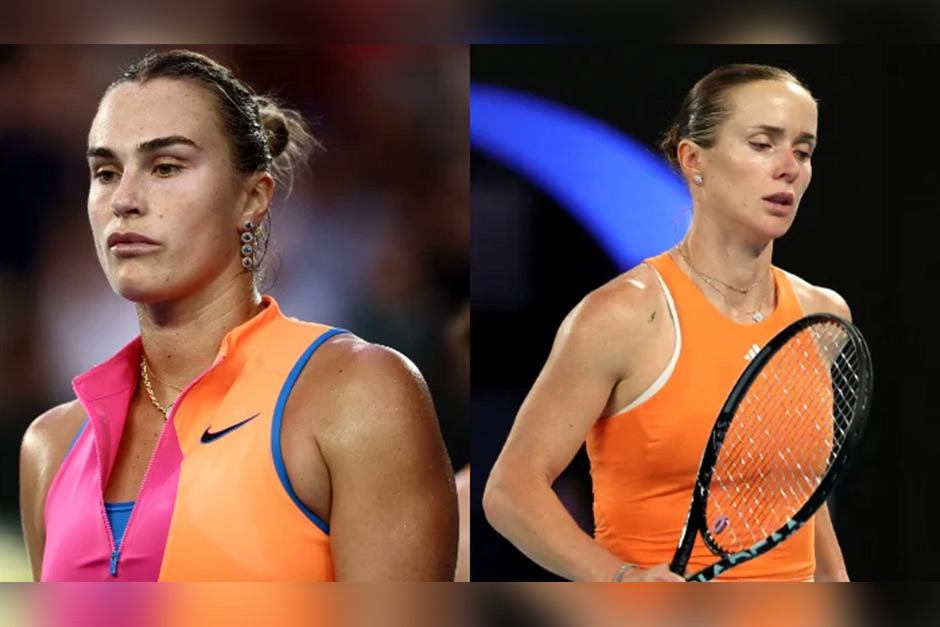
The exhilarating world of professional tennis often serves up drama both on and off the court. The recent Australian Open semi-final between Belarus’s Aryna Sabalenka and Ukraine’s Elina Svitolina delivered a masterclass in aggressive tennis, but it was the moments immediately following the final point that captured global attention, igniting discussions about sportsmanship, protest, and the complex intertwining of geopolitics and athletic competition.
Sabalenka’s Commanding Performance
Defending champion Aryna Sabalenka, known for her powerful groundstrokes and formidable serve, continued her dominant run at the Australian Open. Facing a determined Elina Svitolina in the semi-final, Sabalenka showcased why she is considered one of the sport’s heavyweights. From the outset, the Belarusian star imposed her game, dictating rallies and unleashing an array of winners that often left Svitolina scrambling. Despite Svitolina’s trademark resilience and impressive retrieval skills, she struggled to find a consistent rhythm against Sabalenka’s relentless attack.
The match concluded in straight sets, a testament to Sabalenka’s unwavering focus and execution under pressure. While the scoreline might suggest a straightforward victory, the intensity of the rallies and the quality of tennis on display captivated fans. Sabalenka’s win secured her spot in the coveted final, continuing her quest for another Grand Slam title.
The Unspoken Protocol: Svitolina’s Post-Match Stance
However, the narrative quickly shifted from the on-court action to the customary post-match handshake. As Sabalenka approached the net, extending her hand in a gesture of sportsmanship, Elina Svitolina walked directly past, heading towards her bench without acknowledging her opponent. The moment was stark and immediate, drawing a palpable reaction from sections of the crowd, who responded with boos aimed at Svitolina.
Svitolina’s refusal was not an isolated incident but a consistent stance she has adopted since the full-scale invasion of Ukraine, given Belarus’s alignment with Russia. For Ukrainian athletes like Svitolina, shaking hands with players from these nations is seen as a normalisation of their countries’ actions, an act they are unwilling to perform while the conflict continues. When questioned about her decision, Svitolina articulated her unwavering position:
“I think my stance is pretty clear. I don’t shake hands with Russian and Belarusian players. Some people don’t understand, some people do. But I’m staying with my stance. I’m not going to change my mind.”
Sabalenka, after waiting briefly at the net, gave a slight nod and walked away. She later commented that she respected Svitolina’s position, indicating an understanding of the profound emotional and political context underlying the Ukrainian player’s actions.
Sports, Politics, and Public Perception
This incident at the Australian Open once again highlights the persistent challenge of separating sports from the broader geopolitical landscape. While many proponents argue that sports should remain apolitical, a neutral ground where athletes compete based purely on merit, events like these underscore the difficulty, if not impossibility, of such a separation when real-world conflicts have devastating human costs. For athletes like Svitolina, participating in international competition is not just about tennis; it’s also a platform to express solidarity and protest against actions affecting their homeland.
The crowd’s mixed reaction—some booing Svitolina, others perhaps understanding her plight—reflects the global diversity of opinions and the complex empathy required to navigate such situations. In India, a nation that often champions peace and understanding on the global stage, such events resonate with the ongoing debate about the role of individual conscience in collective arenas. The handshake row serves as a potent reminder that even in the pursuit of athletic glory, the echoes of world events can reverberate loudly, forcing conversations beyond scores and statistics.
The Australian Open semi-final between Sabalenka and Svitolina will be remembered not just for its high-quality tennis, but for the poignant post-match moment that encapsulated the enduring tension between athletic tradition and contemporary global realities. It underscores how individual acts of protest can bring significant international issues to the forefront, challenging spectators and participants alike to consider the deeper human narratives woven into the fabric of competitive sport.

