


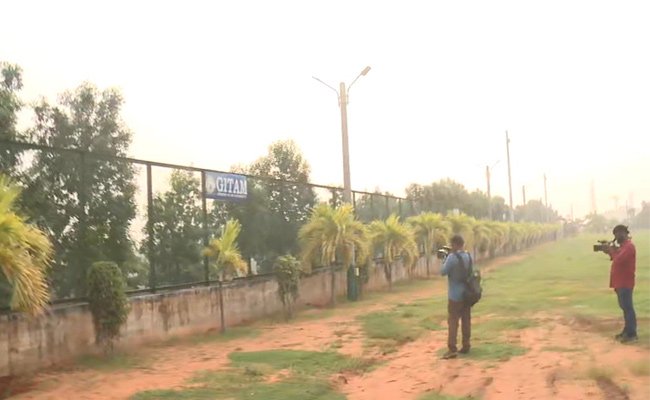
The urban landscape of Visakhapatnam, one of India’s fastest-growing cities, has been a nexus of rapid development and complex land management challenges. Recently, a significant decision by the Greater Visakhapatnam Municipal Corporation (GVMC) has brought these issues sharply into focus: the regularisation of approximately 42 acres of land encroached by the Gandhi Institute of Technology and Management (GITAM), a prominent educational institution. The land in question is estimated to be worth a staggering Rs 5,000 crore, making this regularisation one of the largest and most high-profile instances of its kind in recent memory. This move by the GVMC, while resolving a long-standing dispute, has ignited conversations about urban land policies, institutional accountability, and the precedent it sets for future land governance in Andhra Pradesh.
The Rs 5,000 Crore Regularisation: A Closer Look
For decades, GITAM University, located in Rushikonda, Visakhapatnam, has been operating on land that included significant portions deemed to be encroached government property. The institution, which has grown to become a major educational hub, reportedly expanded its campus over time onto land belonging to various government departments, including the Revenue, Forest, and Endowments departments. The recent decision by the GVMC to regularise these 42 acres effectively legalises GITAM’s occupation of this land, bringing an end to years of uncertainty and legal challenges.
The regularisation process typically involves the payment of a prescribed fee to the government, often based on the market value of the land or a specific percentage thereof, as per existing state government regularisation policies. While specific details of the financial settlement in this case have not been made public, the sheer estimated value of Rs 5,000 crore underscores the colossal scale of the transaction and the potential revenue implications for the state exchequer. This move aligns with a broader trend in Indian states to address and resolve historical land encroachments, often through special government orders (GOs) or regularisation schemes aimed at clearing pending disputes and generating revenue, while also allowing institutions to function without legal impediments.
The GVMC’s decision is rooted in a comprehensive assessment of the land’s usage, the institution’s contribution to the region, and the existing legal frameworks for regularisation. It signifies a governmental approach to formalise informal land occupations that have persisted for extended periods, especially when involving large-scale public institutions. However, it also raises pertinent questions about the initial oversight that led to such an extensive encroachment and the mechanisms in place to protect public land from illegal occupation.
Implications for Urban Planning and Governance
The regularisation of such a vast and valuable parcel of land carries significant implications, not just for GITAM but for the broader urban development paradigm in Visakhapatnam and Andhra Pradesh. For GITAM, the decision provides legal sanctity to its campus infrastructure, enabling planned expansion, better access to funding, and overall stability for its academic and research endeavours. This certainty is crucial for an institution of its stature, attracting students and faculty alike.
However, the move has also opened a public discourse on urban land governance. Critics argue that such large-scale regularisations, while pragmatic in resolving long-standing issues, might inadvertently send a message that encroachment, if sustained long enough, can eventually be legitimised. This perspective often comes from environmental activists, transparency advocates, and opposition parties who stress the importance of preserving public lands for community use, ecological balance, or future infrastructure projects. The estimated value of the land also highlights the immense opportunity cost if these lands had been retained by the government for other public purposes.
Reflecting on the nuances of such decisions, Dr. Anjali Sharma, an urban policy expert based in Hyderabad, commented, “Land regularisation policies in India are a double-edged sword. While they offer a practical solution to historical encroachments and can generate much-needed revenue for civic bodies, they also necessitate a robust framework to prevent future illegal occupations. The key lies in transparent processes and ensuring that such regularisations don’t dilute the sanctity of public land ownership in the long run.” Her statement encapsulates the delicate balance that state governments and municipal corporations must strike between development needs and regulatory integrity.
Conclusion: Charting Visakhapatnam’s Future
The GVMC’s decision to regularise the Rs 5,000 crore worth of land encroached by GITAM is a pivotal development for Visakhapatnam. It underscores the complexities inherent in managing urban land resources in a rapidly expanding city and the challenges of reconciling historical land-use patterns with modern legal frameworks. While it offers a definitive resolution for GITAM University, securing its future in the city, it simultaneously prompts a crucial examination of land management policies across the state.
This incident serves as a significant case study, offering valuable insights into the ongoing efforts by Indian states to rationalise land records, resolve disputes, and pave the way for sustainable urban growth. As Visakhapatnam continues its trajectory as a smart city, the lessons learned from this regularisation will undoubtedly influence future policy-making, aiming for a balance between institutional development and the judicious protection of public assets.

