


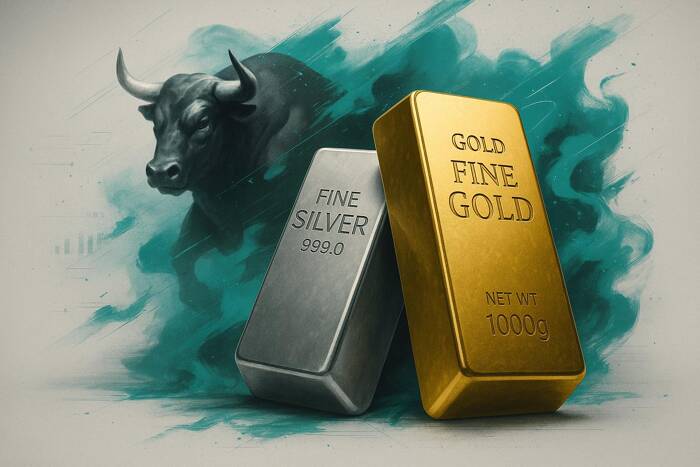
The global geopolitical landscape, already a tapestry of complex tensions, has recently seen a dramatic escalation following the Iran strikes, sending ripples through financial markets worldwide. Amidst this uncertainty, one asset has consistently glittered brighter: gold. The precious metal, long revered as a safe haven, has witnessed a significant surge, prompting experts and investors alike to ponder the unthinkable. Could escalating war risks truly propel gold to an unprecedented $6,500 an ounce and silver to $150?
Geopolitical Tremors and the Enduring Allure of Gold
The recent military actions, particularly those involving Iran, have injected a fresh wave of volatility into global markets. When geopolitical instability flares, investors typically flock to assets perceived as safe stores of value, and gold traditionally tops this list. Its appeal stems from its historical role as a hedge against inflation, currency depreciation, and systemic risk. Unlike equities or bonds, gold’s value is not tied to the performance of any single company or government, making it an attractive refuge during turbulent times.
The current scenario is a potent mix: ongoing inflation concerns in major economies, a looming global slowdown, and now, heightened military tensions in a critical oil-producing region. This confluence of factors creates a fertile ground for gold’s rally. Silver, often dubbed “poor man’s gold,” typically follows gold’s trajectory, albeit with greater volatility due to its dual role as both a precious metal and an industrial commodity. Increased industrial demand in sectors like solar panels and electric vehicles could further amplify silver’s ascent if economic stability returns alongside geopolitical calm.
India’s Gold Affinity Amidst Global Uncertainty
For India, the world’s second-largest consumer of gold, these international price movements have profound implications. Gold is not merely an investment here; it is woven into the cultural and social fabric, essential for weddings, festivals like Akshaya Tritiya and Dhanteras, and as a traditional family heirloom. Indian households hold an estimated 25,000 tonnes of gold, reflecting a deep-seated trust in its value.
A surge in global gold prices translates directly into higher domestic rates, often exacerbated by the depreciation of the Indian Rupee against the US Dollar. While an initial price spike might lead to a brief pause in buying as consumers adjust, India’s inherent demand often resumes. Many view gold as an accessible and reliable investment, especially in rural areas where access to formal financial instruments might be limited. However, persistently high prices could also lead to increased instances of gold recycling or, in extreme cases, a rise in informal market channels. The Reserve Bank of India also holds significant gold reserves, which are indirectly affected by global price fluctuations, impacting the nation’s overall financial stability.
Expert Projections: A New Price Frontier?
The audacious targets of $6,500 for gold and $150 for silver are not casual predictions; they stem from analyses of extreme scenarios. These projections typically assume a significant escalation of current conflicts into a wider regional or even global confrontation, leading to severe economic disruption, rampant inflation, and a widespread loss of confidence in traditional financial systems and fiat currencies. In such a hypothetical environment, investors would seek the ultimate safe haven, driving demand for precious metals to unprecedented levels.
As one prominent market analyst, Mr. Ajay Sharma, Head of Precious Metals Research at Zenith Capital, recently remarked, “While $6,500 gold and $150 silver might seem outlandish today, they represent the apex of potential in a truly chaotic global scenario. It’s less about a linear progression and more about a market capitulation, where the ultimate store of value becomes paramount. However, we must stress that these are extreme projections, not base-case scenarios.”
Such predictions also factor in the possibility of sustained central bank buying, which has been a significant driver of gold prices in recent years. Central banks globally have been diversifying their reserves away from traditional currencies, viewing gold as a crucial component of financial stability. Should geopolitical risks intensify, this trend is likely to accelerate. For silver, reaching $150 would require not only a significant safe-haven rush but also a strong rebound in industrial demand that tightens supply substantially.
However, it is crucial to temper these ambitious forecasts with realism. De-escalation of tensions, stronger economic data, or a shift in monetary policy by major central banks could quickly reverse gold’s upward trajectory. The path to such extreme valuations is fraught with complexities and dependent on a cascade of highly unfavorable global events.
The current gold surge is a stark reminder of the metal’s role as a barometer of global risk. While the dream of $6,500 gold and $150 silver captures the imagination, it underscores the profound anxieties gripping the world. For Indian investors, the appeal of gold remains timeless, but navigating these volatile waters requires a keen understanding of both global geopolitics and domestic market dynamics. Whether these dizzying heights are ever reached will depend on the delicate balance of international relations and the resilience of the global economy.

