


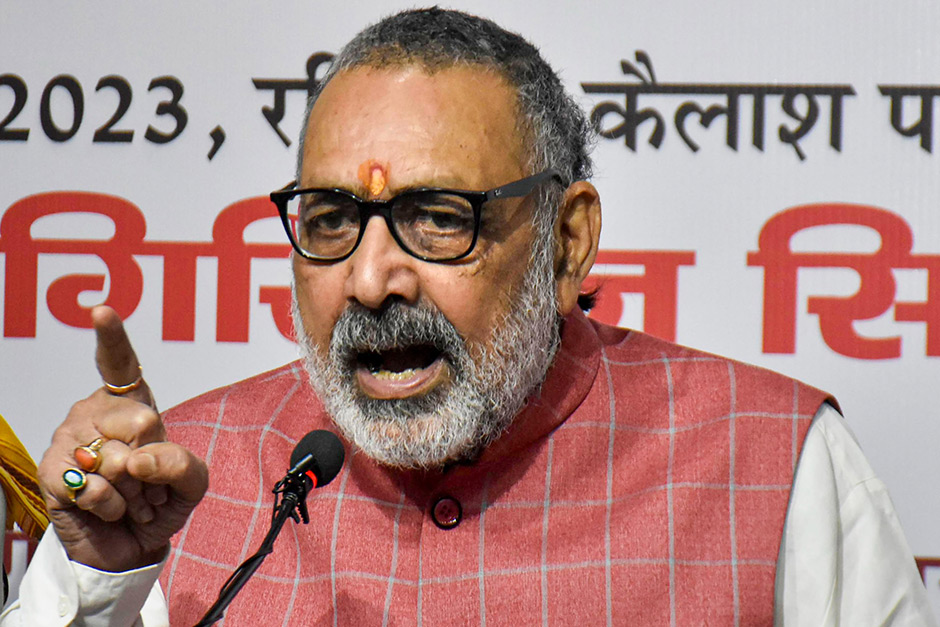
In a political landscape often charged with impassioned rhetoric, a recent statement by Union Minister and BJP leader Giriraj Singh has ignited a fresh wave of controversy in Bihar and beyond. Addressing a query about a woman at the heart of a local hijab dispute, Singh reportedly retorted with a blunt, “Go to hell!” The remark has not only sent ripples of shock through the state’s political circles but has also drawn sharp condemnation from opposition parties, who accuse the minister of insensitivity and fanning communal tensions.
The incident underscores the increasingly polarized nature of public discourse in India, where local disputes can quickly escalate into national debates, especially when senior political figures weigh in. TrendLyric.com examines the origins of this controversy, the minister’s statement, and the widespread political fallout.
The Incendiary Remark and Its Immediate Fallout
The contentious statement by Giriraj Singh, known for his outspoken and often controversial comments, came during a media interaction in Begusarai, Bihar. When questioned by reporters regarding the woman involved in a local hijab-related dispute, Singh’s response was reportedly dismissive and aggressive. While the exact context of the reporter’s question varied in initial reports, the minister’s terse dismissal left little room for misinterpretation.
“Agar koi hijab mein ghusta hai aur aap usko rokte hain toh, ‘go to hell’,” Singh was quoted as saying, roughly translating to, “If someone enters in a hijab and you stop them, then ‘go to hell’.” The comment was widely perceived as a direct attack on the woman involved, rather than a comment on the situation itself, and immediately drew a strong reaction. Opposition parties wasted no time in seizing upon the remark, portraying it as indicative of the ruling party’s alleged disregard for women’s rights and its perceived communal agenda.
The use of such strong and derogatory language by a Union Minister against a citizen, particularly one involved in a sensitive religious matter, has been a central point of contention. Critics argue that it sets a dangerous precedent for political discourse, normalising vitriol and discouraging constructive engagement on community issues.
Bihar’s Hijab Row: A Local Dispute’s National Echo
To fully grasp the implications of Giriraj Singh’s comment, it’s crucial to understand the context of the “Bihar hijab row” to which he was referring. While not as extensively covered nationally as the Karnataka hijab controversy of 2022, Bihar has also witnessed localised incidents concerning religious attire in educational institutions. The specific incident Giriraj Singh referenced appears to stem from a private school in Lakhisarai, Bihar, where a woman, reportedly a teacher or staff member, was allegedly prevented from performing her duties while wearing a hijab. This led to protests and a local standoff, bringing the sensitive issue of religious freedom and institutional rules to the fore.
The controversy in Lakhisarai mirrored broader debates across India about the right to wear religious symbols in schools and colleges versus institutional dress codes. While proponents of allowing the hijab cite religious freedom and personal choice, those against it often invoke secularism in educational settings and the need for uniformity. The woman at the centre of the Lakhisarai dispute found herself navigating this complex interplay of rights and regulations, making her a figure of public interest in the regional media.
It is against this backdrop that Giriraj Singh’s remark takes on added significance. His comment not only weighed in on a sensitive local issue but did so in a manner that critics argue was demeaning and inflammatory, further exacerbating an already delicate situation.
Opposition Fumes: Calls for Accountability
The reaction from opposition parties was swift and severe. Leaders from the Rashtriya Janata Dal (RJD), Congress, and other regional parties condemned Giriraj Singh’s statement, demanding an apology and even action against the minister. RJD spokesperson Mrityunjay Tiwari stated, “It is shameful that a Union Minister makes such derogatory remarks about a woman. This shows the BJP’s mentality towards women and minorities. He should immediately apologise.”
Congress leaders also weighed in, highlighting what they termed the BJP’s consistent efforts to “polarise society” through such statements. They argued that Singh’s comment was not an isolated incident but part of a larger pattern of inflammatory rhetoric employed by ruling party members to consolidate their vote bank by creating communal divisions. The opposition also questioned Prime Minister Narendra Modi and the BJP high command’s silence on the matter, suggesting it implies tacit approval of such divisive language.
The incident has once again brought to the forefront the challenges of maintaining respectful political discourse in India. While freedom of speech is a fundamental right, critics argue that the language used by public representatives, especially Union Ministers, must adhere to a certain decorum, particularly when addressing sensitive social and religious issues. The ongoing furore serves as a stark reminder of the delicate balance between political commentary and maintaining social harmony in a diverse nation.
As the political slugfest continues, the focus remains on whether the BJP leadership will address Giriraj Singh’s remarks and whether the incident will have any lasting impact on the already tense political environment in Bihar, a state known for its complex caste and communal equations.

