


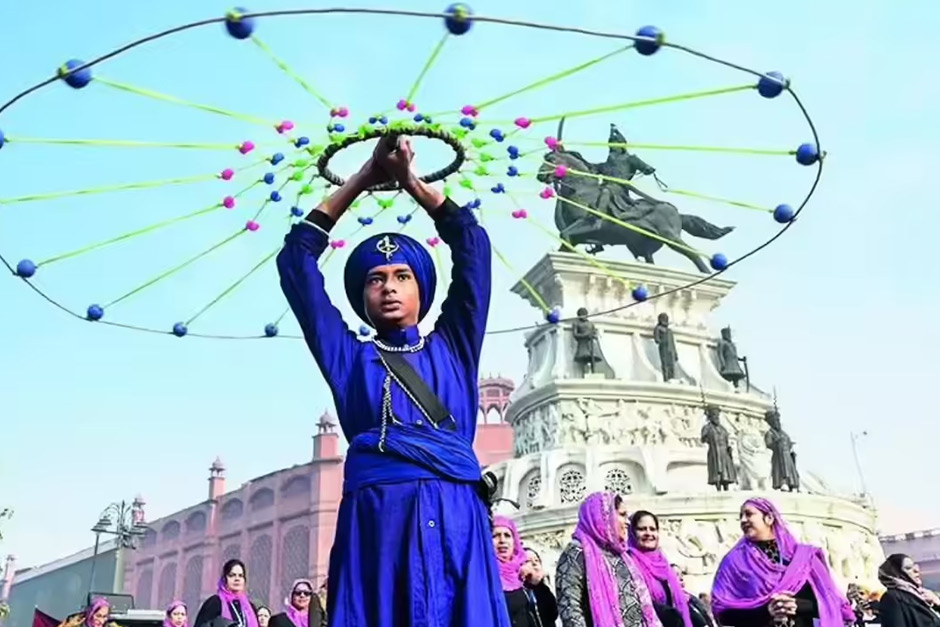
On the solemn occasion of Veer Bal Diwas, Prime Minister Narendra Modi addressed the nation, commemorating the unparalleled sacrifice of the Sahibzadas, the younger sons of Guru Gobind Singh. His address resonated deeply, not only as a tribute to their unwavering courage but also as a powerful call to action for every Indian. The Prime Minister underscored the importance of drawing strength from this historical resolve while simultaneously reiterating his government’s commitment to eradicating the ‘slave mentality’ that he believes has persisted for centuries, vowing to achieve this transformation within the next ten years, ahead of India’s centenary of independence in 2047.
A Tribute to Unwavering Courage and Faith
Veer Bal Diwas, observed annually on December 26th, honours the martyrdom of Baba Zorawar Singh and Baba Fateh Singh, the two youngest Sahibzadas, who were bricked alive in Sirhind at the tender ages of six and nine, respectively, for refusing to convert to Islam. Their elder brothers, Baba Ajit Singh and Baba Jujhar Singh, had earlier attained martyrdom in the Battle of Chamkaur. This day serves as a poignant reminder of their steadfast faith and indomitable spirit in the face of immense adversity.
Prime Minister Modi’s address highlighted the profound significance of their sacrifice, framing it as a beacon of inspiration for present-day India. He emphasized that the Sahibzadas’ story is not merely a historical account but a living testament to the nation’s ethos of courage, conviction, and standing firm against injustice. For centuries, their valour has been a source of strength, particularly for the Sikh community, and now, through national commemoration, it is being consciously integrated into the broader narrative of Indian identity.
The Prime Minister urged citizens to remember that the sacrifice of these young heroes was not in vain, but rather laid a foundation for the resilience and spiritual strength that characterizes India. He stressed the importance of educating younger generations about such acts of unparalleled bravery, ensuring that the legacy of selflessness and sacrifice continues to inspire and guide the nation’s path forward.
Shedding the Shackles of ‘Slave Mentality’
Beyond the commemoration, a central theme of Prime Minister Modi’s speech was the urgent need to shed what he termed the ‘ghulami ki mansikta’, or ‘slave mentality.’ This concept, which he has frequently invoked, refers to the lingering psychological and cultural remnants of India’s colonial past, which he believes continue to influence various aspects of national life, from institutions and policies to individual mindsets and cultural expressions.
The Prime Minister articulated a vision where India, by its 100th year of independence in 2047, would not only be economically prosperous but also entirely free from the psychological baggage of its colonial era. This includes fostering a sense of pride in indigenous heritage, promoting Indian languages and arts, and nurturing an independent, self-reliant spirit in all spheres. He has consistently argued that true freedom encompasses not just political independence but also mental liberation, allowing India to forge its own destiny without external influences or self-doubt.
Addressing the gathering, PM Modi asserted, “The sacrifice of the Sahibzadas strengthens the resolve of every Indian. It is this spirit of unwavering courage and faith that will empower us to definitively end the slave mentality that has unfortunately lingered in various forms for centuries, within the next ten years.” This statement powerfully links the historical courage of the Sahibzadas to the contemporary national project of mental decolonization, suggesting that the same spirit of defiance against oppression can be channeled into overcoming internal psychological barriers.
Forging a Resilient and Self-Reliant India
The Prime Minister’s vision for ending ‘slave mentality’ is inextricably linked to the broader goal of building a ‘Viksit Bharat’ (Developed India) and achieving self-reliance through initiatives like ‘Atmanirbhar Bharat’. He envisions a nation that is confident in its own capabilities, proud of its unique civilizational heritage, and robust enough to stand on its own feet on the global stage, free from the need to emulate foreign models or seek external validation.
This includes an emphasis on indigenization across sectors, from defence and technology to education and culture. The call to embrace a ‘self-reliant’ mindset extends to fostering innovation, promoting local manufacturing, and strengthening traditional knowledge systems. By recognizing and celebrating its own strengths, India, according to the Prime Minister, can truly realize its potential and contribute meaningfully to the world as a leading nation, rather than one defined by its past subjugation.
The commemoration of Veer Bal Diwas, therefore, serves as a dual reminder: a profound appreciation for historical sacrifices that define India’s spirit, and a dynamic impetus for collective action towards a future free from mental constraints. It is a call for every Indian to internalize the lessons of courage and conviction from the past, to actively participate in building a nation that is not only strong and prosperous but also deeply rooted in its own identity and values, charting a truly independent course for the next century.
The message from Prime Minister Modi is clear: the strength derived from exemplary sacrifices like those of the Sahibzadas must be channelled into a nationwide effort to shed historical burdens and cultivate a truly confident, self-reliant, and forward-looking India. The next ten years are presented as a crucial period for this profound transformation, requiring the collective will and determination of over a billion people to achieve complete liberation – both external and internal.

