


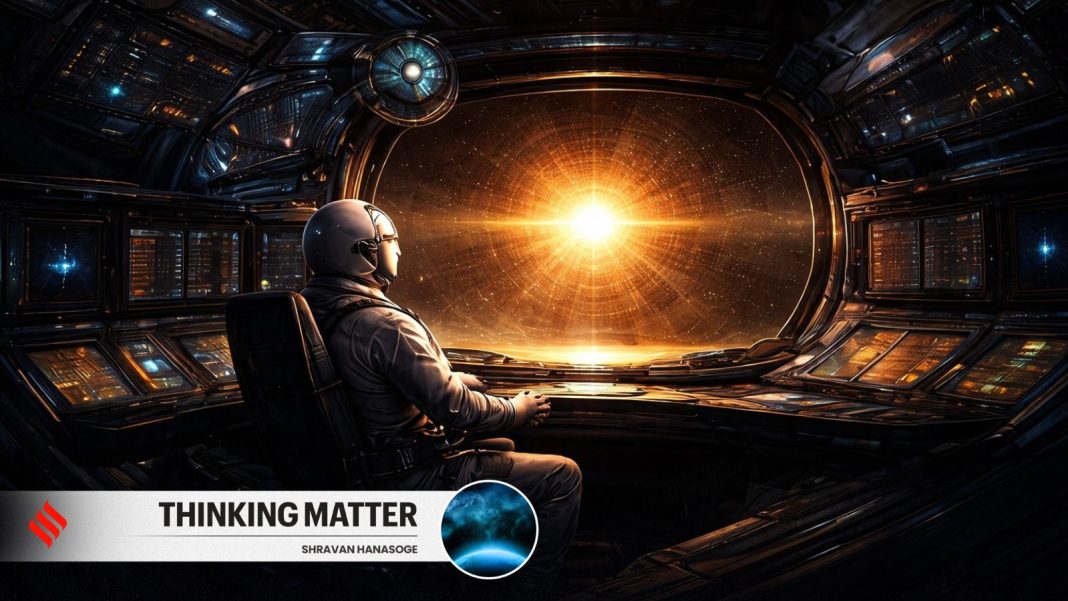
Imagine a rain that never ceases, falling not from the clouds above but from the depths of space, penetrating everything in its path. This invisible deluge, composed of high-energy particles, is known as Galactic Cosmic Rays (GCRs). Originating from distant corners of our galaxy and beyond, these relentless cosmic travellers constantly bombard Earth, presenting both a profound scientific mystery and a tangible challenge to our technological world and future in space. For nations like India, with ambitious space programs and a rapidly expanding digital infrastructure, understanding and mitigating the effects of this eternal cosmic downpour is becoming increasingly crucial.
The Invisible Deluge: Unpacking Galactic Cosmic Rays
Galactic Cosmic Rays are not radiation in the conventional sense of electromagnetic waves like X-rays or gamma rays. Instead, they are energetic subatomic particles – primarily protons (around 90%), with a smaller fraction of helium nuclei (alpha particles) and even heavier atomic nuclei. These particles are accelerated to incredible speeds, approaching the speed of light, carrying energies far beyond anything achievable in terrestrial particle accelerators.
Their genesis remains an active area of research, but the leading theory points to violent cosmic events. The shockwaves from supernova explosions, the cataclysmic deaths of massive stars, are thought to be primary accelerators. Some theories also suggest contributions from active galactic nuclei – the supermassive black holes at the centres of galaxies that gobble up matter and spew out colossal jets of energy. Once launched, these particles traverse vast interstellar distances, navigating through magnetic fields that can bend their paths, making it difficult to pinpoint their exact origins. Unlike solar cosmic rays, which originate from the Sun and typically arrive in bursts during solar flares, GCRs are a constant, background presence, an omnipresent force from the cosmos.
Navigating the Cosmic Storm: Impacts on Earth and Technology
While Earth’s magnetic field and atmosphere offer significant protection, deflecting and absorbing the majority of GCRs, enough particles penetrate to have observable effects. For astronauts outside the protective embrace of Earth’s atmosphere, GCRs pose a serious health risk. The high energy of these particles can damage DNA and cellular structures, increasing the lifetime risk of cancer, cataracts, and neurological damage, a significant concern for India’s ambitious Gaganyaan mission and future manned missions to the Moon or Mars.
Beyond human health, GCRs are a silent threat to our technology. When an energetic cosmic ray strikes a semiconductor device, it can cause a phenomenon called a Single Event Upset (SEU). This can flip a bit from 0 to 1 or vice-versa, potentially leading to errors, data corruption, or even system crashes in satellites, aircraft avionics, and critical ground-based infrastructure. Imagine a satellite navigating through space, crucial data streams being silently corrupted by an invisible particle from a supernova thousands of light-years away.
“Understanding galactic cosmic rays is not just about unraveling cosmic mysteries; it’s about safeguarding our future in space and protecting the very digital fabric of our modern lives. As India ventures further into space and relies more on sophisticated electronics, this research becomes paramount,” says Dr. Kavita Singh, a leading astrophysicist at the Indian Institute of Science, Bangalore.
Even on Earth, at higher altitudes, GCRs contribute to background radiation, impacting sensitive electronics. As India’s digital economy expands, with increasing reliance on data centres and advanced computing, understanding and mitigating these effects becomes a crucial aspect of technological resilience.
India’s Watch: Monitoring and Mitigation in the Cosmic Rain
Indian scientific institutions are actively engaged in the study of galactic cosmic rays. Researchers at the Tata Institute of Fundamental Research (TIFR), the Physical Research Laboratory (PRL), and various universities, often in collaboration with ISRO, employ a range of techniques to monitor and study GCRs. This includes ground-based detectors that measure secondary particles produced when GCRs interact with the atmosphere, as well as instruments aboard satellites and stratospheric balloons.
The data collected helps in understanding GCR flux variations, their interaction with the heliosphere (the bubble of charged particles surrounding our solar system), and their potential effects on Earth’s environment. For ISRO, this research directly informs the design of radiation-hardened electronics for spacecraft and develops effective shielding strategies for astronauts. The goal is not just to understand the “invisible rain” but to learn how to live with it, navigate through it, and protect our vital assets from its relentless shower.
In conclusion, galactic cosmic rays are a powerful reminder of our constant connection to the vast, dynamic cosmos. This invisible rain, falling ceaselessly, shapes our technological advancements, influences our aspirations for space exploration, and keeps scientists across India and the globe perpetually engaged in understanding its profound mysteries and mitigating its challenges. As we look towards a future increasingly reliant on space and advanced technology, mastering the cosmic downpour will be key to our continued progress.

