


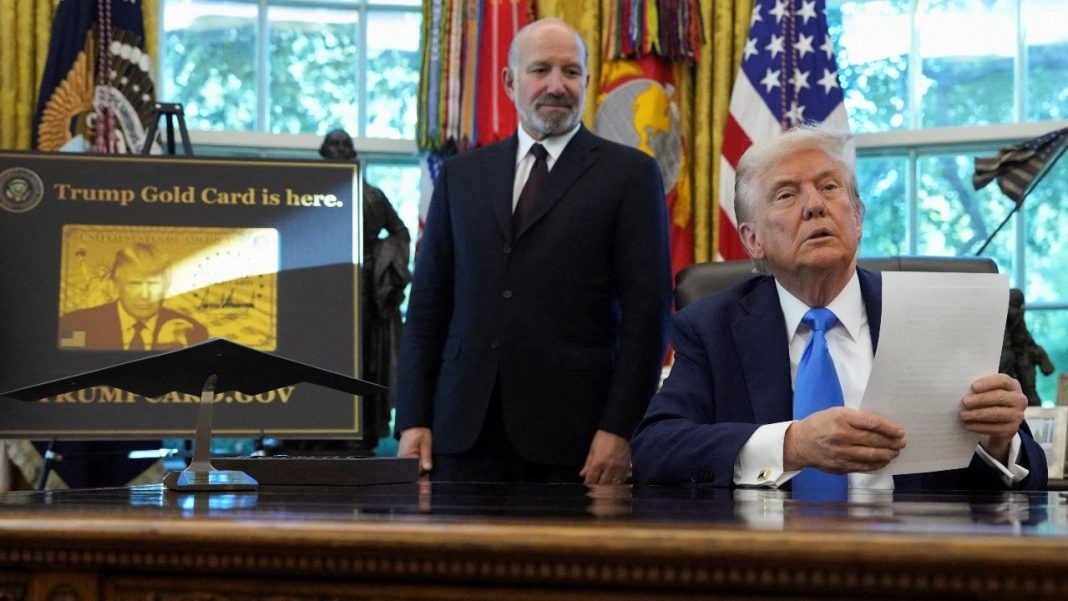
The global race for talent is intensifying, and few nations understand this better than the United States, a long-standing magnet for skilled professionals worldwide. For Indian students and professionals eyeing opportunities across the Atlantic, US immigration policy is a constant point of discussion and often, frustration. Amidst the complex landscape of H-1B visas and green card backlogs, a new concept has emerged from the political discourse: the “Trump Gold Card” fast-track visa. Proposed by former President Donald Trump, this initiative aims to streamline the path to permanent residency for certain foreign graduates from American universities. But what exactly is this proposal, and how might it work for the thousands of Indian aspirants?
What is the Proposed Trump Gold Card?
The “Trump Gold Card” is not a current visa category but rather a recent proposal articulated by Donald Trump, specifically targeting foreign students graduating from US colleges. The idea gained significant traction after Trump stated in a podcast interview that any foreign student graduating from a US university should automatically receive a green card to stay in the country. This starkly contrasts with the existing system, where even highly skilled graduates often face a lottery for temporary work visas (like the H-1B) and then endure lengthy waits for permanent residency.
At its core, the proposed Gold Card seeks to address the perceived “brain drain” where talented international graduates, often in critical STEM fields, are forced to leave the US due to visa hurdles, taking their innovations and skills elsewhere. While details remain sparse, the essence of the proposal is a direct, fast-track pathway to a green card for those who have completed their education at an accredited American institution. This would fundamentally bypass the multi-stage, often uncertain, process that currently governs the transition from student (F-1 visa) to worker to permanent resident.
Potential Application Process and Eligibility: A Hypothetical Framework
Given that the Gold Card is still a proposal, its application process and precise eligibility criteria are yet to be defined. However, drawing from Trump’s statements and existing immigration frameworks, we can outline a hypothetical structure. The primary eligibility criterion would undoubtedly be graduation from an accredited US college or university. While Trump’s initial comments did not specify, it is highly probable that the focus would be on degrees in Science, Technology, Engineering, and Mathematics (STEM) fields, given the consistent demand for these skills in the US economy.
For Indian students, many of whom pursue STEM degrees in the US, this could be a game-changer. Imagine a scenario where, upon completing a Master’s or Ph.D., an individual could apply directly for a green card without needing an employer to sponsor an H-1B and then face years of wait. The application would likely be a streamlined process with the United States Citizenship and Immigration Services (USCIS), requiring proof of graduation, identity, and a clean background check. It would ideally be designed for speed and simplicity, reflecting the “fast-track” nature emphasized by the proposal.
Nuances for Indian Applicants
For Indian students currently on F-1 visas or those contemplating higher education in the US, the prospect of a Gold Card brings both hope and questions. It could significantly reduce the anxiety associated with post-graduation employment and long-term settlement. However, potential challenges might include competitive criteria if the number of Gold Cards is capped, or if eligibility is restricted to graduates from only top-tier universities. The benefit would be immense for those who qualify, offering an unprecedented level of certainty. Dr. Preeti Rao, an immigration consultant based in Bengaluru, notes, “This proposal, if enacted, could fundamentally alter the landscape for international students, particularly those from countries like India who consistently contribute immensely to the American innovation ecosystem. It offers a tangible reward for investing in US education and staying to build the economy.”
Implications and the Road Ahead for Indian Aspirants
Should the Trump Gold Card proposal materialize into policy, its implications for India and Indian professionals would be substantial. It could incentivize more Indian students to choose the US for higher education, confident in a clear path to permanent residency. This would further solidify the US’s position as a premier destination for talent. For India, it could mean a continued, or even accelerated, brain drain of its brightest minds to the US, although some might argue that these individuals often foster strong economic and intellectual ties between the two nations.
However, it is crucial to remember that this remains a political proposal, not enacted law. Its passage would require complex legislative maneuvering, potentially facing scrutiny and amendments in Congress. The specifics—who qualifies, how many, and how it interacts with existing immigration quotas—are yet to be fleshed out. For now, Indian aspirants should stay informed about these developments, recognizing the high potential of such a policy while also acknowledging the significant political hurdles and uncertainties on the road to its implementation. The “Trump Gold Card” represents a powerful idea in the ongoing debate about skilled immigration, one that holds particular resonance for India’s vast pool of talented individuals.

