


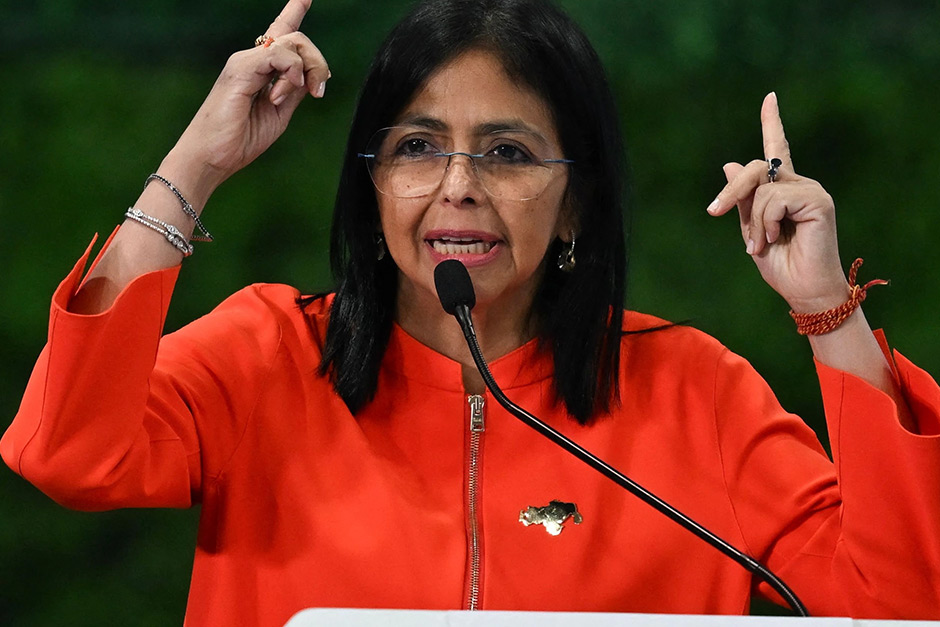
Venezuela’s acting president, Delcy Rodriguez, recently delivered a sharp critique of the United States, accusing the Trump administration of “energy greed.” This statement, made amidst ongoing U.S. sanctions and a profound economic crisis in Caracas, not only reaffirmed Venezuela’s defiant posture but explicitly signalled a deeper pivot towards strategic alliances with Russia and China. For energy-dependent nations like India, these developments in the resource-rich Latin American nation carry significant geopolitical and economic implications, underscoring the complex dance of global energy security and shifting international allegiances.
Caracas Levels ‘Energy Greed’ Charge Against Washington
The latest critique from Caracas came directly from Delcy Rodriguez, who effectively leads the Venezuelan government. Speaking to state media, Rodriguez condemned what she called Washington’s relentless pursuit of Venezuela’s vast oil reserves, framing U.S. sanctions not as a push for democracy, but as an aggressive act driven purely by resource acquisition. “The history of intervention in our region, and indeed in Venezuela, is intrinsically linked to the insatiable appetite for our natural resources,” Rodriguez stated. “President Trump’s administration, under the guise of humanitarian concern, merely masks a profound energy greed aimed at seizing control of our oil wealth.”
This accusation echoes sentiments long articulated by President Maduro, who portrays U.S. actions as imperialistic attempts to undermine Venezuela’s government and plunder resources. The U.S. maintains its sanctions aim to pressure the Maduro regime towards democratic reforms and alleviate humanitarian suffering. However, from Caracas’s perspective, these measures have crippled the nation’s oil industry—its primary revenue source—exacerbating economic hardships and constituting a direct assault on national sovereignty. The rhetoric underscores a deep ideological chasm, framing economic woes as external aggression rather than internal failures.
The Eastward Turn: Caracas Courts Moscow and Beijing
Beyond the verbal broadside against Washington, Rodriguez’s explicit declaration of Venezuela’s intent to strengthen ties with Russia and China was even more significant. By “leaving the door open” for these global powers, Caracas actively recalibrates its geopolitical alignment, seeking economic lifelines and diversifying partnerships amidst continuous U.S. pressure.
Moscow’s Steadfast Support
Russia, a long-standing ally, has consistently provided diplomatic, military, and financial backing to Venezuela. Moscow’s strategic interests are clear: challenging U.S. influence, providing a market for military hardware, and securing lucrative oil and gas deals. Russian energy giants have historically played a crucial role, offering vital capital and expertise. Deepening this relationship promises further military cooperation, debt restructuring, and energy joint ventures, solidifying Moscow’s foothold.
Beijing’s Economic Lifeline
China has emerged as Venezuela’s largest creditor and a major investor, particularly in infrastructure and energy. Beijing’s interest is primarily energy security—Venezuela holds the world’s largest proven oil reserves—and its broader Belt and Road Initiative. While China is cautious regarding direct military support, its economic leverage is immense. Increased cooperation could involve new credit lines, expanded oil-for-loan agreements, and Chinese involvement in revitalising Venezuela’s oil infrastructure, offering a crucial alternative to Western financial systems.
India’s Balancing Act Amidst Shifting Sands
For India, a rapidly growing economy with substantial energy needs, these geopolitical maneuvers in Venezuela present a complex scenario. India has historically been a significant buyer of Venezuelan crude oil, valued for its refineries, but U.S. sanctions have severely complicated this trade. As a nation committed to energy security, India champions stable global energy markets and non-interference, recognizing the increasing multipolarity that aligns with its “multi-alignment” foreign policy.
While India maintains strong strategic partnerships with the United States, it also fosters robust relationships with Russia and China. Navigating the Venezuelan crisis thus requires delicate diplomatic balance. India will likely monitor developments, weighing potential renewed access to Venezuelan oil against broader geopolitical interests and regulatory compliance. This shift by Caracas towards a Moscow-Beijing axis underscores the intricate web of global energy politics and nations’ growing assertion to chart their own course, even when challenging established power structures.
Delcy Rodriguez’s sharp critique of U.S. “energy greed” and the explicit overture to Russia and China mark a significant moment in Venezuela’s protracted struggle. It signals a hardening of Caracas’s anti-Western stance and a determined pivot towards an emerging Eastern axis. As the U.S. continues to exert pressure, Venezuela appears committed to forging a new path, leveraging its strategic resources to attract support from powers willing to challenge the prevailing international order. The implications for global energy markets, regional stability, and the ongoing geopolitical contest for influence are profound, suggesting a more fragmented and complex international landscape ahead.

