


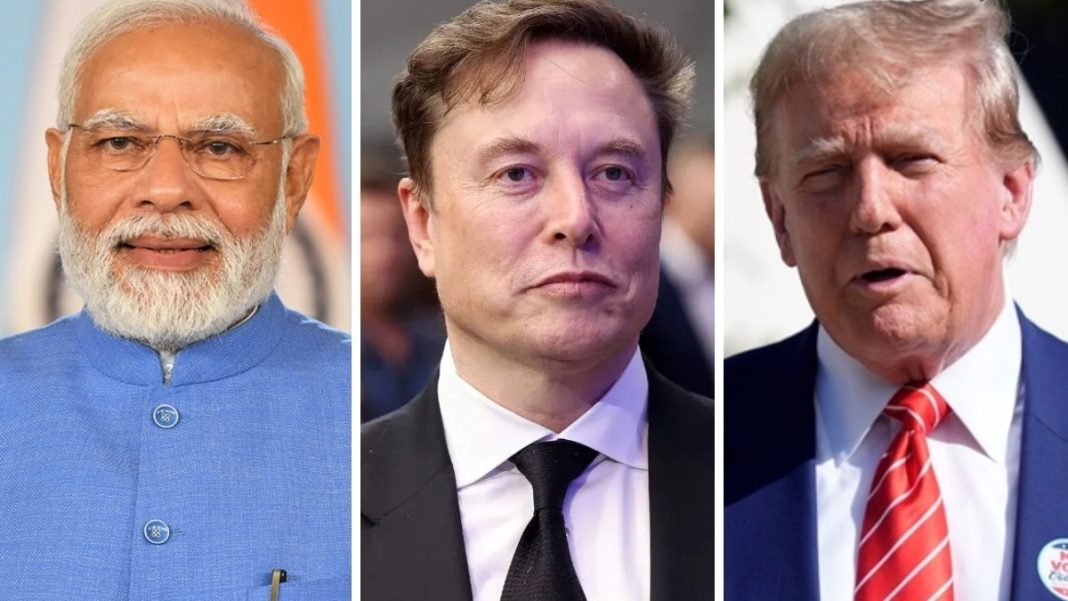
In a move that has captured global attention and sparked considerable debate, tech titan Elon Musk reportedly joined a high-stakes telephone conversation between India’s Prime Minister Narendra Modi and former US President Donald Trump. This unusual trilateral engagement, first brought to light by The New York Times, occurred amidst escalating tensions and an unfolding conflict in the Middle East involving Iran, raising questions about the evolving nature of international diplomacy and the role of private sector giants in geopolitical crises.
The report, which quickly reverberated across diplomatic corridors and newsrooms worldwide, highlights a significant departure from traditional state-to-state interactions. While heads of government regularly engage in bilateral and multilateral dialogues, the inclusion of a non-state actor with such immense technological and economic influence in a discussion involving two major global powers — especially during a critical international flashpoint — signals a potential paradigm shift in how global crises are addressed and managed. For India, a nation deeply invested in regional stability and global peace, understanding the implications of such an unprecedented alignment becomes paramount.
The Unprecedented Trilateral Engagement
The mere fact of Elon Musk’s presence on a call between Prime Minister Modi and Donald Trump during a period of heightened geopolitical volatility is remarkable. While the precise details of the conversation remain under wraps, the context of the Iran war provides a compelling backdrop. The Middle East, a region vital for global energy security and trade, is once again a focal point of international concern. India, with its significant energy imports from the region and a large diaspora living there, has a vested interest in de-escalation and stability. Its foreign policy traditionally emphasizes strategic autonomy and a peaceful resolution to conflicts, making any development that could influence regional dynamics a matter of close observation.
The New York Times report did not elaborate on Musk’s specific contributions to the call, but his involvement inevitably prompts speculation. Was he present to offer technological solutions for communication, intelligence, or even humanitarian aid? Or did his presence signify a broader recognition of the intertwined nature of technology, economy, and statecraft in contemporary international relations? Regardless of the specific agenda, this event underscores a growing trend where the lines between governmental diplomacy and the influence of powerful private entities are becoming increasingly blurred. This is particularly relevant in an era defined by rapid technological advancements and interconnected global challenges.
Geopolitical Chessboard: Iran, India, and Global Stakes
The ongoing conflict involving Iran carries profound implications for global stability, and India’s position in this complex scenario is multifaceted. India maintains historical ties with Iran, a crucial partner for energy and regional connectivity, particularly through projects like the Chabahar Port. At the same time, India shares robust strategic partnerships with the United States and other Western nations. Navigating this delicate balance requires astute diplomacy, emphasizing de-escalation, and protecting its strategic interests.
Former President Trump’s administration had previously adopted a hardline stance against Iran, leading to heightened tensions. Prime Minister Modi’s government, on the other hand, has consistently advocated for dialogue and diplomacy as the primary means to resolve disputes. The convergence of these figures, with Musk as an unexpected participant, suggests a complex interplay of interests and potential strategies aimed at influencing the trajectory of the Middle East conflict. “This development underscores a significant shift in global diplomacy, where non-state actors, particularly those controlling pivotal technologies, are gaining unprecedented access to the highest echelons of power. For India, navigating this new dynamic while upholding its strategic interests in a volatile region like the Middle East becomes even more crucial,” observes an Indian diplomatic observer.
The Musk Factor: Technology, Influence, and Future Diplomacy
Elon Musk’s presence on such a call is a testament to his unique standing as a global figure whose influence extends far beyond the technology sector. As the CEO of Tesla, SpaceX, and X (formerly Twitter), he commands an unparalleled reach in innovation, space exploration, and global communication. His companies often operate at the cutting edge of critical infrastructure, from satellite internet services like Starlink to advanced AI capabilities.
In a conflict zone, secure and reliable communication is paramount. Starlink, for instance, has demonstrated its capacity to provide connectivity in challenging environments. It is plausible that discussions could have revolved around the potential application of such technologies for communication, surveillance, or even humanitarian relief efforts in the midst of the Iran conflict. Beyond practical applications, Musk’s involvement could also be seen as an acknowledgment of the increasing power held by tech leaders in shaping global narratives and influencing political outcomes. This incident opens up new avenues for pondering the role of private innovation and entrepreneurship in addressing global crises, potentially redefining the landscape of future diplomatic engagements.
The report of Elon Musk joining PM Modi and Donald Trump’s call amidst the Iran war is more than just a fleeting news item; it is a significant indicator of the evolving complexities in international relations. For India, it presents both challenges and opportunities as it navigates a multipolar world increasingly shaped by technology and the influence of non-state actors. This unusual engagement underscores the pressing need for adaptable diplomatic strategies and a holistic approach to global governance, where traditional statecraft merges with technological prowess and private sector influence to address the world’s most intricate problems.
As the geopolitical landscape continues to shift, such unprecedented interactions may well become more commonplace, urging nations like India to carefully consider the implications for their sovereignty, strategic autonomy, and global standing.

