


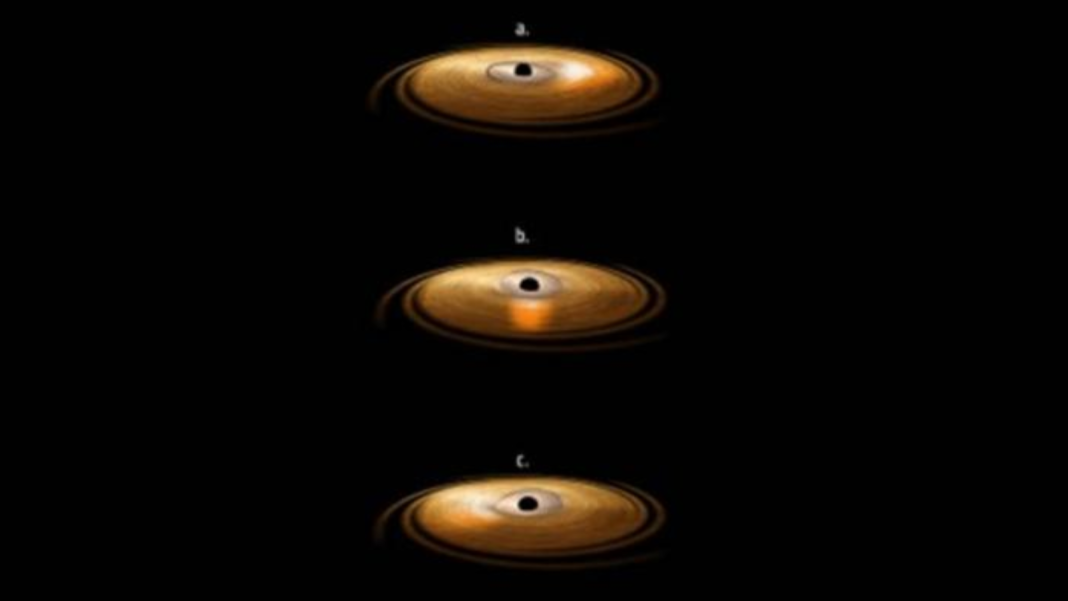
For decades, the concepts of black holes and their profound influence on the fabric of the universe have largely lived in the realm of theory. Yet, recent observations from the far reaches of space are not just confirming these extraordinary ideas; they’re showcasing them with remarkable clarity. Scientists have recently witnessed a black hole in action, actively consuming surrounding material and, in doing so, providing a vivid demonstration of how these cosmic behemoths twist and warp spacetime itself, precisely as Albert Einstein predicted over a century ago.
The Cosmic Feast
Imagine a celestial maelstrom, an invisible gravity well so powerful that nothing, not even light, can escape once it crosses a certain boundary. This is a black hole, and these recent observations offer an unprecedented look at one engaged in a ‘cosmic feast.’ Rather than directly seeing the black hole itself, which is by definition dark, astronomers observed the energetic dance of matter spiraling into its gravitational embrace.
As gas, dust, and even stars approach a black hole, they form an accretion disk, a superheated, swirling vortex of material. Friction and gravitational forces heat this material to millions of degrees, causing it to emit intense radiation across the electromagnetic spectrum, particularly X-rays and ultraviolet light. It’s this brilliant, tell-tale glow from the accretion disk that acts as a beacon, signaling the black hole’s presence and its ongoing meal. The sheer scale and intensity of this observed feeding frenzy underscore the immense power inherent in these enigmatic objects.
Spacetime Takes a Twist
The true marvel of these observations, however, lies in how they emphatically reinforce Albert Einstein’s General Theory of Relativity. Published in 1915, this theory posited that gravity isn’t a force pulling objects together, but rather a curvature of spacetime caused by mass and energy. Massive objects, like black holes, warp this fabric so profoundly that they not only draw in matter but also bend the path of light and even the very flow of time in their vicinity.
What scientists observed was precisely this distortion in action. The light emitted from the accretion disk, instead of traveling in a straight line, was seen to follow the warped contours of spacetime around the black hole. This phenomenon, often referred to as gravitational lensing, was evident in the peculiar way the light appeared to emanate from the disk. In some instances, light from the far side of the accretion disk was bent around the black hole itself, making parts of the disk visible that should otherwise be obscured.
One expert, reflecting on the profound implications, remarked, “Witnessing light literally curve around a black hole isn’t just a pretty picture; it’s a direct, undeniable confirmation of Einstein’s century-old predictions about the geometry of the universe. It’s like seeing the blueprint of reality unfold before your eyes.” This isn’t just about a powerful gravitational pull; it’s about the very structure of space and time being dramatically reshaped by a black hole’s presence, twisting the cosmic stage on which all events play out.
Conclusion
These latest observations serve as a powerful reminder of the enduring genius of Albert Einstein and the remarkable ability of modern astronomy to test and validate even the most mind-bending theories. While black holes remain objects of immense mystery, each new discovery, particularly those demonstrating their direct influence on spacetime, brings us closer to understanding the fundamental rules that govern our universe. The cosmos continues to be a laboratory on the grandest scale, and with every flicker of light from a distant, feeding black hole, we gain deeper insights into the astonishing reality we inhabit.

