


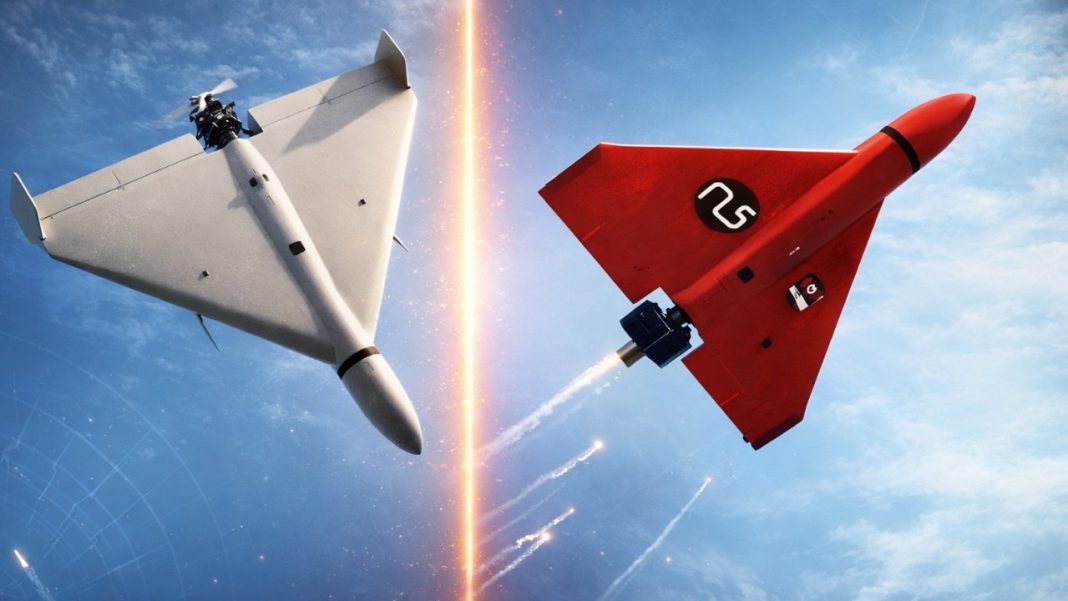
The modern battlefield is constantly evolving, with unmanned aerial vehicles (UAVs) emerging as game-changers. Among these, loitering munitions, often colloquially termed “kamikaze drones,” have grabbed headlines for their cost-effectiveness and devastating impact. The Iranian Shahed-136, prominently featured in recent conflicts, exemplifies this new class of weaponry. This raises a crucial question for India’s defense preparedness: does the nation possess or is it actively developing similar low-cost, killer kamikaze drones?
The Shahed-136 Phenomenon and the Rise of Loitering Munitions
The Shahed-136, a delta-wing unmanned aerial vehicle, gained notoriety for its relatively low cost, long-range capabilities, and precision strike potential. Designed to loiter over a target area before diving to impact, it functions as a highly effective, expendable munition. Its affordability, estimated to be in the tens of thousands of dollars per unit, makes it a potent weapon for adversaries looking to overwhelm defenses without committing expensive assets. These drones typically carry an explosive payload and are guided to their targets, often operating in swarms to maximize impact and overcome air defenses.
The strategic appeal of loitering munitions lies in their ability to provide persistent reconnaissance, pinpoint targets, and then engage them without requiring a separate strike platform. They bridge the gap between traditional missiles and conventional drones, offering a potent mix of intelligence, surveillance, and strike capabilities. This has prompted militaries worldwide, including India’s, to seriously evaluate their own capabilities in this critical domain.
India’s Indigenous Push for Loitering Munitions
India’s defense establishment is acutely aware of the tactical shift brought about by loitering munitions. There is a strong, concerted effort to indigenously develop and acquire such systems, moving beyond reliance on foreign suppliers. The “Make in India” initiative plays a crucial role here, aiming to bolster strategic autonomy and reduce import dependence.
Several Indian private sector companies, alongside the Defence Research and Development Organisation (DRDO), are at the forefront of this development. For instance, Economic Explosives Ltd. (EOL) has developed the Nagastra-1, a man-portable loitering munition capable of engaging targets up to 15 kilometers away. This system has undergone trials and is slated for induction into the Indian Army. Other players like Tata Advanced Systems Limited (TASL) and Adani Defence & Aerospace are also investing heavily in drone technology, including loitering munitions.
At various defense expos, such as Aero India, Indian startups and established firms regularly showcase their prototypes and production models of loitering munitions. These range from smaller, tactical drones designed for infantry support to larger systems with extended range and payload capacities. The emphasis is on developing systems that are not only effective but also cost-efficient, mirroring the economic advantage seen in drones like the Shahed-136.
“The recent global conflicts have underscored the critical importance of loitering munitions in modern warfare. For India, developing an indigenous, affordable, and robust capability in this domain is not just a strategic advantage, but a fundamental necessity for future security challenges,” stated a senior defense analyst, highlighting the urgent imperative.
Challenges and the Road Ahead
While India has made significant strides, challenges remain. Developing sophisticated guidance systems, ensuring robust jamming resistance, and scaling up production to meet potential demand are key areas of focus. Integrating advanced artificial intelligence for swarm capabilities and target recognition is also a complex undertaking. Furthermore, the counter-drone technology aspect cannot be overlooked; as loitering munitions proliferate, so must the means to detect, track, and neutralize them.
The Indian armed forces are actively procuring various types of drones, including those with loitering munition capabilities, from both domestic and international sources to bridge immediate gaps. However, the long-term vision is clear: to achieve self-reliance in this critical technology. The focus is not just on replicating existing foreign models but on innovating to create systems tailored to India’s unique operational requirements and geopolitical landscape.
In conclusion, while India may not yet have a direct, widely-deployed counterpart to Iran’s Shahed-136 in terms of sheer numbers or conflict exposure, the nation is unequivocally on a clear path to developing and fielding its own low-cost, killer kamikaze drones. The indigenous defense ecosystem is robustly engaged in research, development, and production, ensuring that India will be well-equipped with these crucial tools for future asymmetric and conventional warfare scenarios.

