


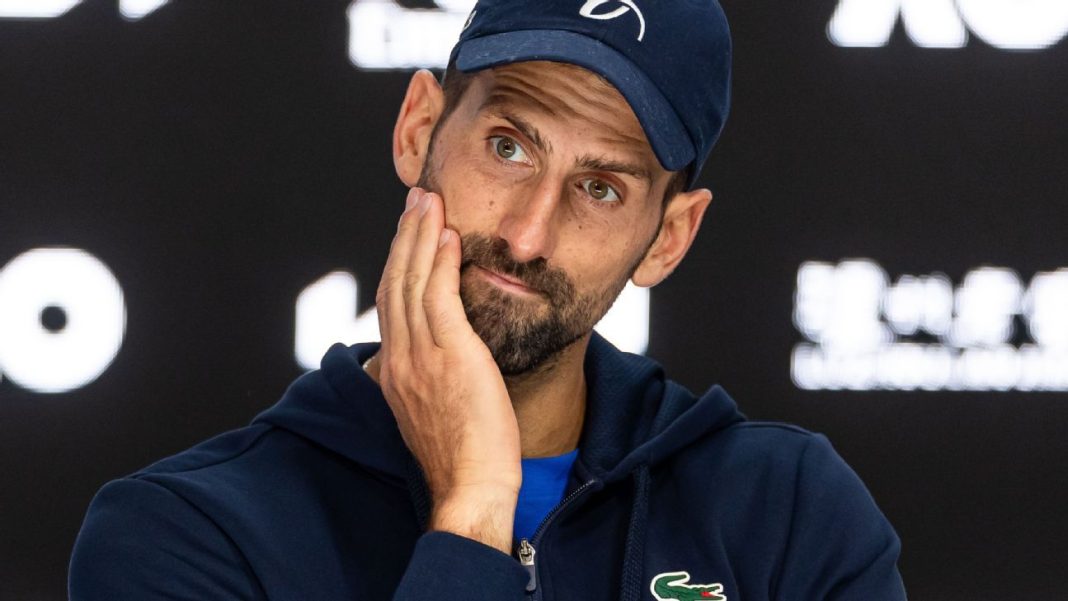
In the high-stakes world of professional tennis, where every ace and unforced error is dissected, an off-court development involving one of the sport’s biggest stars is making significant waves. Novak Djokovic, the Serbian tennis icon, has reaffirmed his commitment to the Professional Tennis Players Association (PTPA), effectively solidifying his distance from the traditional governance structure of the Association of Tennis Professionals (ATP). This move, while not entirely new, underscores a persistent push for independent player representation that continues to shape the future discourse of the sport globally, including among its vast Indian fanbase.
The Genesis of a Separate Voice
The Professional Tennis Players Association (PTPA) was founded in August 2020 by Novak Djokovic and Canadian Vasek Pospisil. Its establishment marked a pivotal moment, emerging from long-standing debates about player welfare, prize money distribution, scheduling, and transparency within the ATP. The ATP, which governs the men’s professional tennis circuit, is a 50/50 partnership between players and tournaments. While the ATP Player Council serves as a representative body for athletes within this structure, Djokovic and Pospisil, along with other proponents, argued that it lacked true independence and bargaining power.
The PTPA’s core mission is to empower players by creating a unified voice independent of the tour organisers. Its formation immediately caused a stir, drawing both support and scepticism from within the tennis community. Supporters see it as a necessary evolution to ensure players have a stronger say in decisions that directly impact their careers and livelihoods. Critics, however, have expressed concerns about potential fragmentation within the sport’s governance and the challenges of having two separate player bodies – the ATP Player Council and the PTPA – vying for influence.
Djokovic’s recent reiteration of his dedication to the PTPA reinforces his belief in this independent model. This isn’t a new ‘cut,’ but rather a reaffirmation of a separation that began when he resigned from the ATP Player Council in 2020 to focus on the PTPA. It signals a continued push for what he believes is a more direct and effective form of player advocacy.
Implications for Tennis Governance and Unity
Djokovic’s unwavering support for the PTPA carries significant weight, given his stature as one of the greatest players of all time. His commitment injects renewed vigour into the organisation, which has faced challenges in gaining universal acceptance and recognition from major tennis bodies. The PTPA aims to represent all professional tennis players, not just a select few, and seeks to address issues such as fair prize money across all tiers of the sport, better health and pension plans, and greater transparency in decision-making processes.
The existence of two player bodies naturally raises questions about player unity and the future landscape of tennis governance. Will the PTPA eventually work in conjunction with the ATP, or will it remain an entirely separate entity, potentially leading to further discord? Many players, including some of Djokovic’s biggest rivals, have expressed differing views on the PTPA’s necessity, with some preferring to work within the existing ATP framework. However, the discussions initiated by the PTPA have undoubtedly put pressure on the ATP to re-evaluate and improve its player representation mechanisms.
The underlying sentiment from PTPA advocates is a desire for players to be treated as equal partners, not just employees. As Djokovic himself stated during the PTPA’s inception, “The only thing is that we want to have 100% of the players represented, not just 50%.” This highlights the perceived need for a body that can advocate solely for player interests without potential conflicts of interest arising from tournament representation.
A Global View, An Indian Perspective
For Indian tennis enthusiasts, who follow Grand Slams and ATP tours with fervent passion, these off-court developments are crucial. India, with its growing interest in professional tennis, has players who aspire to reach the top ranks, and their potential journeys are directly impacted by the policies and structures governing the sport. Better prize money at lower-tier tournaments, improved support systems, and transparent governance are factors that could significantly aid emerging Indian talents on the global stage.
The ongoing dialogue between players, the ATP, and the PTPA will invariably influence how the sport evolves in terms of athlete welfare and career sustainability. From a global standpoint, the PTPA represents a fascinating experiment in player power. If successful, it could set a precedent for other sports. Its long-term impact on the ATP Tour, the Grand Slams, and player-tournament relations remains to be seen, but one thing is clear: the conversation around player representation has been irrevocably altered, largely thanks to the unwavering vision of figures like Novak Djokovic.
As the tennis season continues, all eyes will be on how the PTPA progresses and whether its independent path ultimately leads to a more equitable and player-centric ecosystem for professional tennis worldwide.

