


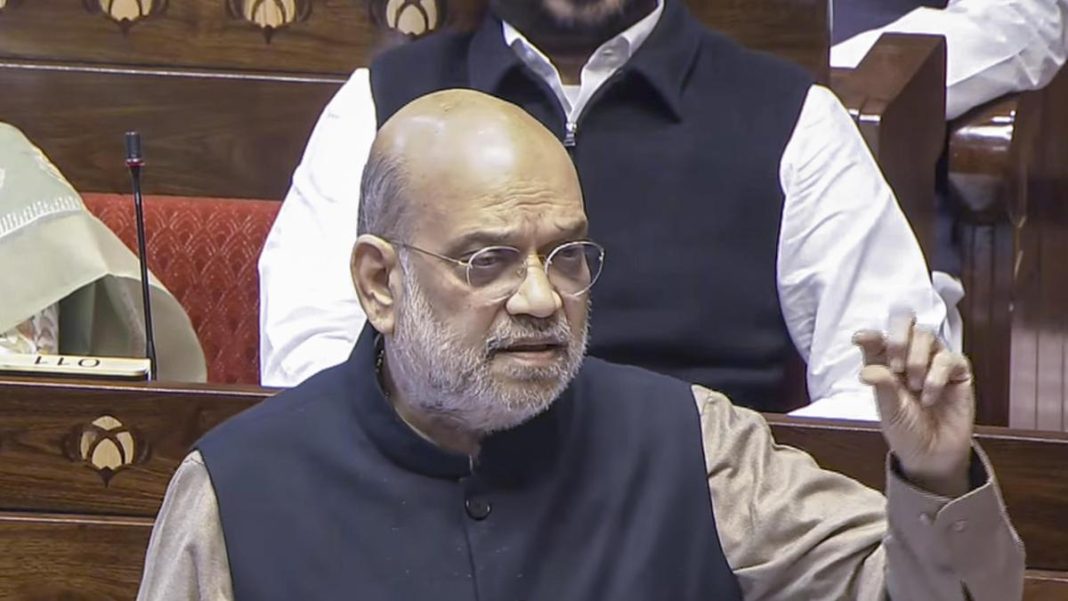
In a recent statement that has sparked considerable debate, Union Home Minister Amit Shah posited a direct link between the decision to “divide” the national song Vande Mataram and the eventual partition of India. Speaking at a public event, Shah articulated his view that this particular historical decision laid the groundwork for the nation’s eventual fragmentation in 1947. This assertion brings to the forefront a complex chapter of India’s freedom struggle, intertwining the symbolic power of a revered song with the contentious politics that shaped the subcontinent.
Vande Mataram: A Symbol Forged in Struggle
The song Vande Mataram, meaning “I bow to thee, Mother,” holds an unparalleled place in India’s nationalist movement. Composed by Bankim Chandra Chattopadhyay in 1875 and published in his 1882 Bengali novel, Anandamath, it quickly transcended its literary origins. The song gained prominence during the Swadeshi movement of 1905, becoming an anthem for freedom fighters protesting the partition of Bengal. Its powerful imagery of the motherland as a divine entity resonated deeply with a populace yearning for liberation. Leaders like Aurobindo Ghosh hailed it as the “Mantra of Nationalism,” and it was routinely sung at Indian National Congress sessions, embodying the collective aspiration for a united, independent India.
However, the song’s origins in a novel depicting an anti-Muslim rebellion, coupled with its overt Hindu idolatry references in certain stanzas, began to draw objections from sections of the Muslim community. While the initial stanzas, which metaphorically praised the motherland, were widely accepted, later verses invoking deities like Durga and Lakshmi became a point of contention. As the demand for a separate Muslim state gained momentum, the song became a flashpoint, symbolizing the growing communal divide.
The 1937 Resolution and Amit Shah’s Interpretation
The controversy surrounding Vande Mataram reached a critical juncture in 1937. Faced with increasing dissent from Muslim League leaders and sections of the Muslim clergy regarding the song’s more idolatrous passages, the Indian National Congress formed a committee, including Mahatma Gandhi and Jawaharlal Nehru, to address the issue. The committee recommended that only the first two stanzas, which were devoid of direct religious invocation and focused purely on the beauty and bounty of the motherland, should be adopted as the national song. This decision was an attempt to maintain unity within the broader freedom movement and accommodate the concerns of all communities.
It is this particular decision that forms the crux of Amit Shah’s recent statement. Shah argued that the very act of pruning the song, or “dividing” it to appease a particular section, marked a crucial deviation from the principle of an undivided nation. He suggested that by yielding to these demands, the Congress inadvertently validated the idea of separate religious identities influencing national symbols, thereby setting a precedent that eventually culminated in the demand for Pakistan and the partition of India.
Addressing the historical context, Home Minister Shah stated, “The day a decision was taken to divide Vande Mataram, the foundation for partition was laid.” He further emphasized that had the nationalist leadership stood firm on the entirety of the song, the trajectory of Indian history might have been different, implying that appeasement policies contributed significantly to the nation’s eventual split.
Revisiting a Complex History
While Shah’s statement offers a pointed interpretation, the partition of India remains one of the most complex and debated events in modern history. Historians generally attribute Partition to a confluence of factors, including the British policy of ‘divide and rule,’ the rise of communal politics, the strategic blunders of various political leaders, socio-economic disparities, and the inability of the Congress and the Muslim League to arrive at a mutually acceptable power-sharing formula. To attribute the catastrophic event of Partition solely to the controversy surrounding Vande Mataram is an interpretation that invites further scrutiny and discussion.
The decision to adopt only certain stanzas of Vande Mataram in 1937 was seen by many at the time as a pragmatic compromise aimed at fostering communal harmony within the nationalist movement, rather than an act of surrender. However, Shah’s perspective highlights a school of thought that views such compromises as foundational steps towards the eventual fragmentation of the country along religious lines.
Conclusion
Amit Shah’s assertion linking the “division” of Vande Mataram to the partition of India reignites a significant historical debate, urging a re-examination of critical junctures in the freedom struggle. It underscores the profound symbolic power of national anthems and cultural markers, and how their interpretation can be central to defining national identity and unity. While historians continue to dissect the myriad factors that led to Partition, Shah’s statement offers a distinct perspective, reminding us that the echoes of past decisions continue to resonate in contemporary discussions about nationhood and historical narratives in India.

