


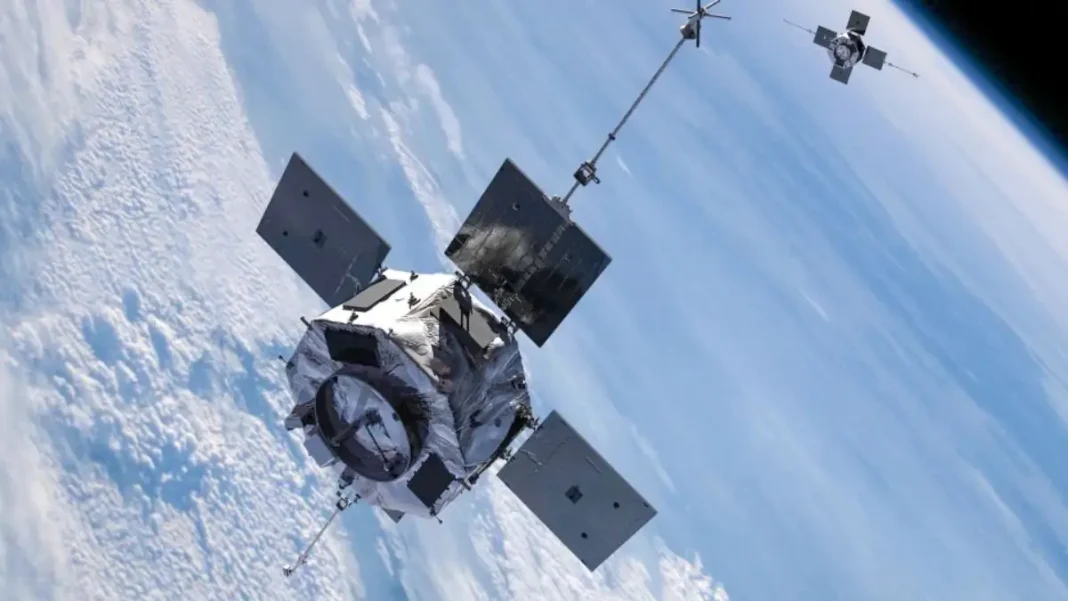
The vast expanse of space, while offering unparalleled opportunities for scientific discovery, also serves as a silent graveyard for countless defunct satellites and rocket stages. Each piece of debris poses a potential threat, and its eventual return to Earth’s atmosphere is a carefully monitored event. One such upcoming re-entry involves NASA’s Van Allen Probe A, a veteran spacecraft that has completed its mission and is now on an uncontrolled descent towards our planet’s protective atmospheric shield.
For nearly a decade, the twin Van Allen Probes meticulously studied Earth’s radiation belts, contributing immensely to our understanding of space weather. As Probe A now prepares for its final descent, the event serves as a stark reminder of the lifecycle of space missions and the ever-growing challenge of space debris management, a concern that resonates globally, including within India’s burgeoning space sector.
The Van Allen Probes: A Legacy of Discovery
Launched in August 2012, the Van Allen Probes, initially known as the Radiation Belt Storm Probes (RBSP), were a crucial part of NASA’s Living With a Star program. Their primary mission was to unravel the mysteries of Earth’s Van Allen radiation belts – two concentric layers of energetic charged particles held in place by our planet’s magnetic field. These belts can expand and contract dramatically during geomagnetic storms, posing risks to operational satellites and astronauts.
The twin spacecraft, named Van Allen Probe A and Van Allen Probe B, were built to withstand the harsh radiation environment they were designed to study. Over their operational lifetime, they provided unprecedented insights into how these radiation belts are energized, depleted, and transformed by solar activity. Their discoveries included the identification of a temporary third radiation belt, the role of plasma waves in accelerating particles to relativistic speeds, and a better understanding of the dynamics of space weather.
After successfully completing their five-year prime mission and subsequent extended operations, the probes began to run low on fuel. To prevent them from becoming long-term space junk in a critical orbital region, NASA made the decision to decommission them in 2019. The two probes were nudged into orbits that would ensure their eventual re-entry, albeit over several years or even decades. Van Allen Probe A is now anticipated to make its atmospheric re-entry in the coming weeks or months, having exhausted its propulsive capabilities.
Atmospheric Re-entry and Global Space Debris Concerns
The re-entry of a defunct satellite like Van Allen Probe A is a natural consequence of space operations. As the probe gradually loses altitude due to atmospheric drag, it will eventually plunge into denser layers of the atmosphere. The intense friction generated will cause the spacecraft to heat up dramatically, leading to its disintegration. While some larger, more robust components might survive and reach the Earth’s surface, the vast majority of the satellite is expected to burn up completely. NASA, along with other international agencies, continuously monitors its trajectory to provide updates and assess any potential, albeit extremely low, risks.
This event underscores a global challenge: the escalating problem of space debris. Thousands of defunct satellites, spent rocket stages, and fragments from collisions orbit Earth, posing a threat to operational spacecraft and future missions. The international community, including India, is actively engaged in developing strategies for space situational awareness and debris mitigation. The Inter-Agency Space Debris Coordination Committee (IADC), of which ISRO is a member, outlines guidelines for responsible space operations, including end-of-life disposal measures.
As Dr. K. Sivan, former Chairman of ISRO, once stated, “Space debris is a global problem that requires global solutions. For a nation like India, which is rapidly expanding its space footprint, ensuring the long-term sustainability of space is paramount for our scientific and economic progress.” This sentiment reflects India’s proactive stance on space sustainability, evident in initiatives like Project NETRA (Network for Space Object Tracking and Analysis), which aims to build indigenous capabilities for tracking space objects and mitigating collision risks.
India’s Commitment to Space Sustainability
India, with its ambitious space program driven by ISRO, is acutely aware of the importance of a clean and safe orbital environment. The re-entry of Van Allen Probe A, while not an immediate concern for India directly, serves as a significant event that highlights the shared responsibility of spacefaring nations. ISRO has its own guidelines for post-mission disposal, including passive de-orbiting for Low Earth Orbit (LEO) satellites and graveyard orbits for Geostationary Earth Orbit (GEO) satellites.
The nation’s commitment extends to developing advanced technologies for space debris management, including research into active debris removal and better tracking systems. As India prepares for more complex missions, including human spaceflight with Gaganyaan, the safety of its assets and personnel in orbit becomes even more critical. Events like the Van Allen Probe A re-entry serve as valuable case studies, offering data and insights into atmospheric re-entry dynamics that can inform future mission planning and debris management strategies.
In conclusion, the impending re-entry of NASA’s Van Allen Probe A marks the dignified end of a highly successful scientific mission. While the event carries an inherent fascination, it more importantly casts a spotlight on the growing imperative for sustainable space practices. For India and the global space community, it’s a timely reminder to continue collaborating on solutions for managing space debris, ensuring that the final descent of one mission paves the way for a safer, more sustainable future in space for all.

