


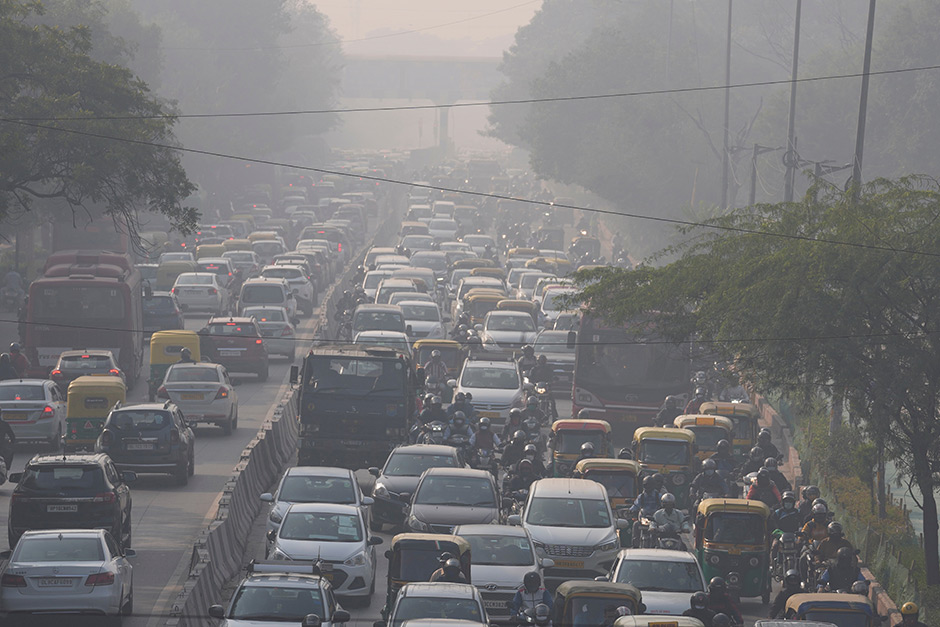
The worsening air quality across the Delhi-National Capital Region (NCR) has become an annual environmental crisis, prompting authorities to implement stringent measures under the Graded Response Action Plan (GRAP). While these interventions aim to curb pollution levels, their recent execution, particularly the enforcement of GRAP Stage IV guidelines, has sparked widespread frustration among daily commuters. Border crossings connecting Noida, Ghaziabad, Gurgaon, and Faridabad to Delhi have transformed into chokepoints, triggering hours-long traffic jams and raising pertinent questions about the efficacy and planning behind such reactive policies.
The latest phase of GRAP, triggered by ‘severe plus’ air quality readings, mandates a complete ban on specific categories of vehicles, including non-BS VI diesel light motor vehicles and all diesel medium and heavy goods vehicles not involved in essential services. While the intent is clear – to reduce vehicular emissions – the implementation has led to significant logistical nightmares. Commuters, already grappling with the psychological and physical toll of pollution, now face unprecedented delays, fuel wastage, and disruption to their daily lives.
The GRAP IV Mandate: A Double-Edged Sword for NCR Commuters
With air quality indices consistently in the ‘severe’ or ‘hazardous’ categories, the Commission for Air Quality Management (CAQM) invoked GRAP Stage IV, introducing a slew of restrictions. These include a ban on all types of construction and demolition activities, restrictions on industries operating on non-clean fuels, and the aforementioned stringent vehicular curbs. For millions residing in satellite cities like Noida, Ghaziabad, Gurgaon, and Faridabad who commute to Delhi for work, education, or essential services, these regulations have had an immediate and severe impact.
The primary pain points have emerged at the inter-state borders. Police and transport department officials, tasked with enforcing the ban on non-compliant vehicles, have set up checkpoints, leading to thorough inspections. While necessary for compliance, these checks drastically slow down traffic flow, particularly during peak hours. The result is a cascading effect, with queues extending for kilometres, turning what would typically be a 30-minute journey into a multi-hour ordeal. Families, office-goers, students, and businesses alike are bearing the brunt of this bottleneck.
Commuters Fume: “Decisions Feel Knee-Jerk”
The sentiment on the ground is overwhelmingly one of exasperation and a feeling of being caught unprepared. Many commuters express understanding for the need to combat pollution but question the suddenness and lack of alternative provisions accompanying such drastic measures. The common refrain is that while the problem is chronic, the solutions often appear reactive and poorly coordinated.
“Every year, we see this pattern,” remarked Priya Sharma, a marketing professional commuting from Noida to South Delhi. “The air quality deteriorates, and then suddenly, there are these bans. Decisions feel knee-jerk. I spent three hours in traffic yesterday morning. It’s not just the delay; it’s the wasted fuel, the stress, and missing important meetings. Where are the long-term solutions? Where is better public transport infrastructure to handle this sudden load?” Her sentiments echo those of thousands traversing the DND Flyway, Kalindi Kunj, Chilla border, and other entry points into Delhi.
The impact extends beyond mere inconvenience. Businesses relying on timely movement of goods and personnel face operational challenges. Gig economy workers, dependent on daily commutes, see their earnings plummet due to prolonged travel times. The economic ripple effect, though harder to quantify immediately, is undoubtedly significant. While authorities are struggling to balance environmental protection with daily life, the consensus among affected citizens is that the current approach is causing undue hardship without a clear path towards sustainable change.
Beyond Reactive Bans: The Quest for Sustainable Solutions
The recurring pollution crisis and the subsequent, often disruptive, GRAP measures highlight a critical need for a more comprehensive and proactive approach to air quality management in the NCR. While emergency bans are a necessary evil in severe conditions, they cannot be the sole or primary strategy. The current situation underscores the urgent need for a robust, integrated public transport network that can absorb millions of commuters, thereby reducing reliance on private vehicles, especially during periods of high pollution.
Furthermore, there is a strong argument for stricter enforcement of emission norms year-round, promotion of electric vehicles with adequate charging infrastructure, and a concerted effort to control other major sources of pollution, such as industrial emissions and biomass burning, long before the air quality reaches hazardous levels. Rather than imposing sudden bans that cripple daily life, a phased, well-communicated strategy with viable alternatives would alleviate commuter frustration and foster greater public cooperation. The current scenario at NCR borders serves as a stark reminder that while tackling pollution is paramount, the chosen methods must also be sustainable, equitable, and considerate of the millions whose livelihoods and daily routines depend on efficient urban mobility.

