


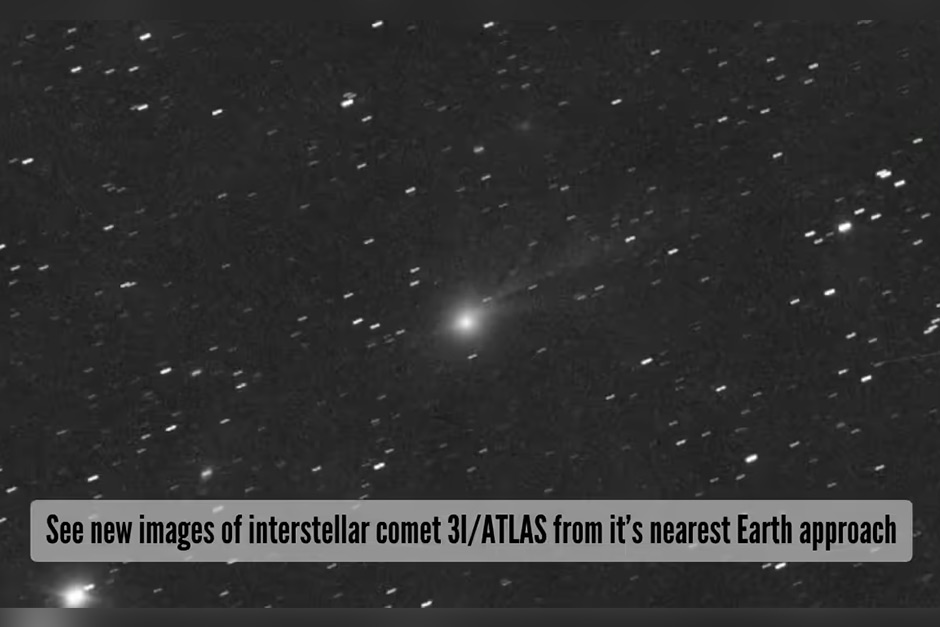
The cosmos continually offers breathtaking spectacles, and recently, the celestial stage was graced by a truly extraordinary performer: Comet 3I/ATLAS. This enigmatic visitor from beyond our solar system made its closest approach to Earth, captivating astronomers and amateur skygazers alike. As new images of this interstellar wanderer emerge, they offer an unprecedented glimpse into an object that has travelled untold light-years to brush past our cosmic neighbourhood, igniting fresh wonder and scientific curiosity across India and the globe.
The Journey of an Interstellar Enigma
Unlike the countless comets that originate from our own solar system’s Oort Cloud or Kuiper Belt, Comet 3I/ATLAS holds a unique distinction: it is an interstellar object. This means its journey began not in the frozen fringes of our Sun’s gravitational influence, but around another star entirely. Its presence marks it as only the third such confirmed visitor, following the perplexing ‘Oumuamua and the more cometary 2I/Borisov, elevating its scientific significance immensely.
Discovered by the ATLAS (Asteroid Terrestrial-impact Last Alert System) telescope, Comet 3I/ATLAS was quickly identified by its hyperbolic trajectory – a clear sign it was not gravitationally bound to our Sun. This path indicates it entered our solar system from interstellar space, made a slingshot manoeuvre around our Sun, and is now on its way out, never to return. Such objects are invaluable time capsules, carrying pristine material from their distant stellar birthplaces, offering clues about the chemical composition and conditions of other star systems.
For Indian astronomy enthusiasts, the arrival of 3I/ATLAS has been a source of immense excitement. From bustling city observatories to quiet remote outposts, the anticipation of tracking an object originating from another star system provided a unique thrill. It serves as a vivid reminder that our solar system is not an isolated island, but part of a dynamic, interconnected galaxy.
A Celestial Close-Up: Nearest Approach and Revealing Photos
The recent period marked Comet 3I/ATLAS’s nearest approach to Earth, passing at a safe yet astronomically significant distance of several tens of millions of kilometres. While not visible to the naked eye, its proximity allowed for unprecedented observation opportunities using advanced telescopes both on Earth and in space. These observations have yielded a treasure trove of fresh photos, offering detailed insights into its physical characteristics and activity.
The newly released images are nothing short of spectacular. They reveal a distinct coma – the hazy envelope of gas and dust surrounding the comet’s nucleus – and a developing tail, characteristic of cometary activity as the Sun’s radiation heats its icy surface. Some photographs even hint at jet-like emissions, indicating active outgassing from specific regions of the nucleus. These visual details are crucial for scientists to understand the composition of interstellar ice and rock, and how they react under the influence of an alien star – our Sun.
“The clarity of these new images is astounding,” says Dr. Ananya Sharma, Professor of Astrophysics at the Indian Institute of Science, Bengaluru. “For the first time, we are getting such a detailed look at a truly interstellar body as it sheds its material. It’s like receiving a postcard from another star system, carrying vital clues about its home environment. Every pixel tells a story of a journey across unimaginable cosmic distances, offering us a rare comparative study to our own solar system’s comets. This data will keep researchers busy for years.”
Scientists are meticulously analysing the spectral data alongside these images to determine the chemical makeup of the comet’s tail and coma. This could reveal whether its parent star system had similar volatile compounds to ours, or if it harboured exotic materials we rarely encounter. The opportunity to study such an object up close is a once-in-a-lifetime event for many astronomers.
Conclusion: An Ever-Expanding Universe of Discovery
The fleeting visit of Comet 3I/ATLAS serves as a powerful testament to the dynamic and interconnected nature of our galaxy. As it now recedes back into the vastness of interstellar space, it leaves behind a legacy of invaluable data and stunning imagery. For researchers, it’s a goldmine of information about the formation and evolution of other star systems. For the public, and particularly for a nation like India with its burgeoning interest in space, it reinforces the enduring wonder of the cosmos and the endless possibilities of discovery that await beyond our terrestrial confines. Each such encounter broadens our understanding, reminding us that the universe is far richer and more diverse than we can ever fully imagine.

