


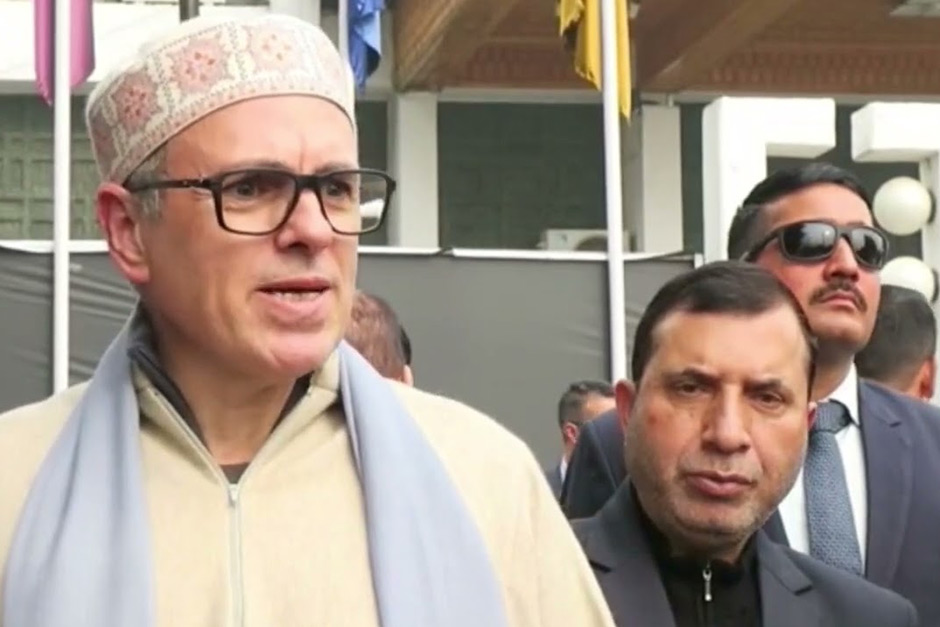
In the dynamic and often contentious landscape of Indian politics, statements by prominent leaders frequently ignite debates that transcend immediate issues, delving into the deeper currents of identity, secularism, and electoral strategy. A recent instance saw former Jammu and Kashmir Chief Minister Omar Abdullah drawing a sharp parallel between Bihar CM Nitish Kumar’s recent comments on the hijab and an older incident involving former J&K CM Mehbooba Mufti and the burqa. This juxtaposition has brought to the fore discussions around political opportunism, consistency, and the complex interplay of religious attire in public life.
Nitish Kumar’s Stance Ignites Hijab Debate
Bihar Chief Minister Nitish Kumar recently garnered significant attention for his vocal support of the right of Muslim girls to wear the hijab in educational institutions. His remarks came amidst an ongoing national debate, particularly in the aftermath of the Karnataka High Court’s ruling upholding a ban on hijabs in classrooms in certain educational settings. Kumar’s stance was interpreted by many as a clear counter-narrative to policies in other states and a firm statement in favour of minority rights and religious freedom.
Kumar, known for his nuanced political positioning, emphasized that while uniforms are essential, the hijab should not be seen as a hindrance to education. He stated that it is a matter of personal choice and should be respected, rather than criminalized or restricted. This position, divergent from the often-polarizing discourse, has been seen by some as a strategic move to consolidate minority votes in Bihar, while others lauded it as a principled stand against the increasing communalisation of public spaces and educational institutions. His comments have been praised by minority groups and secular-leaning political parties, but have also drawn scrutiny from those who question the timing and potential electoral motivations behind such a public declaration.
Recalling the Mehbooba Mufti ‘Burqa’ Incident
The incident Omar Abdullah referenced dates back to 2017 when Mehbooba Mufti, then serving as the Chief Minister of Jammu and Kashmir, reportedly refused to remove her burqa for a security check at the Srinagar airport. The incident quickly escalated into a political hot potato, sparking a debate across various platforms. On one side, proponents argued for the sanctity of personal religious freedom and suggested that alternative, respectful security protocols should be implemented for individuals wearing religious head coverings.
Conversely, critics emphasized the paramount importance of national security protocols, arguing that no individual, regardless of their position, should be exempt from standard security procedures. The incident became a symbol of the broader tension between individual religious rights and collective security concerns, especially in sensitive regions. Mufti’s refusal was seen by some as a defiant assertion of her identity and religious belief in the face of what she might have perceived as an intrusive demand, while others viewed it as setting a problematic precedent for VIPs.
Omar Abdullah’s Critical Juxtaposition
It is against this backdrop that Omar Abdullah’s recent comments gain significant traction. Abdullah, a prominent voice from Jammu and Kashmir, specifically linked Nitish Kumar’s recent advocacy for the hijab to the earlier criticism faced by Mehbooba Mufti over her burqa. His core argument zeroes in on what he perceives as a double standard or selective outrage within the Indian political discourse.
Omar Abdullah remarked, “When Mehbooba Mufti chose to uphold her personal religious freedom by wearing a burqa, she faced a barrage of criticism, some of it vitriolic. Now, when Nitish Kumar speaks of the hijab, is it a genuine principle or merely a calculated move to appeal to a particular vote bank? The double standards in our political discourse are glaring when it comes to religious attire and personal liberty.” Abdullah’s statement implies that political reactions to similar expressions of religious identity are often dictated not by consistent principles but by political convenience and electoral calculus. He suggests that while Mufti’s act was largely condemned or viewed with suspicion by certain political factions, Kumar’s current stance on the hijab is being embraced or seen as progressive, highlighting a perceived hypocrisy depending on the leader’s alignment or the political climate.
This comparison forces a critical examination of how religious symbols are weaponized or embraced in Indian politics. Abdullah’s remarks underscore the fluidity of political stances and the often-expedient nature of public declarations on sensitive issues, particularly when elections are on the horizon. The debate also highlights the challenges faced by minority communities in navigating their religious practices within a diverse and often polarized public sphere.
The ongoing discourse surrounding religious attire, sparked by Omar Abdullah’s pointed comparison, serves as a crucial reminder of the intricate relationship between personal liberty, religious freedom, and political ambition in India. It compels leaders and citizens alike to reflect on the consistency of their values and the motivations behind their public pronouncements, revealing the deeper fault lines in India’s secular fabric and democratic dialogue.
Ultimately, this debate underscores that issues like the hijab or burqa are rarely just about clothing; they are often proxies for larger battles over identity, rights, and political power, making the actions and words of leaders like Nitish Kumar and the critiques by figures like Omar Abdullah increasingly significant in shaping the national narrative.
—

