


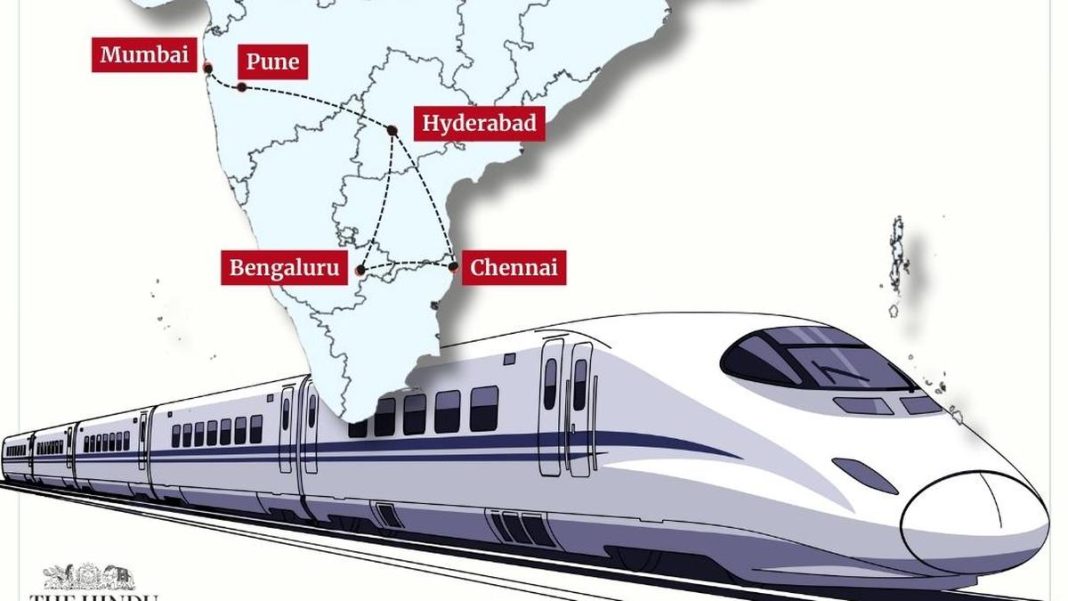
The Union Budget 2026 has ushered in a new era of connectivity for Chennai, earmarking significant allocations for the development of two ambitious High-Speed Rail (HSR) corridors radiating from the bustling Southern metropolis. This landmark announcement, a cornerstone of the government’s vision for a modernised India, positions Chennai at the forefront of the nation’s high-speed rail network expansion, promising to redefine travel, commerce, and regional integration across South India.
The move is a testament to the escalating priority placed on state-of-the-art infrastructure development, aimed at bolstering economic growth and reducing transit times dramatically. For a city that serves as a major industrial, educational, and cultural hub, these HSR corridors are not merely about faster trains; they represent a fundamental shift in how Chennai interacts with its regional counterparts, potentially unlocking unprecedented opportunities for residents and businesses alike.
High-Speed Corridors: Chennai’s New Lifelines
The Union Budget 2026 has specifically greenlit two crucial HSR routes emanating from Chennai: the Chennai-Bengaluru-Mysuru High-Speed Rail Corridor and the Chennai-Hyderabad High-Speed Rail Corridor. These corridors are strategically designed to link some of South India’s most vibrant economic and technological centres, promising to shrink travel times considerably and foster seamless connectivity.
The Chennai-Bengaluru-Mysuru corridor, an approximately 500-kilometre stretch, is envisioned to connect Tamil Nadu’s capital with Karnataka’s IT hub and cultural city in a fraction of the current travel duration. Passengers can expect journeys that typically take 6-8 hours by conventional rail or road to be completed in under 2.5 hours, transforming daily commuting and business trips. This route is expected to relieve immense pressure on the highly congested existing rail and road networks, offering a swift and efficient alternative.
Similarly, the Chennai-Hyderabad corridor, spanning roughly 700-800 kilometres, will forge a rapid link between the capitals of Tamil Nadu and Telangana. This connection will drastically cut down travel time from the current 12-15 hours to approximately 3.5-4 hours, revolutionising interstate travel and fostering greater synergy between these two economic powerhouses. Both projects are slated to operate trains at speeds exceeding 250-300 km/h, leveraging advanced technology and engineering expertise.
These projects underscore a broader governmental strategy to create a “Diamond Quadrilateral” of high-speed rail routes across India, connecting major metropolitan cities and fostering balanced regional development. The funding mechanism is expected to be a blend of central government allocation, potential external financing, and public-private partnerships, ensuring financial viability and timely execution.
Economic Impetus and Regional Transformation
The introduction of high-speed rail in Chennai is poised to be a significant economic catalyst, generating a ripple effect across multiple sectors. The construction phase alone is projected to create thousands of direct and indirect jobs, encompassing skilled labour, engineering, project management, and ancillary services. Post-completion, the operation and maintenance of these corridors will sustain a substantial workforce, contributing significantly to employment generation.
Beyond job creation, the enhanced connectivity will profoundly impact business and tourism. Reduced travel times will facilitate more frequent business interactions, enabling companies to expand their reach and optimise supply chains. Industries like manufacturing, IT, and logistics, which thrive on efficient transport, stand to gain immensely. Tourism is also expected to flourish, as historical sites, cultural landmarks, and natural attractions along these routes become more accessible to domestic and international visitors. Peripheral towns and cities along the corridors could witness new waves of investment and development, leading to decentralised growth and better urban planning.
The project represents not just an upgrade in transportation but an investment in India’s future economic resilience and global competitiveness. As one expert noted, “This initiative underscores the government’s unwavering commitment to modernizing India’s transportation backbone, paving the way for unprecedented economic growth and connectivity across the southern states.”
Charting the Course: Challenges and the Future
While the announcement brings immense promise, the execution of such large-scale infrastructure projects is invariably accompanied by significant challenges. Land acquisition remains a perennial hurdle in India, requiring meticulous planning, fair compensation, and community engagement to ensure smooth progress. The sheer scale of investment also necessitates robust financial management to prevent cost overruns and ensure judicious use of public funds.
Technological integration, safety standards compliant with international benchmarks, and environmental impact assessments will also be crucial aspects requiring careful consideration and expert execution. The construction will involve navigating diverse terrains, including densely populated urban areas and environmentally sensitive zones, demanding innovative engineering solutions.
Despite these complexities, the Union Budget 2026’s commitment to Chennai’s HSR corridors signals a clear and ambitious trajectory for India’s infrastructure development. These projects are more than just tracks and trains; they are arteries of progress, designed to pump vitality into the nation’s economy and social fabric. As Chennai gears up for this transformative journey, the promise of a more connected, prosperous, and efficient future shines bright on the horizon, cementing its role as a key player in India’s high-speed revolution.

