


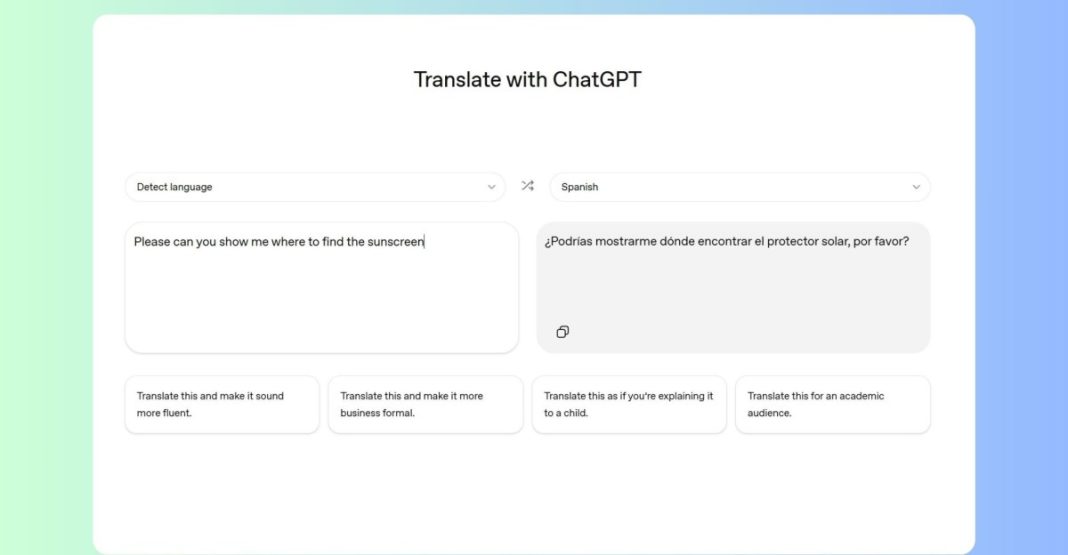
The world of artificial intelligence is always buzzing with innovation, but few developments capture attention quite like those impacting our daily communication. Recently, OpenAI’s ChatGPT has thrown its hat into the translation ring, unveiling a new capability that has language enthusiasts and tech analysts alike asking a crucial question: Is Google Translate, the long-reigning champion of digital translation, finally facing a serious challenger? The early signs suggest a compelling race is underway, promising to reshape how we break down language barriers across the globe.
The Nuance of the Newcomer
What makes ChatGPT’s translator so compelling? Primarily, it’s its foundation as a large language model designed for conversational fluency and contextual understanding. Unlike many traditional translation tools that often perform a more literal, word-for-word substitution, ChatGPT leverages its deep understanding of natural language patterns to produce translations that feel remarkably human. It doesn’t just translate words; it interprets intent, tone, and cultural nuances, often resulting in output that flows more naturally in the target language.
This capability is particularly evident when dealing with idioms, complex sentence structures, or colloquialisms where a direct translation often falls flat. As a seasoned polyglot and early adopter recently observed, “It’s not just about getting the words right anymore; ChatGPT’s translator seems to ‘get’ the feeling behind the message. For creative writing or complex discussions, that’s a game-changer. It maintains the author’s voice much better than I expected.” This focus on contextual coherence allows for translations that are not only accurate but also appropriate and engaging, making it a powerful tool for more sensitive or high-stakes communication.
Google Translate’s Enduring Strength
While ChatGPT’s entry is exciting, it’s crucial to remember that Google Translate isn’t just resting on its laurels. With years of development and billions of users, it boasts an immense dataset and a truly global presence. Its strengths lie in sheer breadth, speed, and integration. Google Translate supports an impressive number of languages, far exceeding many competitors, making it an indispensable tool for travelers and global communication at large. Its instant camera translation, real-time voice translation, and browser integration are features that have set the standard for convenience and accessibility.
For quick look-ups, navigating foreign signs, or simple conversational exchanges, Google Translate remains incredibly effective and often the go-to solution. Its reliability for everyday tasks, coupled with its seamless availability across various platforms and devices, means it has an established ecosystem that is difficult to disrupt overnight. Google’s continuous refinement of its neural machine translation models also ensures that it’s always improving, gradually catching up in areas of nuance while maintaining its speed and accessibility advantages.
The Evolving Landscape of Language AI
The emergence of ChatGPT’s translator shouldn’t necessarily be seen as a direct replacement for Google Translate, but rather as a significant evolution in the broader field of AI-powered language tools. Each platform seems to be carving out its niche or excelling in different scenarios. For intricate, creative, or conversationally rich content where subtlety is key, ChatGPT’s nuanced approach might offer superior results. For rapid, on-the-go translations, access to a vast array of less common languages, or integrated real-time features, Google Translate still holds a formidable lead.
This new competition is ultimately a boon for users. It forces both powerhouses to innovate further, pushing the boundaries of what machine translation can achieve. We are likely to see Google refine its contextual understanding, while ChatGPT might expand its language offerings and real-time capabilities. The landscape isn’t about one victor and one loser; it’s about a dynamic ecosystem where users can choose the best tool for their specific needs, or even use them in conjunction to achieve the highest quality communication.
Conclusion
The buzz surrounding ChatGPT’s translator challenging Google Translate is well-founded. It represents a significant leap forward in achieving more human-like, contextually aware machine translation. However, Google Translate’s established reliability, vast language support, and integrated features ensure its continued relevance. We are entering an exciting era where AI translation is becoming more sophisticated and specialized. This healthy competition will undoubtedly drive further innovation, making global communication more accessible, accurate, and nuanced for everyone. The future of language barriers looks increasingly bright, with multiple advanced tools at our disposal.

